SQL, SQLite, and the Data Architecture Behind Citation Matching
How scholarly systems store hundreds of millions of works, how a database transforms a SQL statement into disk reads, and how SQL, full-text search, vector search, and graph data cooperate to repair noisy references.
1. Executive summary
Canonical works, authors, identifiers, venues, and relationships.
Full-text and fuzzy indexes generate candidate records rapidly.
A scoring model decides which candidate best matches the noisy input.
The system explains why the selected reference is trustworthy.
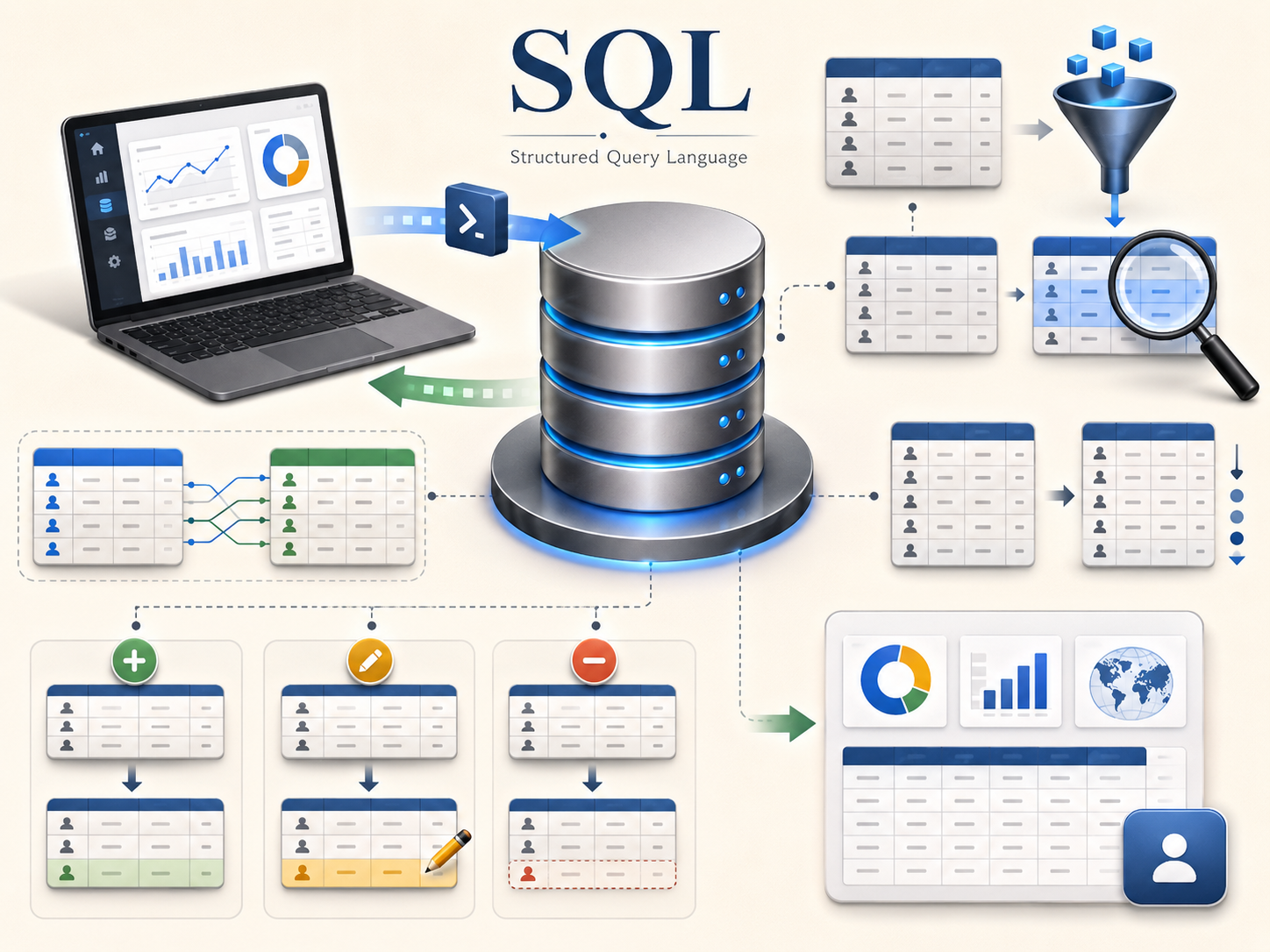
SQL is not a database product. It is a declarative language: you describe the result you need, and a database engine decides how to obtain it. SQLite is one implementation of an SQL database. It runs inside the application and stores the database in a file, which makes it excellent for prototypes, desktop tools, mobile apps, local research subsets, and read-heavy citation indexes.
2. What SQL is
SQL means Structured Query Language. It lets a developer define tables, enforce constraints, insert data, connect related tables, aggregate results, and update records. The developer specifies what should be returned; the engine selects how to execute the request.
Human question
“Find computer-science papers from 2024 whose titles mention citation matching, and show their authors.”
SQL expression
SELECT p.title, a.name
FROM papers p
JOIN paper_authors pa ON pa.paper_id = p.id
JOIN authors a ON a.id = pa.author_id
WHERE p.year = 2024
  AND p.title_search MATCH 'citation matching';
Core relational concepts
| Concept | Meaning | Citation example | Why it matters |
|---|---|---|---|
| Table | A named collection of rows | papers, authors | Separates entities cleanly |
| Row | One record | One scholarly work | Represents a canonical object |
| Column | A typed attribute | DOI, title, year | Enables filtering and validation |
| Primary key | Unique row identifier | paper_id | Stable internal identity |
| Foreign key | Reference to another row | paper_authors.paper_id | Preserves relationships |
| Index | Auxiliary structure for faster lookup | Index on DOI or normalized title | Avoids scanning every row |
| Transaction | Atomic group of operations | Insert work, authors, and references together | Prevents partially imported records |
Normalization: why data is separated
A paper may have five authors, and one author may have hundreds of papers. Repeating the full author record inside every paper wastes space and produces inconsistencies. A normalized schema stores each author once and represents authorship with a join table.
3. What SQLite is—and what “SQL light” actually means
The product is named SQLite, pronounced “S-Q-L-ite” or “sequel-lite.” It is not a simplified query language. It is a complete embedded relational database engine delivered as a library. The application calls SQLite directly; there is no separate database server process and no network round trip.
| Question | SQLite | PostgreSQL / server DB |
|---|---|---|
| Where does it run? | Inside your process | Separate server process |
| Storage | Usually one portable file | Managed directory of database files |
| Setup | Almost zero configuration | Installation, users, networking, maintenance |
| Concurrency | Many readers, limited concurrent writing | Designed for many readers and writers |
| Best use | Local tools, mobile, desktop, prototypes, subsets | Shared APIs, multi-user systems, large ingestion pipelines |
| Citation project role | Local cache or compact research database | Canonical central metadata store |
Important 2025–2026 direction
SQLite continues to improve schema evolution, JSON manipulation, command-line formatting, indexing, and reliability. For citation systems, the enduringly useful features are its B-tree indexes, ACID transactions, JSON functions, FTS5 full-text search, generated columns, expression indexes, and write-ahead logging.
4. What happens behind a SQL query
A SQL query looks compact, but the database performs a pipeline of interpretation, planning, storage access, and result construction.
Example: exact DOI lookup
SELECT id, title, year
FROM papers
WHERE doi = '10.1145/1234567.1234568';
Without an index, the engine may inspect every paper row. With a unique index on doi, it traverses a
B-tree from the root to a small leaf page, finds the row pointer, and fetches the matching record.
How joins are chosen
| Join algorithm | How it works | Good situation | Citation example |
|---|---|---|---|
| Nested-loop join | For each row on one side, probe the other side | Small outer result and indexed inner table | Ten candidate paper IDs joined to author rows |
| Hash join | Build a hash table from one input, probe with the other | Large unsorted equality joins | Bulk linking imported works to identifiers |
| Merge join | Walk two sorted inputs together | Both sides already sorted or indexed | Comparing ordered DOI lists from two providers |
5. How scholarly data looks before and after ingestion
Citation databases publish different data formats. An ingestion pipeline parses those formats, normalizes identifiers and text, and writes a query-friendly representation.
<article key="journals/example/Smith24">
  <author>Alice Smith</author>
  <author>Bob Lee</author>
  <title>Fuzzy Citation Matching at Scale</title>
  <year>2024</year>
  <journal>Journal of Data Systems</journal>
  <ee>https://doi.org/10.1234/example.2024.7</ee>
</article><PubmedArticle>
<MedlineCitation PMID="40123456">
<Article>
<ArticleTitle>Reference Resolution in Biomedical Literature</ArticleTitle>
<Abstract>...</Abstract>
<Journal>...</Journal>
</Article>
</MedlineCitation>
</PubmedArticle>{
"id": "https://openalex.org/W1234567890",
"doi": "https://doi.org/10.1234/example.2024.7",
"title": "Fuzzy Citation Matching at Scale",
"publication_year": 2024,
"authorships": [
{"author": {"id": "A100", "display_name": "Alice Smith"}}
],
"referenced_works": ["W99", "W105"]
}papers
┌──────┬──────────────────────────────────┬──────┬────────────────────────┐
│ id │ title │ year │ doi │
├──────┼──────────────────────────────────┼──────┼────────────────────────┤
│ 7821 │ Fuzzy Citation Matching at Scale │ 2024 │ 10.1234/example.2024.7│
└──────┴──────────────────────────────────┴──────┴────────────────────────┘
paper_authors
┌──────────┬───────────┬──────────┐
│ paper_id │ author_id │ position │
├──────────┼───────────┼──────────┤
│ 7821 │ 100 │ 1 │
│ 7821 │ 205 │ 2 │
└──────────┴───────────┴──────────┘{
"_id": "7821",
"title": "Fuzzy Citation Matching at Scale",
"title_normalized": "fuzzy citation matching at scale",
"authors": ["Alice Smith", "Bob Lee"],
"year": 2024,
"venue": "Journal of Data Systems",
"doi": "10.1234/example.2024.7"
}{
"id": "7821",
"vector": [0.021, -0.117, 0.308, ... 765 more values ...],
"metadata": {
"year": 2024,
"source": "openalex"
}
}Node: Work W7821
Edge: W7821 --CITES--> W99
Edge: W7821 --CITES--> W105
Node: Author A100
Edge: A100 --AUTHORED--> W7821Row storage versus columnar storage
6. The index structures behind fast search
| Index type | Stores | Best query | Citation use | Typical technologies |
|---|---|---|---|---|
| B-tree | Sorted keys and pointers | Equality, range, ordered retrieval | DOI, PMID, year, author ID | SQLite, PostgreSQL, MySQL |
| Hash index | Hash buckets | Equality only | Exact normalized identifier lookup | PostgreSQL, in-memory caches |
| Inverted index | Token → document postings list | Keyword, phrase, fuzzy text search | Title, abstract, author string | FTS5, Elasticsearch, OpenSearch, Lucene |
| Trigram index | Overlapping character triples | Typo-tolerant similarity | “Szeider” versus “Sezider” | PostgreSQL pg_trgm |
| LSM tree | Sorted immutable runs plus memory table | High-throughput writes | Streaming provider updates | RocksDB, Cassandra, ScyllaDB |
| HNSW / ANN | Graph or partitioned vector structure | Nearest vectors | Semantic title/abstract retrieval | pgvector, Qdrant, Milvus, FAISS |
| Graph adjacency | Node relationships | Neighborhood and path traversal | Citation and co-author networks | Neo4j, graph extensions |
How an inverted index looks
Documents
D1: "fuzzy citation matching"
D2: "citation graph search"
D3: "fuzzy author resolution"
Inverted index
citation → [D1, D2]
fuzzy    → [D1, D3]
matching → [D1]
graph    → [D2]
author   → [D3]
A keyword search for fuzzy AND citation intersects the postings lists and immediately identifies
D1, rather than scanning every title.
Why one index is not enough
Exact
Input: correct DOI
Winner: B-tree unique index
Confidence: very high
Lexical fuzzy
Input: misspelled title
Winner: trigram or full-text index
Confidence: medium to high
Semantic
Input: remembered concept, not exact wording
Winner: vector index
Confidence: candidate-generation only
7. SQL databases and their alternatives in 2026
“Alternative to SQL” is often the wrong framing. Most specialized systems solve a different access pattern. The architectural question is: which storage and index should own each responsibility?
| Technology | Data model | Strength | Weakness | Best role in citation systems |
|---|---|---|---|---|
| SQLite | Relational, embedded | Portable, simple, ACID, local FTS | Limited concurrent writes | Desktop/local index, prototype, filtered corpus |
| PostgreSQL | Relational + JSON + extensions | Strong joins, constraints, text, vectors | Operational complexity versus SQLite | Primary metadata store and hybrid-search backbone |
| MySQL | Relational | Mature, widely hosted, strong OLTP | Less rich extension ecosystem for this use case | Conventional metadata service |
| DuckDB | Embedded columnar analytics | Fast local Parquet/CSV analysis | Not intended as a high-concurrency API store | Explore OpenAlex snapshots without full import |
| ClickHouse | Distributed columnar | Huge analytical scans and compression | Less natural for transactional graph updates | Aggregate citation statistics at scale |
| Elasticsearch / OpenSearch | Search documents | Full-text, typo tolerance, scoring, facets | Not ideal as the sole system of record | Candidate generation from titles/authors/venues |
| Neo4j | Property graph | Relationship traversal and path queries | Extra operational layer | Citation networks, co-author paths, graph features |
| Qdrant / Milvus / Weaviate | Vectors + metadata | Approximate nearest-neighbor search | Semantic similarity can return plausible but wrong records | Broad semantic candidate generation |
| pgvector | Vectors inside PostgreSQL | SQL filters and vectors together | Dedicated systems may scale further for extreme vector loads | Excellent first production vector layer |
| RocksDB / LMDB | Embedded key-value | Fast low-level lookup, compact storage | No rich SQL joins by default | Identifier maps, caches, precomputed features |
| Object storage + Parquet | Files, columnar | Cheap snapshots, partitioning, interoperability | Needs query engine or ingestion pipeline | Raw provider lake and reproducible archives |
Decision matrix
| Need | Recommended first choice | Why |
|---|---|---|
| Exact DOI/PMID lookup | PostgreSQL or SQLite B-tree | Unique indexed key lookup |
| Typo-tolerant title matching | PostgreSQL trigram or OpenSearch | Character-level similarity and text ranking |
| Search by remembered meaning | pgvector, Qdrant, Milvus, or FAISS | Embedding similarity |
| Analyze 200M+ works locally | Parquet + DuckDB | Column pruning and no mandatory full import |
| Shared canonical service | PostgreSQL | Constraints, joins, reliability, extension ecosystem |
| Explore citation paths | SQL recursive query first; graph DB if needed | Avoid premature graph infrastructure |
| Mobile or desktop offline database | SQLite | Single-file embedded deployment |
8. How DBLP, PubMed, and OpenAlex can be stored locally
| Dataset | Primary scope | Bulk format | Typical local strategy | Strong identifier |
|---|---|---|---|---|
| DBLP | Computer science bibliography | Large XML dump | Stream XML → normalized SQL and search index | DBLP keys, DOI when present |
| PubMed/MEDLINE | Biomedical literature | Annual XML baseline + update files | Load baseline, apply updates in order, index PMID/DOI/title/MeSH | PMID, DOI |
| OpenAlex | Cross-disciplinary scholarly graph | JSONL/Parquet-style snapshots and APIs | Keep raw snapshot in object/file storage; query with DuckDB or import selected tables | OpenAlex IDs, DOI |
| Crossref | DOI metadata | API and bulk options | Cache canonical DOI metadata and update timestamps | DOI |
| OpenCitations | Open citation links | APIs and bulk datasets | Store DOI-to-DOI edges in partitioned files or edge table | DOI pairs |
Scale changes the architecture
Do companies really keep all of this “locally”?
“Local” can mean a laptop, an on-premise server, or the company’s own cloud account. Production companies often download provider snapshots into their own object storage, transform them with batch jobs, load canonical records into PostgreSQL or another serving database, and build separate text and vector indexes. They may not load every raw field into the serving database.
9. How a citation-matching system finds the correct reference
A raw citation is noisy. It may have a missing DOI, misspelled author, abbreviated venue, incorrect year, broken page range, reordered fields, or copied punctuation. Matching therefore uses multiple signals.
Example input
Smith A., Lee B. Fuzzy citaton maching scale.
J Data Syst, 2024, doi 10.1234/example.2024.?
Parsed representation
{
  "authors": ["Smith A", "Lee B"],
  "title": "Fuzzy citaton maching scale",
  "venue": "J Data Syst",
  "year": 2024,
  "doi_prefix": "10.1234",
  "doi_complete": false
}
Candidate-generation methods
| Signal | Query method | Example contribution | Risk |
|---|---|---|---|
| DOI exact | Unique SQL index | Immediately resolves canonical work | User may provide malformed DOI |
| Title token overlap | Full-text search | Finds documents sharing distinctive words | Common titles produce many candidates |
| Title edit similarity | Trigram / Levenshtein | Handles “citaton” and “maching” | Can overvalue similar short strings |
| Author similarity | Normalized names + aliases | Confirms candidate identity | Name collisions and transliteration |
| Year | SQL filter or score feature | Strongly narrows the space | Online-first and print years may differ |
| Venue | Alias dictionary + fuzzy index | Expands “J Data Syst” | Abbreviations can be ambiguous |
| Semantic embedding | ANN vector search | Finds paraphrased or remembered concepts | Semantic closeness is not bibliographic identity |
| Citation graph | Graph/edge features | Uses neighboring references or citing document context | Unavailable for isolated inputs |
A transparent scoring formula
score =
  0.40 * title_similarity
+ 0.20 * author_similarity
+ 0.12 * venue_similarity
+ 0.10 * year_compatibility
+ 0.08 * page_similarity
+ 0.05 * identifier_prefix_match
+ 0.05 * source_agreement
A learned model can replace fixed weights, but the features should remain inspectable. For a citation-fixing product, confidence calibration matters: a system should abstain when top candidates are too close.
Illustrative ranked candidates
| Rank | Candidate | Title | Authors | Year | Overall | Decision |
|---|---|---|---|---|---|---|
| 1 | W7821 | 0.97 | 0.93 | 1.00 | 0.95 | Accept |
| 2 | W4410 | 0.83 | 0.45 | 1.00 | 0.72 | Keep as fallback |
| 3 | W9920 | 0.74 | 0.91 | 0.00 | 0.65 | Reject: year conflict |
10. Efficient local querying of very large datasets
Strategy A: import a filtered subset into SQLite
Select the relevant subject area, years, fields, or providers, then create a compact database containing only the fields needed for matching. This is ideal for a prototype or a computer-science-only DBLP system.
CREATE TABLE papers (
  id INTEGER PRIMARY KEY,
  source TEXT NOT NULL,
  source_id TEXT NOT NULL,
  doi TEXT,
  title TEXT NOT NULL,
  title_norm TEXT NOT NULL,
  year INTEGER,
  venue_id INTEGER,
  raw_json TEXT
);

CREATE UNIQUE INDEX ux_papers_source
ON papers(source, source_id);

CREATE INDEX ix_papers_doi
ON papers(doi);

CREATE INDEX ix_papers_year
ON papers(year);
Strategy B: keep snapshots as Parquet and query with DuckDB
For a huge OpenAlex snapshot, importing everything into a row database may take substantial time and disk space. DuckDB can query partitioned Parquet directly and only read the required columns and partitions.
SELECT id, doi, title, publication_year
FROM read_parquet('openalex/works/**/*.parquet')
WHERE publication_year BETWEEN 2022 AND 2026
  AND lower(title) LIKE '%citation matching%';
Strategy C: central PostgreSQL plus specialized indexes
Store canonical entities in PostgreSQL; send denormalized search documents to OpenSearch; store embeddings in
pgvector initially; keep provider snapshots in object storage; and build batch pipelines for updates.
Storage optimizations
| Technique | What it does | Example | Benefit |
|---|---|---|---|
| Partitioning | Divides data by a predictable key | Works by publication year or source | Prunes irrelevant files or table partitions |
| Compression | Encodes repeated values compactly | Parquet dictionary encoding for venue names | Less disk and I/O |
| Column pruning | Reads only required fields | Read DOI/title/year, skip concepts and grants | Faster analytical queries |
| Batch insert | Writes many rows per transaction | 10,000 works per commit | Far faster ingestion |
| Materialized feature table | Precomputes matching fields | Normalized title tokens and author signatures | Low-latency ranking |
| Cache | Stores frequent answers | DOI metadata and common citation strings | Reduces repeated search work |
11. Recommended architecture for a citation-fixing company
The following design is appropriate for a product that accepts malformed references, searches DBLP, PubMed, OpenAlex, Crossref, and OpenCitations, and returns ranked canonical matches with evidence.
What each layer owns
| Layer | Owns | Should not own |
|---|---|---|
| Raw snapshot store | Immutable provider files and update batches | Low-latency user queries |
| Canonical SQL store | Trusted entities, IDs, constraints, provenance | All fuzzy search logic |
| Text search | Lexical candidate retrieval and relevance features | Final bibliographic truth |
| Vector layer | Semantic candidates and similarity features | Inventing missing identifiers |
| Ranker | Combining evidence and confidence | Silently accepting ambiguous cases |
| Formatting service | APA, IEEE, Chicago, BibTeX, RIS, CSL-JSON | Changing canonical metadata without provenance |
pg_trgm + PostgreSQL full-text search
+ pgvector + object storage for raw snapshots. Add OpenSearch only when text-search scale, ranking,
or operational requirements justify a separate cluster.
12. A practical canonical schema
CREATE TABLE works (
  work_id            BIGSERIAL PRIMARY KEY,
  canonical_title    TEXT NOT NULL,
  title_normalized   TEXT NOT NULL,
  publication_year   SMALLINT,
  work_type          TEXT,
  venue_id            BIGINT,
  created_at          TIMESTAMPTZ NOT NULL DEFAULT now(),
  updated_at          TIMESTAMPTZ NOT NULL DEFAULT now()
);

CREATE TABLE work_identifiers (
  work_id             BIGINT NOT NULL REFERENCES works(work_id),
  scheme              TEXT NOT NULL,  -- doi, pmid, openalex, dblp
  value               TEXT NOT NULL,
  source              TEXT NOT NULL,
  is_primary          BOOLEAN NOT NULL DEFAULT false,
  PRIMARY KEY (scheme, value)
);

CREATE TABLE authors (
  author_id            BIGSERIAL PRIMARY KEY,
  display_name         TEXT NOT NULL,
  name_normalized      TEXT NOT NULL,
  orcid                TEXT
);

CREATE TABLE work_authors (
  work_id              BIGINT NOT NULL REFERENCES works(work_id),
  author_id            BIGINT NOT NULL REFERENCES authors(author_id),
  author_position      SMALLINT,
  raw_name             TEXT,
  PRIMARY KEY (work_id, author_id)
);

CREATE TABLE citations (
  citing_work_id       BIGINT NOT NULL REFERENCES works(work_id),
  cited_work_id        BIGINT NOT NULL REFERENCES works(work_id),
  source               TEXT NOT NULL,
  confidence           REAL,
  PRIMARY KEY (citing_work_id, cited_work_id, source)
);

CREATE TABLE source_records (
  source               TEXT NOT NULL,
  source_record_id     TEXT NOT NULL,
  work_id              BIGINT REFERENCES works(work_id),
  payload              JSONB NOT NULL,
  source_updated_at    TIMESTAMPTZ,
  ingested_at          TIMESTAMPTZ NOT NULL DEFAULT now(),
  PRIMARY KEY (source, source_record_id)
);
Indexes for matching
CREATE UNIQUE INDEX ux_identifier
ON work_identifiers (scheme, value);

CREATE INDEX ix_work_year
ON works (publication_year);

CREATE INDEX ix_title_trgm
ON works USING gin (title_normalized gin_trgm_ops);

CREATE INDEX ix_author_name_trgm
ON authors USING gin (name_normalized gin_trgm_ops);

CREATE INDEX ix_citations_cited
ON citations (cited_work_id);
Why raw payloads are retained
The canonical tables make querying simple, but provider-specific fields can be lost during normalization. Keeping the original payload enables audits, reprocessing, new feature extraction, and resolution of disagreements between sources.
13. Practical query examples
Exact DOI resolution
SELECT w.work_id, w.canonical_title, w.publication_year
FROM work_identifiers i
JOIN works w ON w.work_id = i.work_id
WHERE i.scheme = 'doi'
  AND i.value = '10.1234/example.2024.7';
Typo-tolerant title candidates in PostgreSQL
SELECT
  work_id,
  canonical_title,
  similarity(title_normalized,
             'fuzzy citaton maching at scale') AS title_score
FROM works
WHERE title_normalized % 'fuzzy citaton maching at scale'
ORDER BY title_score DESC
LIMIT 25;
Combined title, author, and year ranking
WITH title_candidates AS (
  SELECT
    w.work_id,
    similarity(w.title_normalized, :title_norm) AS title_score
  FROM works w
  WHERE w.title_normalized % :title_norm
  LIMIT 100
)
SELECT
  w.work_id,
  w.canonical_title,
  w.publication_year,
  tc.title_score,
  MAX(similarity(a.name_normalized, :first_author_norm)) AS author_score,
  CASE WHEN w.publication_year = :year THEN 1.0 ELSE 0.0 END AS year_score
FROM title_candidates tc
JOIN works w ON w.work_id = tc.work_id
LEFT JOIN work_authors wa ON wa.work_id = w.work_id
LEFT JOIN authors a ON a.author_id = wa.author_id
GROUP BY w.work_id, w.canonical_title, w.publication_year, tc.title_score
ORDER BY
  0.65 * tc.title_score +
  0.25 * MAX(similarity(a.name_normalized, :first_author_norm)) +
  0.10 * CASE WHEN w.publication_year = :year THEN 1.0 ELSE 0.0 END
  DESC
LIMIT 10;
Find all works citing a DOI
SELECT citing.canonical_title, citing.publication_year
FROM work_identifiers target_id
JOIN citations c ON c.cited_work_id = target_id.work_id
JOIN works citing ON citing.work_id = c.citing_work_id
WHERE target_id.scheme = 'doi'
  AND target_id.value = '10.1234/example.2024.7'
ORDER BY citing.publication_year DESC;
SQLite FTS5 prototype
CREATE VIRTUAL TABLE work_search USING fts5(
  title,
  authors,
  venue,
  content='works_flat',
  content_rowid='work_id'
);

SELECT rowid, title, bm25(work_search) AS rank
FROM work_search
WHERE work_search MATCH '"citation matching" OR "reference resolution"'
ORDER BY rank
LIMIT 20;
Vector search with SQL filters
SELECT
  work_id,
  canonical_title,
  1 - (embedding <=> :query_embedding) AS semantic_score
FROM work_embeddings
WHERE publication_year BETWEEN 2020 AND 2026
ORDER BY embedding <=> :query_embedding
LIMIT 50;
14. Implementation roadmap for a real citation matcher
| Phase | Build | Output | Main evaluation |
|---|---|---|---|
| 1. Baseline | DBLP subset + SQLite + normalization | Exact and FTS candidate search | Recall@10 on corrupted citations |
| 2. Fuzzy fields | Title trigrams, author aliases, venue dictionary | Feature-based ranker | Top-1 accuracy and mean reciprocal rank |
| 3. Multi-source | OpenAlex, Crossref, PubMed adapters | Canonical entity resolution | Duplicate rate and source agreement |
| 4. Semantic retrieval | Embeddings and ANN index | Recovery of weak lexical matches | Incremental recall versus false positives |
| 5. Confidence | Calibration and abstention policy | Accept / review / unresolved result | Precision at automatic-accept threshold |
| 6. Product | API, browser UI, BibTeX/CSL export, provenance | Usable citation-fixing service | Latency, user correction rate, trust |
Recommended evaluation dataset
Start from known canonical references, then generate realistic corruption: delete fields, alter punctuation, introduce OCR-like substitutions, abbreviate venues, reorder authors, change initials, remove DOI suffixes, and perturb years. Keep the original work ID as ground truth.
Retrieval metrics
Recall@1, Recall@5, Recall@10, candidate-set size, retrieval latency.
Ranking metrics
Top-1 accuracy, mean reciprocal rank, precision at confidence threshold, calibration error.
Final recommendation
15. Research sources and further reading
This article consolidates the prior deep-research report and extends it with original explanatory diagrams, sample schemas, and architecture recommendations. Product versions and dataset sizes change, so verify operational details against current official documentation before deployment.
- SQLite official documentation and release notes
- ISO/IEC SQL standard information
- DBLP XML data and documentation
- PubMed data download guidance
- OpenAlex developer documentation
- Crossref REST API documentation
- OpenCitations datasets and services
- PostgreSQL official documentation
- DuckDB official documentation
- pgvector documentation
- OpenSearch documentation
Interactive hyperlinks are available in the HTML version.