OVHcloud has introduced Olala Mini, the first language model in a family the French cloud provider trained itself. In a November 17 interview with Agence France-Presse, founder Octave Klaba described a model developers will be able to download and run on their own machines. The public launch is scheduled for November 19. For teams that already rent infrastructure from OVHcloud, that opens a new question: could the same supplier provide the model as well as the machine?
What the 7A1B name tells you
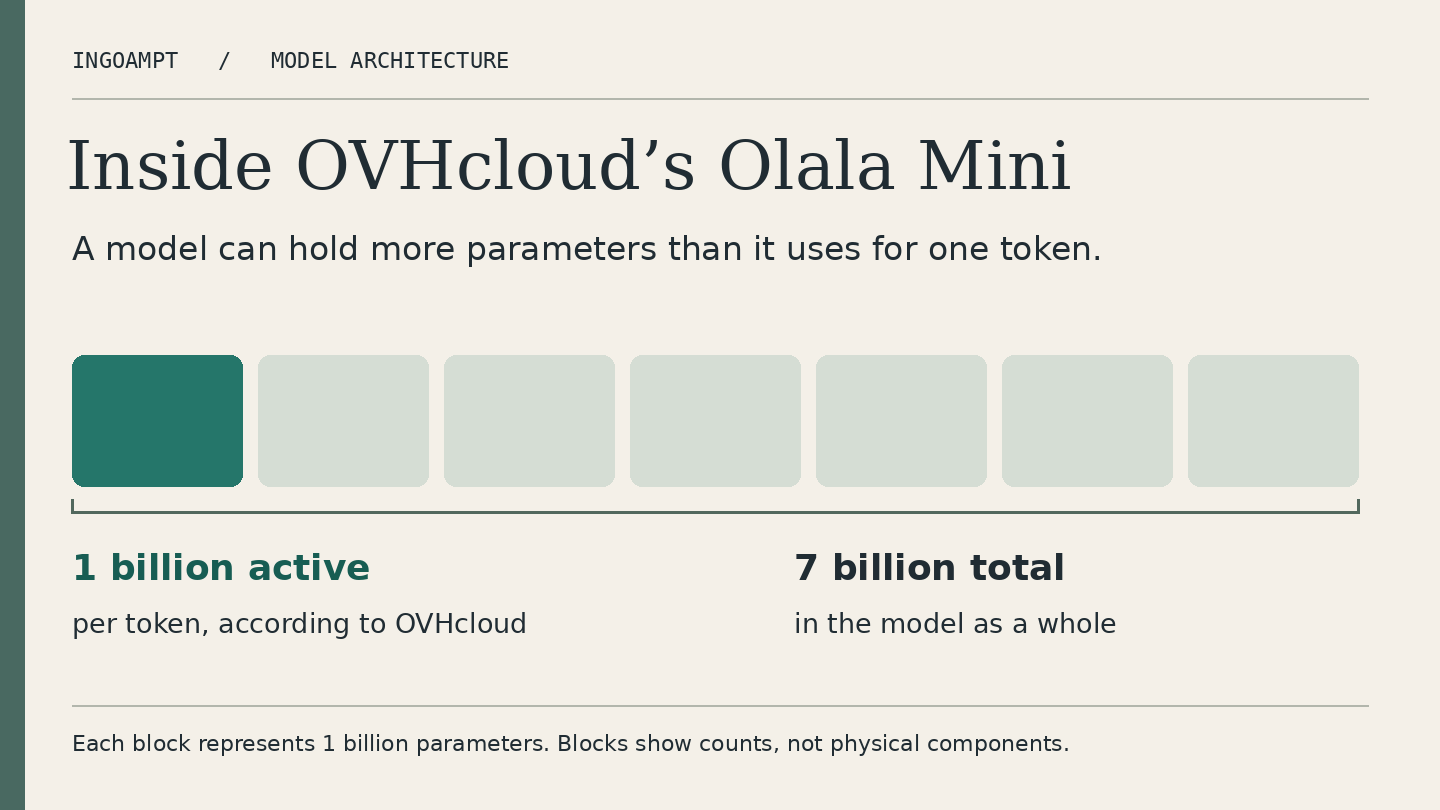
Olala Mini has about seven billion parameters, the learned numerical values that shape its answers. According to OVHcloud’s technical announcement, roughly one billion are active for each token it processes. A token is a small unit of text. The model uses an approach known as a mixture of experts, routing each token through selected parts of the network.
Think of predicting the next token in a sentence. A dense model applies the same set of layers on every step. An expert model can send different tokens through different groups of weights. That gives it a larger collection of learned patterns than the number it activates on any particular step. The green block in our illustration shows the share of parameters active at one time. The selected parameters can change from token to token.
Those two numbers answer different hardware questions. The total count matters when loading or storing the weights. The active count helps explain the computation required to generate text. Neither tells you by itself how much memory your application will use: the weight format, the length of the conversation and the software running the model all matter.
What a developer could run locally
OVHcloud lists a 32,000-token context window and says the model can run on a GPU with at least 8 GB of memory, or on a CPU. It plans to offer the model through Hugging Face under the Apache 2.0 license. The announcement gives a developer a reason to investigate an existing workstation before renting another server. It gives no guarantee about the speed of a particular machine or the quality of the answers it will return.
Consider a support team summarizing the same kind of ticket hundreds of times a day. A local model offers control over where the tickets are processed. The deciding test would be whether it preserves the customer’s issue and the action already taken. Output speed alone could make a fast but inaccurate summary look like a success.
Qwant offers an early example
OVHcloud says Qwant already uses Olala Mini for its flash answers, and reports a 20% speed improvement and operating costs one-third of those of Qwant’s previous model. That comparison concerns one search feature. A different workload, such as reviewing a long technical document, could produce a different result.
In its independent coverage on November 17, French technology publication Numerama highlighted a gap in the launch evidence: comparative quality benchmarks were still missing at the time of its report. For anyone deciding whether to switch models, a relevant comparison would use the same prompts, hardware and scoring criteria and let reviewers judge the answers without seeing which model produced them.
Olala Mini gives European developers another prospective self-hosted option. The announcement establishes the architecture, an intended release date and a reported production use. The public weights and evaluations on real workloads will make it possible to judge where it belongs. For another way to think about model size and capability, see our explanation of AI distillation. Find further reporting in INGOAMPT AI News.