November 17, 2026 · AI news and explanation
Chinese AI developers are using answers from American models to train domestic systems, according to a Reuters investigation published November 17. Its examination of more than 300 documents describes distillation spreading into industrial use as access to advanced chips tightens. The reporting also reveals July discussions between American and Chinese officials over intellectual-property concerns.
The technology behind that dispute has a straightforward purpose: use a capable model to help train another model. Understanding what transfers—and what does not—is essential to understanding the headline.
What is AI distillation?
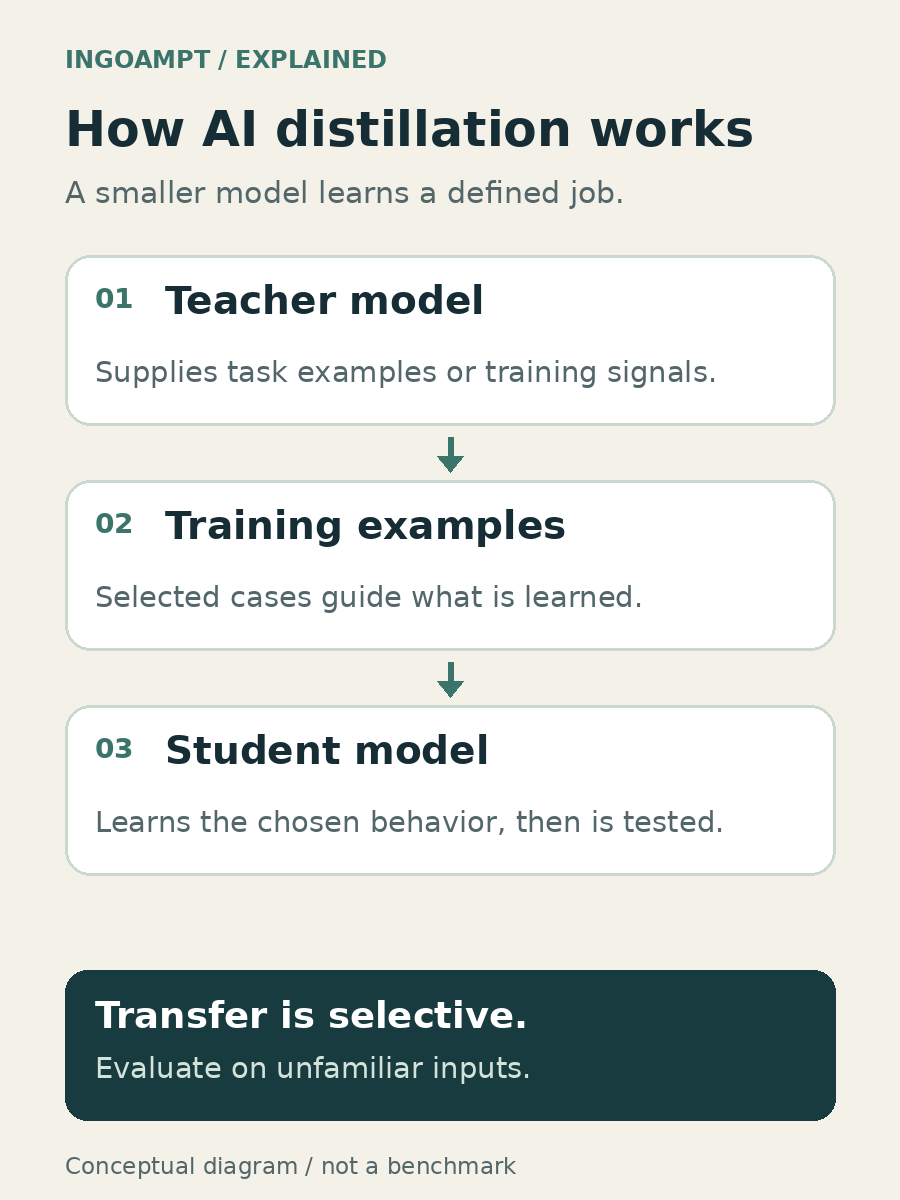
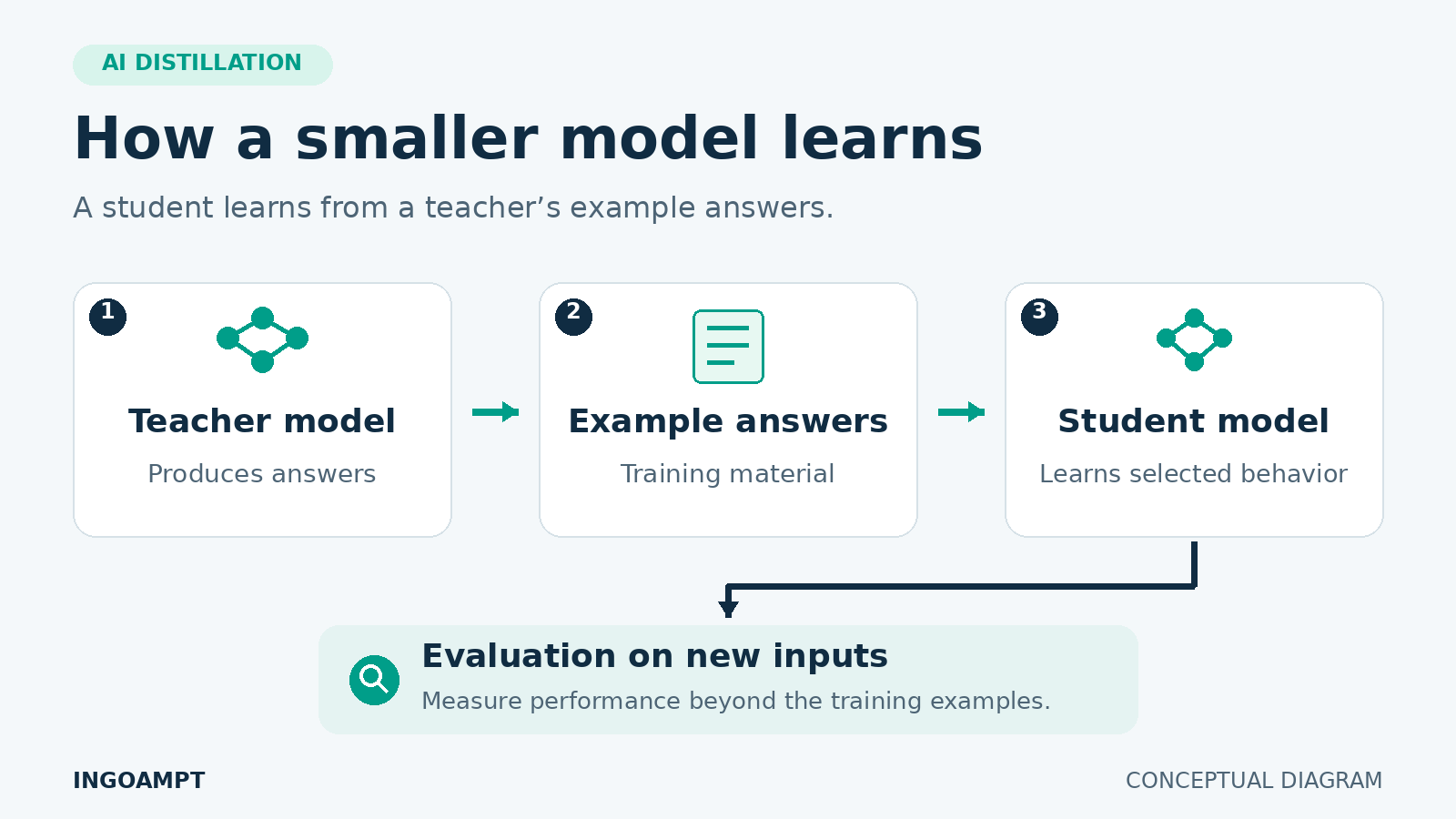
AI distillation is a training method in which one model learns from another model’s predictions or demonstrations. The established model is called the teacher; the model being trained is the student. A developer can use this relationship to improve a smaller system without asking it to discover every useful pattern from ordinary labeled examples alone.
The 2015 paper by Geoffrey Hinton, Oriol Vinyals and Jeff Dean developed a way to transfer useful behavior from a large model or an ensemble into a model easier to deploy. One insight was that a teacher’s confidence across possible answers carries information beyond its single winning answer.
For instance, a classifier that strongly favors one category but gives a related category a smaller probability conveys a relationship between the two. Training only on the final label discards that extra information. Training on the distribution can preserve some of it. The student learns through an optimization process; it does not receive a complete copy of the teacher’s internal knowledge.
How it works for language models
Distillation is a family of methods. Some workflows train on completed answers. Others use explanations alongside answers, or compare the teacher’s and student’s probabilities for the next token. A token is a unit of text, such as a word or part of a word.
Those approaches require different access. A collection of generated answers is different training material from the detailed probability distribution a model assigns to possible next tokens. A description of a “distilled model” therefore leaves an important question open: what information actually supervised the student?
One implementation in Hugging Face’s development documentation illustrates the distinction. Hugging Face’s TRL Distillation Trainer lets the student generate completions and uses the teacher’s next-token probabilities to guide learning on those completions. That addresses a practical problem: the sequences a student produces after deployment may differ from the examples it saw during training. This is technical background, not a new November 17 release; the linked page documents the development version of TRL.
What smaller models have actually demonstrated
A Google Research study published at ACL 2023 trained small models using both labels and rationales generated by a larger language model. Across four language-processing benchmarks, the researchers reported improvements in performance and data efficiency.
In one benchmark task, their 770-million-parameter T5 model outperformed a 540-billion-parameter PaLM model while using 80% of the available training data. Parameters are the numerical values learned during training. The size comparison is striking, but its scope matters: it describes a particular experiment, task and training setup. It is not evidence that a 770-million-parameter model can replace a much larger assistant across writing, coding, reasoning and every other use.
| Evidence | What it tells a reader |
|---|---|
| A strong result on a named benchmark | The student performed well on that evaluated task. |
| Lower parameter count | The model has fewer learned numerical values; actual speed and memory still depend on its implementation. |
| A teacher–student training recipe | How learning was guided; it does not establish reliability on every new input. |
Why a smaller model is not automatically an equivalent model
Distillation changes training, so its value must be checked after training. The official PyTorch knowledge-distillation tutorial compares a teacher, a smaller model trained without a teacher, and a smaller model trained with teacher guidance. It also explains why matching internal representations does not necessarily help when architectures and learning capacities differ.
A meaningful comparison keeps unfamiliar evaluation examples separate from the material used to fit the model. Repeatedly adjusting a model against the same evaluation set can make the result look better without showing that it will handle genuinely new cases. PyTorch’s tutorial distinguishes validation from a final test for this reason.
For a reader assessing a model release, the useful evidence is consequently specific: which tasks were evaluated, what the comparison used, and what changed in accuracy, memory or response time. A model’s name, size or training label cannot answer those questions by itself.
Why today’s story matters
Our analysis: AI competition involves both developing broadly capable teachers and turning selected capabilities into systems that can be deployed economically. Distillation makes that second stage easier to understand. It gives readers a way to distinguish an impressive transfer of particular skills from a claim of general equivalence.
Today’s investigation concerns the growing industrial use of an established technique. The research explains its promise and its boundaries. Keeping those two layers clear makes the news more useful than treating every smaller model as either a complete breakthrough or a simple copy.
View the original detailed teacher–student diagram.
Sources: Reuters reporting first published November 17, 2026, at 03:42 UTC; the 2015 distillation paper; ACL 2023 research; and the linked PyTorch and Hugging Face documentation. The accompanying INGOAMPT teacher–student diagram is a conceptual explanation, not a benchmark.
Continue with how transformer models work or explore the latest INGOAMPT AI News.