OpenAI published Codex 0.171.0 on November 20, introducing GPT-6.2 Sol and Astra to its model catalog, a more capable terminal workspace, and a way to run noninteractive tasks against an existing app server. For independent developers, the useful change is not a claim that coding agents suddenly work better at everything. It is that model selection, reviewing context, and connecting an existing Codex service now have more explicit controls.
The official release was first published at 00:44 UTC on November 20 (1:44 a.m. in Vienna). The changes were developed in earlier pull requests; November 20 is the public release date, not the date every individual patch was written or merged. The summary below is based on the release notes and linked code reviews, not a benchmark we ran.
Model choices changed, but access is still provider-dependent
Codex 0.171.0 adds GPT-6.2 Sol and Astra to bundled model catalogs, with Sol now the default catalog selection. The model-catalog pull request also describes Bedrock and Vertex variants and an ultrafast tier advertised for Astra on Bedrock. That is a change in the choices presented and routed by the software. It is not a guarantee that every account has access to every model, region or service tier.
A developer comparing model behavior should first inspect the provider and account actually used. An entry in a client model picker does not establish an included subscription, zero-cost API usage, a measured speed improvement or consistent support on every endpoint. Pricing, credentials, country and quota restrictions remain dependent on the chosen provider; the Codex release notes do not provide a universal price for these combinations.
A workspace for reading what the agent is doing
The text-based user interface (TUI) workspace is now enabled by default. Its documented features include searchable document previews, image previews and subagent transcripts alongside the main conversation. A subagent is a separate unit of work delegated by the main agent; seeing its transcript can help a developer understand which files and decisions contributed to a result rather than judging only the final response.
The release also brings configurable undo and redo shortcuts to the non-Vim prompt editor. The implementation notes describe restoring longer pasted text and attachments as part of an edit history. That is particularly useful when a coding prompt combines detailed instructions with reference files: a mistaken edit does not have to mean reconstructing the entire prompt from memory.
Remote execution is a connection to your server, not free hosting
The new command codex exec --remote <ADDR> can start or resume a noninteractive task through an existing Codex app server. According to the original implementation, it uses that server’s configuration and credentials, accepts an optional bearer token provided through an environment variable, and can produce human-readable or JSON output. It rejects certain conflicting endpoints and unsupported overrides.
Consider a solo developer who already runs a controlled app server for a development project. The new remote option may let a separate authorized terminal command use the same configured service without setting up an unrelated local agent session. That describes a supported workflow, not an INGOAMPT deployment test. The app server, access policy and provider charges are still the developer’s responsibility; exposing an unauthenticated server publicly would be an unsafe shortcut.
The release, at a glance
| Change in 0.171.0 | What a developer gains | Limit to remember |
|---|---|---|
| GPT-6.2 Sol and Astra in model catalogs | More explicit model selection; Sol is the catalog default | Provider access, region and usage charges are separate |
| TUI workspace enabled by default | Searchable document and image previews; subagent transcripts | Not evidence of greater model accuracy or adoption |
codex exec --remote |
Noninteractive work on an existing configured app server | Requires a reachable, authorized server |
| Prompt undo and redo | Recover edits, attachments and large pasted instructions | Applies to the documented non-Vim composer |
Availability, checks and a practical decision
This is an open-source Codex command-line release, not an announcement of a free quota for hosted model inference. The GitHub tag identifies version 0.171.0 and its release notes; actual model service availability must be checked with the developer’s own authorized provider. We inspected the GitHub release and the linked pull-request descriptions. We did not install the new binary, run a remote app server, measure its speed or validate model entitlement.
For developers already using Codex, the decision is straightforward: upgrade only after checking compatibility with your workflow, then verify whether the new workspace or remote option solves a concrete problem. For everyone else, this is best read as a map of what the current release exposes, not as a recommendation to buy a new API plan.
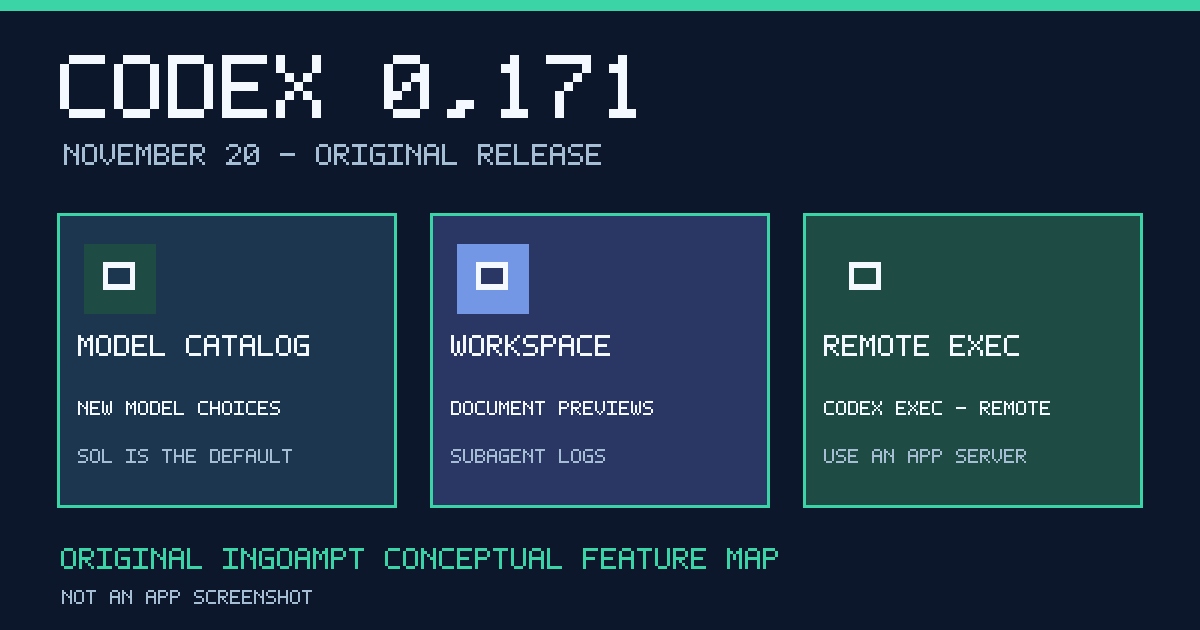
Featured image: original INGOAMPT conceptual feature map of Codex 0.171.0, illustrating the model catalog, TUI workspace and remote execution. It is not a Codex product screenshot.
For context on how another coding tool recently handled prompt costs, read our separately dated OpenCode 2.3.2 prompt-caching explanation. Find the latest original-source coverage in the INGOAMPT AI News edition.