New U.S. restrictions on advanced AI computing are changing how Chinese technology companies plan their next models. In original reporting first published at 3:21 a.m. New York time on November 20, Reuters described a market selloff and fresh comments from Tencent and Alibaba. The central distinction: training a frontier model and serving an existing model do not require exactly the same computing resources. That matters when an AI provider promises continuity despite losing access to some of the most advanced hardware.
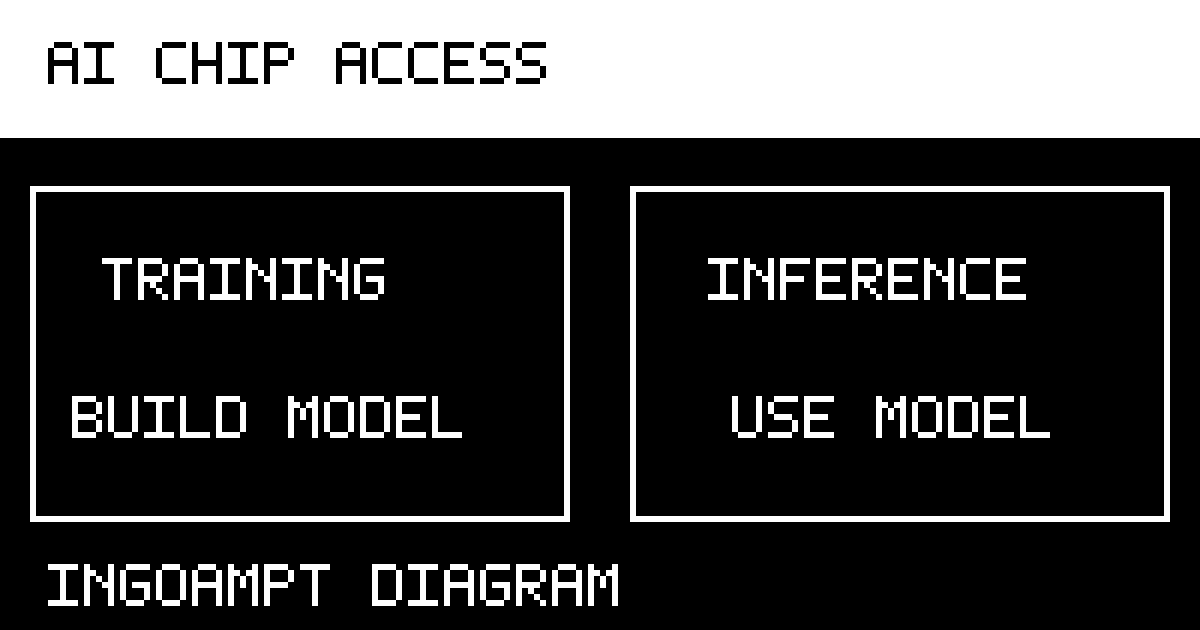
Featured illustration: INGOAMPT conceptual comparison of training and inference; not a product screenshot or measured hardware benchmark.
What Reuters reported on November 20
The new Reuters report brings together several developments from earlier in the week rather than announcing that every rule was introduced today. U.S. controls now address certain overseas remote-computing arrangements as well as physical chip shipments. Nvidia has suspended some previously licensed China shipments, and manufacturing constraints affect proposed domestic alternatives. Each measure has a different scope; it would be misleading to say all AI services or all Chinese cloud users are blocked.
Tencent President Martin Lau said the restrictions could slow work on the company’s next generation of models, while its existing cloud services are less exposed because much of their activity is inference. Alibaba warned that adjusting to the new restrictions could affect its cloud offerings next year. Reuters reported that Alibaba expects 30% to 45% cloud revenue growth next year, versus 53% in its most recent quarter. Those are corporate expectations, not independent forecasts or a prediction for every AI provider.
Why training and inference can react differently
Training is the resource-intensive process of updating model weights from data. A very large training run may require many high-performance accelerators working together, with substantial fast memory and networking. Inference is using an already trained model to answer a request. Some inference jobs can run on different, less powerful or more locally available processors, although the actual requirement still depends on model size, latency and serving scale.
| Decision | Training a new frontier model | Serving an existing model |
|---|---|---|
| Main workload | Repeatedly update a large model using distributed computation | Produce responses using already learned weights |
| Hardware dependence | Often sensitive to access to advanced accelerators and high-speed interconnects | May have more hardware choices, subject to model size and throughput |
| Likely business effect | Longer experiments and model-development cycles if suitable capacity is scarce | Some existing services may continue, but capacity, price and performance still need checking |
| What cannot be assumed | That domestic supply can replace restricted chips immediately | That every model works unchanged on every alternative chip |
That distinction explains why two statements from the same company can be true: an existing AI service may keep operating while the next major model takes longer to train. It does not establish that a particular AI model was successfully migrated, that prices stayed constant or that all access remained lawful.
Independent coverage shows the economic stakes
The Associated Press separately reported on November 19 that Alibaba’s AI-cloud and computing revenue had risen 53% year over year to almost 61 billion yuan in the July–September quarter. Its own reporting included comments from industry researchers and described how overseas data centers had become part of Chinese firms’ computing strategies. This is independent coverage and corporate financial context, not evidence of social-media virality or a newly released November 20 product.
Reuters on November 20 reported that Z.AI shares were down 22% and MiniMax shares 34% over the preceding two weeks. Those are two companies and one specified period; they should not be generalized to an entire national technology market. The selloff is one measurable sign that investors are reassessing the companies’ ability to access computing resources.
What developers and customers should take from the changes
For a developer using any third-party AI API, the relevant question is not simply where a provider’s headquarters are. It is whether the exact model, region and endpoint remain available for the expected workload, and whether its provider can continue offering the advertised throughput and price. The new restrictions do not, by themselves, establish a ban on an ordinary U.S. or U.K. developer using a particular service; actual licensing and customer eligibility must be checked with the provider.
A useful vendor comparison separates three facts that marketing pages can blur: which model version is currently served, what access or region restrictions apply, and which hardware or capacity assumptions underpin the service. Readers comparing their own machines with remote providers can also see our explanation of CUDA and GPU computing.
Sources, dates and limits
Original reporting: Reuters, Casey Hall and Sophie Yu, November 20, 2026, 08:21 UTC (03:21 New York). Reuters’ report covers restrictions and corporate statements arising on earlier days. Independent reporting: Associated Press, Chan Ho-Him, November 19, 2026. Regulatory background: U.S. Bureau of Industry and Security announcement, November 16. This article compares published information; INGOAMPT did not test restricted chips, negotiate a cloud contract or measure model performance.