Published by Pegah Tafvizi for INGOAMPT AI News on November 18, 2026 at 10:11 a.m. Vienna time. Chart by INGOAMPT using measurements published by the OpenCode project.
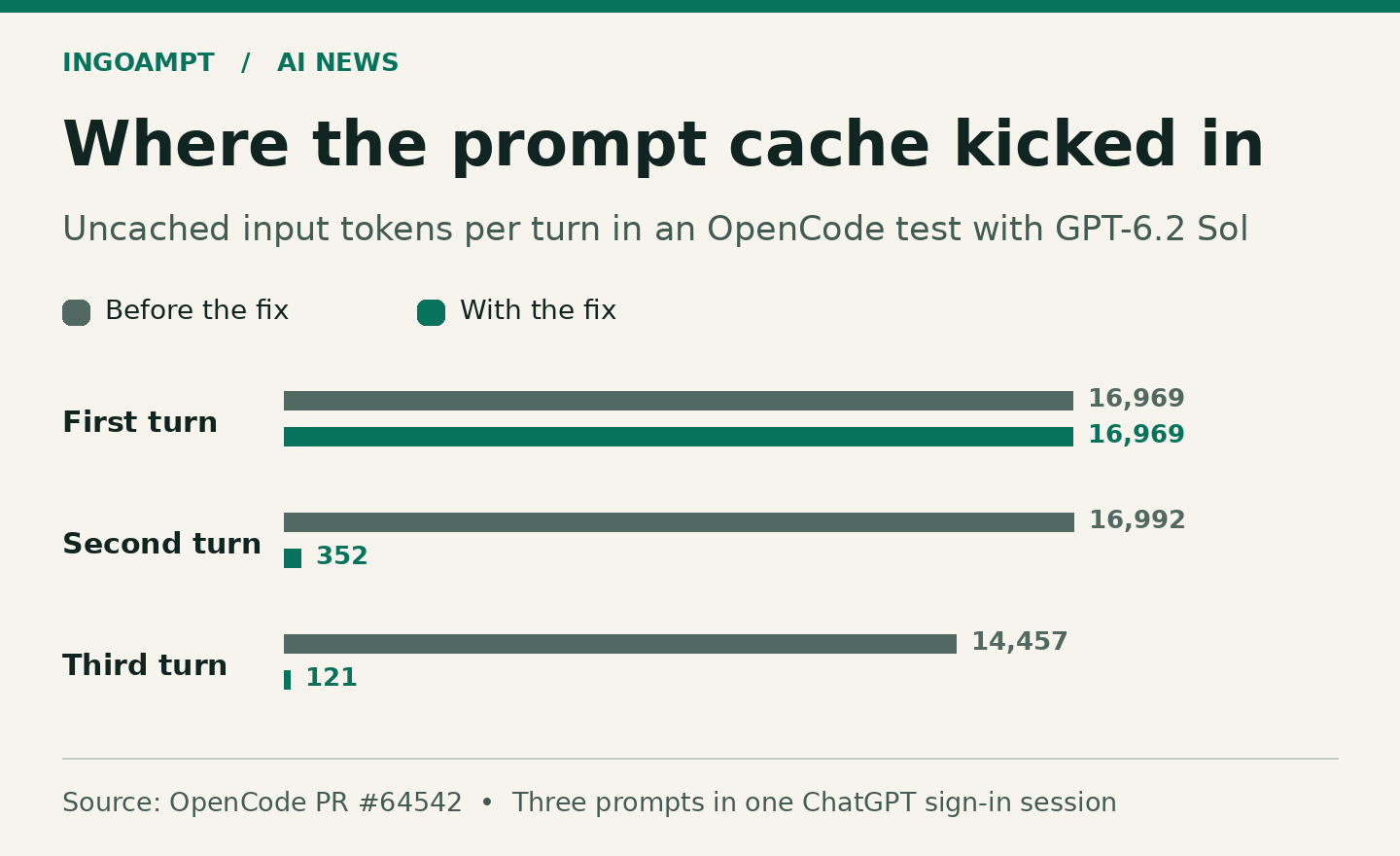
On November 18, OpenCode released a fix for developers who saw GPT-6.2 treat the same instructions as fresh input on every step of a coding session. Version 2.3.2 changes how the open-source coding agent sends those instructions. In one project test, the first turn used exactly as many uncached tokens as before. On the second turn, the count fell from 16,992 to 352.
Why the second turn matters
A coding agent sends more than the question you type. It can also send the same long set of instructions about its role and tools every time it asks the model what to do next. Prompt caching lets a service recognize a repeated beginning of a request. The next step can then reuse that work. A short follow-up such as “run the tests” can otherwise bring thousands of tokens of unchanged instructions along for the ride.
OpenCode had been placing the system prompt in the Responses API’s separate instructions field. In the project’s GPT-6.2 tests the text there registered as uncached input each time. OpenCode 2.3.2 places the same instructions at the start of the conversation as a developer message. The release covers Responses routes including OpenAI, GitHub Copilot, Azure and OpenRouter.
What changed in a three-turn coding session
The contributor who implemented the fix ran three one-line prompts in one OpenCode session using ChatGPT sign-in and GPT-6.2 Sol. The table shows the reported uncached input tokens. Each row compares the same turn before and after the change.
| Turn | Before the fix | With the fix |
|---|---|---|
| First prompt | 16,969 | 16,969 |
| Second prompt | 16,992 | 352 |
| Third prompt | 14,457 | 121 |
Adding the two follow-ups gives 31,449 uncached tokens before the change and 473 after it. The first turn had no earlier request to reuse. These are the contributor’s measurements from one setup. Other workloads can have shorter instructions, changing prefixes or different providers. The token counts alone cannot tell you what a subscription or an API invoice will cost.
Where to look in your own usage
If you use OpenCode with GPT-6.2 for long coding sessions, compare the reported input and cached-input counts on two successive turns with the same setup. The first request establishes a baseline. A follow-up in the same session shows whether the provider recognized reusable input. An especially useful detail from the project’s investigation is that its cache diagnostic could report a hit while the usage record showed zero cached tokens. Look at the usage numbers before drawing a conclusion about cost.
OpenCode published the version 2.3.2 release at 02:35 Vienna time on November 18. The project published its measurement setup and turn-by-turn results and documented how it extended the change to other Responses routes. INGOAMPT calculated the two-turn totals from the published measurements. For more verified releases, see AI News for Developers and Solo Founders.