By INGOAMPT AI News · November 19, 2026
OVHcloud unveiled 55 cloud and AI products on November 19, extending its European-hosted portfolio into graphics processors, managed inference, networking and AI agents. Reuters reported the announcement that morning, and ETDatacenters separately described the technical lineup. For a small software company, the useful question is not how many products appeared in the launch. It is which can be used today, what is still planned, and what Europe-hosted AI would actually change.
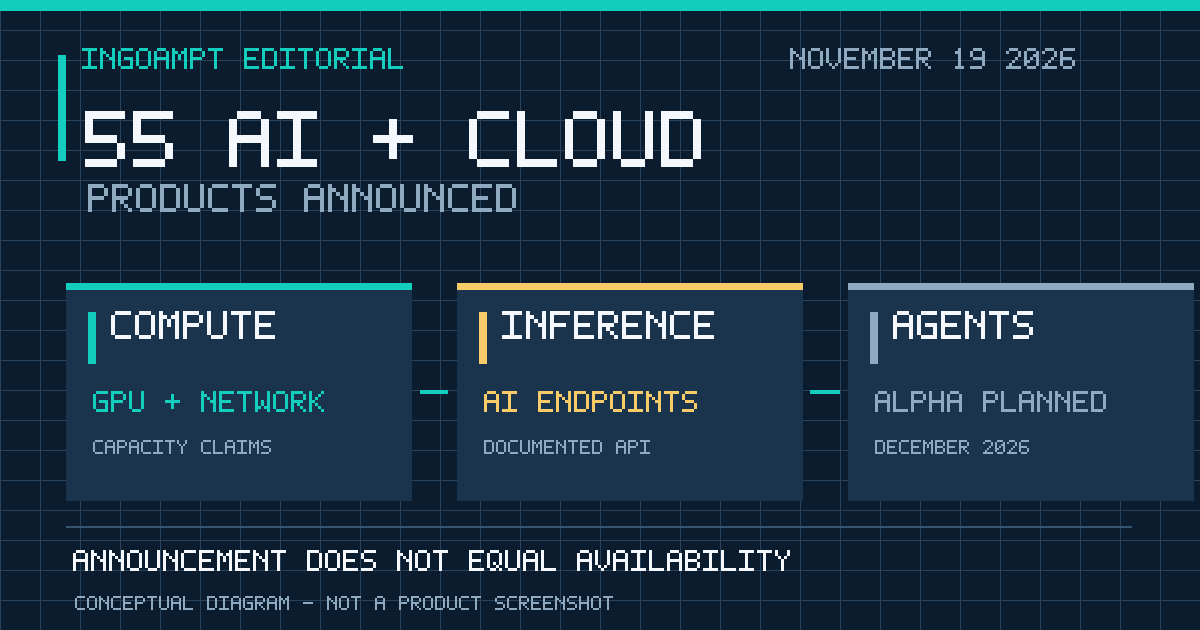
Illustration: original INGOAMPT conceptual comparison of announced compute and networking, documented AI Endpoints, and agent-platform alphas planned for December. This is not an OVHcloud screenshot or a measured deployment result.
The announcement goes beyond OVHcloud’s earlier Olala Mini language model. It spans the systems needed to operate an AI application, from private networking to the model endpoint that generates a response. That broader deployment story affects developers selling to European customers, including teams based in the US or UK.
What the 55-product announcement actually covers
The November 19 OVHcloud release describes several layers. On the compute side, OVHcloud says it is adding NVIDIA RTX 6000 Pro, Blackwell B300 and Rubin R200 hardware to its Bare Metal and Public Cloud offerings. The company says its facilities have capacity for up to 60,000 B300 GPUs or 35,000 R200 GPUs. Those are company-stated capacity figures, not independently measured installed inventory or an offer to rent that many GPUs immediately.
At the networking layer, the company lists web application firewalls, private DNS, VPNs, load balancing and virtual private-cloud connectivity. Its inference portfolio covers more AI Endpoints models and governance tools, including speech capabilities through Gladia. It also presents AI Fabric for Python agent environments, AI Agents for linking enterprise tools and AI Search for private documents. Each has a different purpose and potentially a different maturity level.
The important difference between announced and available
Comparing the release with OVHcloud Labs’ public availability listings reveals a distinction the headline cannot show. The Labs page describes AI Agents as an alpha expected in December 2026. AI Fabric is likewise listed for a December alpha, and AI Routers appears as coming in December. Those listings do not prove that developers can turn on every one of these products in a production account today.
By contrast, the existing AI Endpoints documentation already describes a base service with published model choices and request constraints. Developers can compare that documented API with alternatives now, while monitoring the proposed agent products. They still need to confirm regional access and the exact chosen model in their own account.
This availability comparison is INGOAMPT’s reading of the provider’s documentation. We did not deploy the services or test an endpoint. A launch, a publicly documented product and an announced alpha are different stages of readiness.
What hosting in Europe does and does not guarantee
European data centers may help teams meet customers’ location requirements. But a European region alone cannot establish privacy compliance, security or complete control over data flows. Those depend on the contracted service, processors, backups, logging and any other providers called by the application. A US or UK developer serving European businesses should examine the product’s own terms instead of treating its marketing description as a compliance certificate.
An AI system could still send prompts or metadata to a search provider, payment service, identity system or outside model endpoint. The new integration options become more useful when developers map those connections and verify where data actually travels.
A real cost check for solo developers
For scale, consider 10,000 calls to the existing gpt-oss-120b endpoint, each using 1,000 input tokens and 200 billable output tokens. That adds up to 10 million input and 2 million output tokens. On November 19, OVHcloud’s Worldwide AI Endpoints catalogue listed $0.09 per million input tokens and $0.47 per million output tokens for this model. At those rates, the estimated inference charge is $1.84 before VAT (10 × $0.09 plus 2 × $0.47). Use the price for your billing region and your actual token counts when budgeting. This example covers model inference alone. Storage, networking and other services can add to the bill.
The published Public Cloud price list includes usage charges for GPU instances and AI model tokens. OVHcloud also changed some infrastructure billing on October 1: its pricing note explains that local storage and public IPv4 addresses on certain instance types are separate charges.
That produces a useful comparison for a small SaaS team: the per-request model cost, any continuously running compute, storage, public networking and required managed services should be counted separately. A serverless label does not mean free operation. The larger GPU-capacity numbers do not tell a developer what a single request will cost, how quickly it will respond or whether a particular device is in stock.
Why this is news beyond the company’s presentation
Reuters reported the November 19 announcement at 08:43 UTC, while ETDatacenters published its own same-day industry desk coverage at 13:55 India time. Their independently dated reporting documents wider industry attention to the European cloud expansion. Neither publication establishes independent adoption statistics or benchmark superiority, and the company’s capacity claims remain attributed to OVHcloud.
The practical takeaway is to separate the product-launch promise from an account-ready service and a dated roadmap. In a changing AI platform market, that distinction is more valuable than the size of a launch-day product list.
Original reporting: November 19, 2026 · Reuters. Independent industry coverage: November 19, 2026 · ETDatacenters. OVHcloud’s primary launch statement, product schedule and pricing are linked above. INGOAMPT’s comparative analysis is based on public documentation; no service was benchmarked.
Related INGOAMPT background: the earlier Olala Mini model announcement addresses a separate model release.