Anthropic’s public listing has put a familiar AI-safety promise under new scrutiny. In original reporting published November 21, NPR interviewed legal scholars about whether the company behind Claude can continue to delay risky models when shareholders demand faster growth. The Verge separately examined the tension between Anthropic’s safety mission, the costs of frontier AI and its unusually structured board. For developers who rely on Claude, the immediate lesson is to distinguish corporate governance from concrete safeguards available to API customers.
The IPO itself took place earlier in the week, not today. The development on November 21 is new, independent reporting about what happens after it. Anthropic’s SEC filing documents the governance structure; NPR’s November 21 interviews and The Verge’s November 21 interview examine how it may work under pressure.
Who controls Anthropic’s board?
Anthropic is a public benefit corporation. Its directors must balance shareholder financial interests, the interests of people materially affected and the company’s stated public benefit. But the specific election rights tell a more useful story than the corporate label alone.
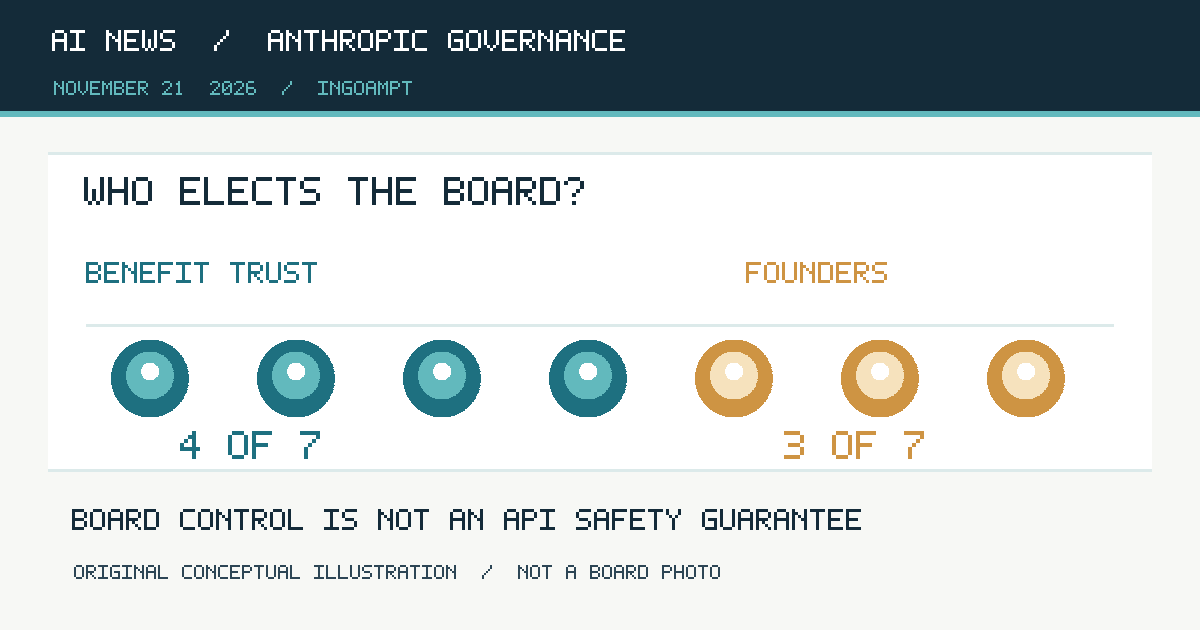
The Long-Term Benefit Trust holds special Class T rights that generally let it elect and remove a majority of the authorized directors. NPR reports that this currently means four of seven board seats, while founders effectively determine the other three. Separately, a founders’ special Class F share carries 50.1 percent of general stockholder voting power. Choosing directors, controlling a shareholder vote and deciding the day-to-day release of a model are different kinds of authority.
The SEC filing does not give the trust an automatic, direct veto over each Claude model launch. Nor does the four-to-three board split prove that a particular safety evaluation ran successfully. The original diagram accompanying this article distinguishes the election rights from operational control.
What the new reporting actually found
In NPR’s November 21 report, Harvard Law professor Roberto Tallarita discussed the possibility of founders and employees siding against trustees when a safety decision could hurt the business. Cornell’s Sarah Kreps described how personal financial rewards might affect institutional choices. These are informed concerns about possible conflicts, not findings that Anthropic has weakened a specific safeguard.
NPR also reported CEO Dario Amodei’s pledge to pace model training and deployment according to safety needs. The company says its mission remains unchanged. A public statement is evidence of a commitment, not proof of how the next disputed decision will be resolved.
The Verge’s separate November 21 conversation with AI reporter Hayden Field looks at a second pressure: the enormous cost of training new models and supplying enough computing power to paying users. Even a safety-oriented lab must pay for infrastructure. The discussion asks whether growth and competition will encourage more rapid launches while a safety team might prefer additional evaluation. It is reporting and analysis, not an announcement of a new Claude price, capability or API restriction.
Compare the promise with what a developer can verify
Governance promise: The benefit trust helps select directors with oversight responsibilities. Developer-level evidence: The actual service terms, model-version policies, release notes and independently relevant evaluations describe what a product team may rely on. A board structure alone does not establish a service-level guarantee.
Safety promise: The vendor aims to restrict dangerous model behavior. Developer-level evidence: The application still needs permission boundaries, safeguards on tool execution and testing for prompt injection using representative inputs. No general governance mechanism substitutes for controlling what an agent can do inside a customer’s system.
Continued model development: The vendor expects to build and operate frontier systems. Developer-level evidence: Before switching a live product to a new model, compare task quality, latency, costs and failure recovery using the application’s own workload. Publish a clear version and fallback plan. Actual controls and notice periods depend on the customer’s contract and product.
For example, a document assistant that can read a user’s uploaded files should enforce access to those files in application code, even if its underlying model is sold as safety-focused. Whether a future model behaves differently is a testable product question; who elects a board director is not that test.
What remains unknown
Neither November 21 report establishes how Anthropic will resolve a future conflict between a model launch and further safety review. The SEC document is the primary source for share classes and board-election rights; the two journalists’ independent interviews supply timely questions about incentives and oversight. INGOAMPT has not audited Anthropic’s internal deliberations or tested a changed Claude model for this story.
For a separate explanation of how financing and hardware capacity affect AI providers, see our training-versus-inference comparison. That earlier reporting is context, not evidence that Anthropic’s API changed today.
By Pegah Tafvizi, INGOAMPT. News reporting first published by NPR and The Verge on November 21, 2026. Official governance filing dated November 10, 2026. Original INGOAMPT diagram; not a photograph of Anthropic’s board.