Understanding MCP-DBLP: How AI Can Find Real Scholarly Citations Without Inventing Them
A beginner-friendly explanation of Stefan Szeider’s paper, the MCP-DBLP tool, why MCP matters, and how similar ideas can become useful tools for researchers, developers, students, and AI builders.
Reference paper
This article explains the paper “Unmediated AI-Assisted Scholarly Citations” by Stefan Szeider, Algorithms and Complexity Group, TU Wien.
The paper presents MCP-DBLP, an open-source Model Context Protocol server that connects language models to the DBLP computer-science bibliography database and exports verified BibTeX entries directly from DBLP.
Main project reference: szeider/mcp-dblp on GitHub.
1. Why this topic matters
AI tools are now used by students, scientists, developers, and writers to search papers, summarize research, and draft academic text. But there is one serious problem: AI can generate references that look professional but are wrong.
A reference may have a wrong author, wrong title, wrong year, missing DOI, wrong venue, or even point to a paper that does not exist. This is called a citation hallucination.
Simple warning: AI can write a beautiful bibliography that still contains fake or damaged citations.
Stefan Szeider’s paper asks an important question:
Can we keep the convenience of AI chat, but make the final citation data come from a trusted database?
2. What is MCP?
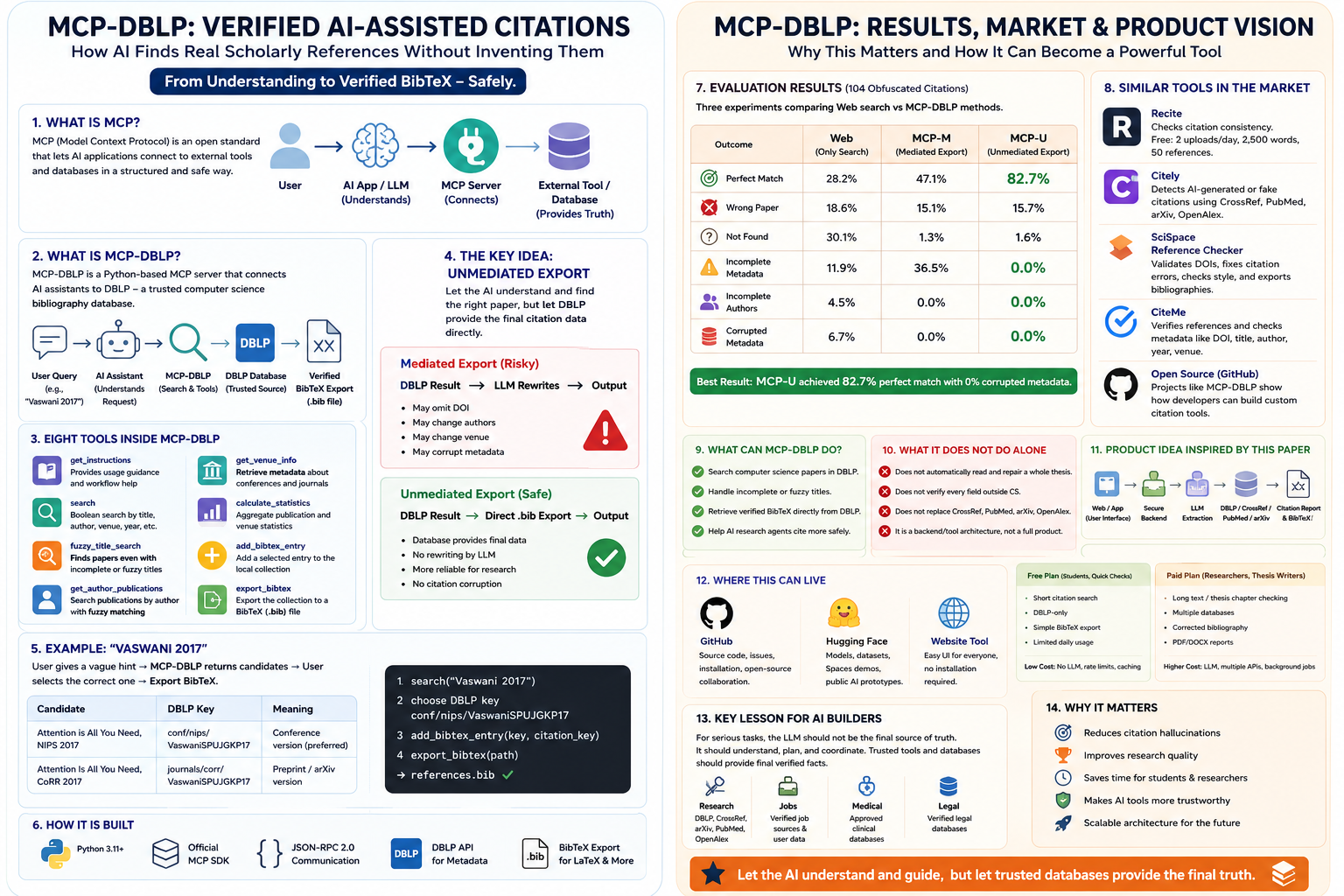
MCP means Model Context Protocol. It is an open standard that helps AI applications connect to external tools, databases, files, and workflows.
A very simple explanation is:
MCP is like a safe plug or bridge for AI. It lets an AI app use real tools instead of only guessing from memory.
MCP itself is not the AI model. It is also not the database. It is the connection layer that lets an AI client communicate with external tools in a structured way.
| Term | Beginner meaning | Example in this paper |
|---|---|---|
| LLM | A language model, like an AI chatbot brain that understands text. | The AI assistant understands citation hints like “Vaswani 2017”. |
| MCP | A standard way for an AI app to use external tools. | The protocol between the AI assistant and MCP-DBLP. |
| MCP server | A helper program that exposes tools to the AI. | MCP-DBLP. |
| Database/API | A real source of information that software can query. | DBLP API. |
3. What are “free tools” in AI?
Many AI tools are built by connecting an AI model to free or open data sources, open-source libraries, or public APIs. This does not mean the final product costs nothing to run, but it can reduce cost because the tool does not need to train a huge model or store a huge database.
AI model
The AI understands messy user text and decides which tool to call.
MCP tool
The MCP server performs a real action, such as searching DBLP or exporting BibTeX.
Trusted data
The final facts come from databases such as DBLP, CrossRef, PubMed, arXiv, or OpenAlex.
For MCP-DBLP, the tool itself is open source. DBLP provides bibliographic data. The LLM may be a paid model or a local model, but the citation export can still be designed so that final data comes from DBLP, not from the AI’s imagination.
4. What is MCP-DBLP?
MCP-DBLP is a tool built by Stefan Szeider. It connects an AI assistant to DBLP, a trusted bibliography database for computer science.
The tool lets an AI assistant search DBLP, find matching papers, add selected papers to a local bibliography collection, and export BibTeX entries directly from DBLP.
Main idea: Let the AI understand the user’s messy citation request, but let DBLP provide the final citation data directly.
5. How MCP-DBLP is built
The paper explains that MCP-DBLP is implemented as a Python MCP server. It uses the official MCP SDK, communicates using JSON-RPC 2.0, and calls the DBLP API to retrieve real publication metadata.
| Part | What it means | Why it matters |
|---|---|---|
| Python 3.11+ | The programming language used to build the tool. | Easy to build, test, and integrate with APIs. |
| Official MCP SDK | The library used to create the MCP server. | Lets the tool expose functions to AI clients. |
| JSON-RPC 2.0 | A structured way for programs to send requests and responses. | Helps the AI client and tool communicate clearly. |
| DBLP API | The source of real publication metadata. | Prevents the AI from inventing citation fields. |
| BibTeX export | The final .bib file written by the tool. | Useful for LaTeX, research papers, and reference managers. |
The eight tools inside MCP-DBLP
| MCP-DBLP tool | Simple explanation |
|---|---|
get_instructions |
Gives the AI usage instructions and workflow guidance. |
search |
Searches DBLP using a query, author, year, or venue. |
fuzzy_title_search |
Finds papers even when the title is incomplete or slightly wrong. |
get_author_publications |
Lists publications by an author. |
get_venue_info |
Retrieves information about conferences or journals. |
calculate_statistics |
Computes simple publication statistics. |
add_bibtex_entry |
Adds a selected paper to the bibliography collection. |
export_bibtex |
Writes all selected citations to a .bib file. |
6. The key idea: unmediated export
The strongest idea in the paper is unmediated export. This means the final BibTeX entry is exported directly from DBLP, instead of being rewritten by the LLM.
Risky path: mediated export
DBLP result → LLM rewrites citation → final output
- The LLM may omit a DOI.
- The LLM may change an author name.
- The LLM may change the venue.
- The LLM may produce incomplete metadata.
Safer path: unmediated export
DBLP result → direct .bib export → final output
- The database gives the final metadata.
- The AI does not rewrite the citation fields.
- The result is more reliable for scholarly work.
- The workflow reduces citation corruption.
Memory sentence: Let the AI think, but let the database speak the final truth.
7. Example: “Vaswani 2017”
A user may write a vague citation hint such as “Vaswani 2017” or “Attention Is All You Need”. MCP-DBLP can search DBLP and return candidate papers.
| Candidate | DBLP key | Meaning |
|---|---|---|
| Attention is All You Need, NIPS 2017 | conf/nips/VaswaniSPUJGKP17 |
The conference version; usually the preferred scholarly citation. |
| Attention Is All You Need, CoRR 2017 | journals/corr/VaswaniSPUJGKP17 |
The preprint/arXiv-style version. |
search("Vaswani 2017")
→ choose DBLP key: conf/nips/VaswaniSPUJGKP17
→ add_bibtex_entry(dblp_key, citation_key)
→ export_bibtex(path)
→ references.bib
8. Did the tool work better?
The paper evaluated 104 obfuscated academic citations across three independent experiments. It compared ordinary web search with two MCP-DBLP-based methods.
| Method | Meaning |
|---|---|
| Web | AI uses web search only. |
| MCP-M | AI uses MCP-DBLP search, but the LLM still manually writes the BibTeX. |
| MCP-U | AI uses MCP-DBLP with unmediated direct export from DBLP. |
| Outcome | Web | MCP-M | MCP-U |
|---|---|---|---|
| Perfect Match | 28.2% | 47.1% | 82.7% |
| Wrong Paper | 18.6% | 15.1% | 15.7% |
| Not Found | 30.1% | 1.3% | 1.6% |
| Incomplete Metadata | 11.9% | 36.5% | 0.0% |
| Incomplete Authors | 4.5% | 0.0% | 0.0% |
| Corrupted Metadata | 6.7% | 0.0% | 0.0% |
Best result: MCP-U reached 82.7% perfect match and 0% corrupted metadata.
9. What MCP-DBLP can and cannot do
MCP-DBLP is a strong citation engine for DBLP, but it is not a complete thesis-checking platform by itself.
What it can do
- Search computer-science papers in DBLP.
- Find papers from incomplete or fuzzy titles.
- Retrieve verified BibTeX directly from DBLP.
- Help AI research agents cite more safely.
What it does not do alone
- It does not automatically read and repair a whole thesis.
- It does not verify every academic field outside computer science.
- It does not replace CrossRef, PubMed, arXiv, OpenAlex, or human review.
- It is a backend/tool architecture, not a complete public web product.
10. Similar tools already on the market
Citation checking is already a real product category. This means there is demand, but a new product needs a clear difference.
| Tool | Main focus | What readers can learn from it |
|---|---|---|
| Recite | Checks whether in-text citations match the reference list. Its free plan includes 2 uploads per day, first 2,500 words, and first 50 references. | Simple citation consistency checking has a student/researcher market. |
| Citely | Checks fake or AI-generated citations against sources such as CrossRef, PubMed, arXiv, and OpenAlex. | AI hallucinated references are now a practical problem people want to solve. |
| SciSpace Reference Checker | Validates DOIs, checks citation style, fixes citation errors, and exports clean bibliographies. | Users want not only verification, but also cleanup and export. |
| CiteMe | Verifies references and bibliographies against academic databases, checking DOI, title, author, year, and venue metadata. | Browser-based citation verification can be useful for broad audiences. |
| Open-source / GitHub tools | Tools such as MCP-DBLP and other reference-checking projects show that citation verification can be built as developer infrastructure. | Developers can build custom workflows using open-source components. |
Market insight: Many tools check or format citations, but MCP-DBLP’s special strength is the safe AI-to-database architecture and unmediated export.
11. GitHub, Hugging Face, and open-source angle
Developers can learn from MCP-DBLP because it shows how to turn a trusted database into an AI-usable tool. This kind of tool can live in several places:
GitHub
Best for source code, issues, installation instructions, tests, and open-source collaboration.
Example MCP-DBLP is available on GitHub.
Hugging Face
Best for models, datasets, Spaces demos, and public AI prototypes.
Possible use A citation-checker demo interface.
Website tool
Best for normal users who do not want to install anything.
Possible use Paste citation hint → export BibTeX.
A website version should not show the raw MCP Inspector interface to users. A public tool should have a simple user interface, while the backend quietly calls DBLP or an MCP server.
12. What tool could be made from this idea?
A public product inspired by this paper should not simply say “MCP-DBLP.” Normal readers do not buy a protocol. They understand a clear promise.
Free tool
Verified BibTeX Finder
Users paste a citation hint, search DBLP, select the correct paper, and export BibTeX.
Low cost No LLM required for the simplest version.
Paid tool
Thesis Citation Auditor
Users upload or paste a thesis section. The tool checks references, finds missing metadata, and produces a report.
Higher value Uses multiple databases and optional LLM extraction.
ChatGPT app
Verified Citation Checker
A separate ChatGPT app/tool could verify references with trusted databases.
Important It would not replace ChatGPT’s built-in research button.
13. Free vs paid feature idea
| Plan | Good for | Features | Cost control |
|---|---|---|---|
| Free | Students, developers, quick checks. | Short citation search, DBLP-only, simple BibTeX export, limited daily usage. | No LLM, rate limits, caching, limited word count. |
| Paid | Researchers, thesis writers, labs, AI-assisted writers. | Longer text, thesis chapter checking, multiple databases, corrected bibliography, PDF/DOCX report. | Payment before heavy processing, background jobs, file deletion policy. |
14. The bigger lesson for AI builders
This paper is not only about citations. It teaches a bigger AI engineering principle:
For serious tasks, the LLM should not be the final source of truth. It should understand, plan, and coordinate. Trusted tools and databases should provide final verified facts.
This same idea can apply to many AI products:
| AI product area | Trusted tool or database needed | Why it matters |
|---|---|---|
| Academic research assistant | DBLP, CrossRef, PubMed, arXiv, OpenAlex | Prevents fake or damaged citations. |
| AI job application agent | Verified job sources, user CV, permission rules | Prevents applying to wrong jobs or inventing job facts. |
| Medical AI assistant | Approved clinical databases and guidelines | Reduces unsafe unsupported claims. |
| Legal assistant | Verified legal databases | Prevents fake cases or wrong legal citations. |
15. Final conclusion
MCP-DBLP is a useful example of how AI tools can become safer. The LLM understands the user’s request, MCP connects the AI to a real tool, and DBLP provides verified citation metadata.
The paper’s main lesson is simple but powerful:
Sources and further reading
- Stefan Szeider, Unmediated AI-Assisted Scholarly Citations, MCP-DBLP paper.
- MCP-DBLP GitHub repository: https://github.com/szeider/mcp-dblp
- Model Context Protocol documentation: https://modelcontextprotocol.io/docs/getting-started/intro
- Recite pricing/free plan: https://reciteworks.com/pricing
- Citely AI Citation Checker: https://citely.ai/
- SciSpace Reference Checker: https://scispace.com/agents/reference-checker-xkr8e2ko
- CiteMe Citation Checker: https://citeme.app/tools/citation-checker