How to Build an AI Marketing Tool with Hugging Face and GitHub Models in 2026
A practical guide for developers, founders, marketers, and creators who want to build useful AI marketing tools,
choose the right open models, understand commercial licenses, and avoid wasting money training from scratch.
Introduction
AI marketing tools are becoming one of the most practical ways to use artificial intelligence in real business.
A good AI marketing tool can help people write ads, generate SEO blog posts, create email campaigns, improve
landing pages, produce App Store descriptions, make social media posts, analyze competitors, and build full
marketing plans.
But there is one big question for builders:
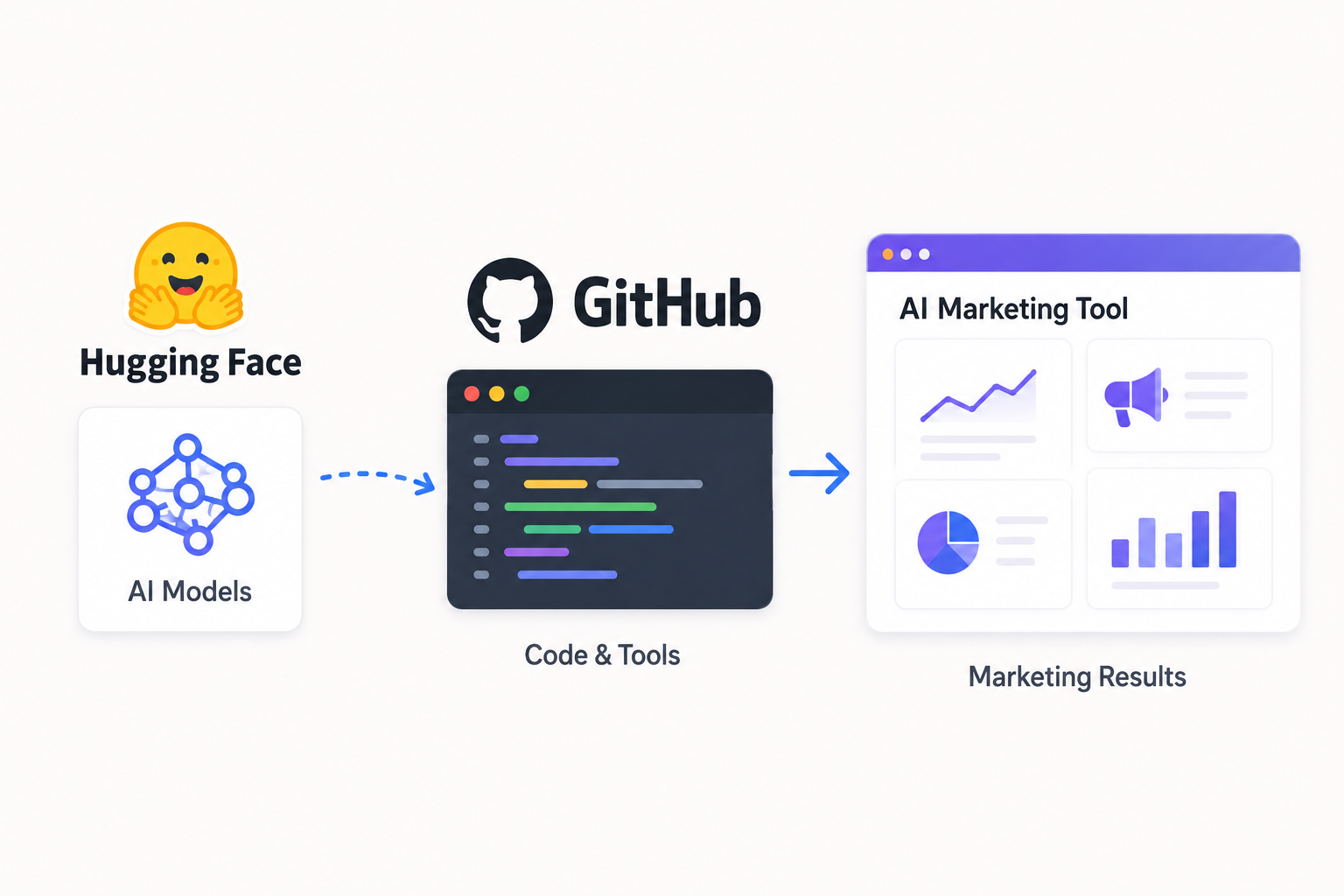
This article explains the difference between Hugging Face and GitHub, gives real examples of useful marketing
models and tools, and shows which options are better for fine-tuning, commercial products, and long-term business use.
Hugging Face vs GitHub: What Is the Difference?
Before building an AI marketing tool, it is important to understand the difference between
Hugging Face and GitHub.
The AI Model Platform
Hugging Face is mainly a platform for AI models, datasets, machine learning demos, and model cards.
It is where developers can find language models, fine-tuned models, datasets, deployment tools,
and important license information.
The Code and Workflow Platform
GitHub is mainly a platform for code repositories. A repository can include a full application,
scripts, prompts, agents, automation workflows, documentation, website code, or a complete SaaS product.
Simple explanation:
Hugging Face gives you the AI model.
GitHub gives you the code, workflow, or product structure around the model.
For example, a developer might use a Hugging Face model to generate ad copy, a GitHub project to build a
marketing dashboard, a custom dataset to fine-tune the model for a specific niche, and a website or SaaS app
to sell the final tool.
The best AI marketing products usually combine both: a strong model from Hugging Face and a useful
workflow inspired by GitHub projects.
What Can an AI Marketing Tool Do?
An AI marketing tool can be simple or advanced. A simple tool may only generate ad copy. A more advanced tool
can create a full marketing system.
- SEO blog post generator
- App Store Optimization assistant
- Google Ads copy generator
- LinkedIn post writer
- Email sequence generator
- Product launch planner
- Landing page copy improver
- Competitor analysis tool
- Customer persona generator
- Social media calendar planner
- Marketing audit report generator
The most valuable tools do not only “write text.” They help users complete a full marketing job from start to finish.
Product name, target audience, features, price, website URL
Output:
SEO title, blog outline, landing page copy, ad copy, email campaign,
social posts, competitor positioning, and improvement checklist
That is much more useful than a normal chatbot.
Best Hugging Face Models for AI Marketing Tools
There are many models on Hugging Face, but not all are useful for marketing. Some are general-purpose language
models. Some are trained specifically for ads, copywriting, push notifications, or marketing strategy.
marketeam/Qwen-Marketing
Qwen-Marketing
is one of the most interesting Hugging Face models for marketing. It is designed for marketing tasks such as
product descriptions, campaign ideas, customer feedback summaries, messaging variants, and marketing Q&A.
It can be useful for marketing strategy, campaign planning, brand messaging, landing page generation,
email sequences, and long product brief analysis.
Best for: advanced marketing assistant, strategy generation, long-form marketing tasks.
Fine-tuning difficulty: medium to high.
Commercial use: check license and base model terms carefully before selling.
Adnane10/AdsGeniusAI
AdsGeniusAI
is a marketing-focused model made for ad copy, slogans, and promotional text. It is one of the most practical
examples for people who want to build an AI ad-copy tool.
It can be useful for ad headlines, product slogans, promotional text, short website copy, product descriptions,
and simple campaign ideas.
Best for: ad copy generation.
Fine-tuning difficulty: easier than many 7B or 8B models.
Commercial use: check the model license, base model license, and dataset rights.
Adnane10/NovaAdsAI
NovaAdsAI
is an advertising-focused model based on a smaller model family. Because it is lighter, it can be useful
for cheaper experiments and simple prototypes.
It can be useful for testing ad-copy generation, building a low-cost prototype, running experiments on limited
hardware, and creating a small marketing assistant.
Best for: lightweight advertising tools.
Fine-tuning difficulty: easier than larger models.
Commercial use: check license and dataset rights before selling.
Kavyaah/copywriting-llm
copywriting-llm
is designed for short-form copywriting, push notifications, app banners, micro-ad copy, offers, FOMO alerts,
re-engagement messages, and campaign text.
This type of model can be useful for mobile app owners, e-commerce brands, SaaS tools, and businesses that
need many short variations for A/B testing.
Best for: push notifications and short app marketing copy.
Fine-tuning difficulty: medium.
Commercial use: check license wording carefully before using it in a paid product.
Which Hugging Face Model Is Best to Fine-Tune?
For most builders, the best first choice is:
Best first fine-tuning choice: Adnane10/AdsGeniusAI
This is a good starting point because it is focused on marketing, smaller than many large models, easier to
experiment with, designed for ads and promotional copy, and practical for real marketing content.
For better quality and deeper reasoning, Qwen-Marketing is more powerful, but it is bigger, heavier, and should
be checked carefully before commercial use.
| Goal | Recommended Model Type | Why |
|---|---|---|
| First fine-tuning experiment | AdsGeniusAI / Phi-2 style model | More focused, smaller, easier to test |
| Cheap prototype | NovaAdsAI / 1B advertising model | Lower hosting and experimentation cost |
| Better marketing reasoning | Qwen-Marketing | Better for strategy and long-context tasks |
| Push notifications | copywriting-llm style model | Good for short, catchy app and campaign text |
| Commercial SaaS | Permissive model + own dataset | Safer for selling and long-term product building |
Best GitHub Examples for AI Marketing Tools
Hugging Face gives models. GitHub gives builders full product ideas.
AI Marketing Suite for Claude Code
ai-marketing-claude
is an AI marketing suite that shows how marketing workflows can be organized into commands such as audits,
copy generation, email sequences, social media posts, competitor analysis, and launch planning.
OpenClaudia Marketing Skills
OpenClaudia-style marketing skills show how marketing can be split into separate skills for SEO, content,
ads, analytics, growth, social media, outreach, and conversion optimization.
SEO Machine
SEO-focused AI projects
show how a tool can research, write, rewrite, analyze, and optimize long-form blog content with commands,
agents, keyword clustering, readability scoring, and SEO ratings.
Agent-Based Marketing Kits
Agent-based marketing tools divide the work between different AI agents, such as an SEO agent, copywriting
agent, email agent, ads agent, analytics agent, and competitor research agent.
Example Command Structure
/market copy
/market emails
/market social
/market competitors
/market launch
/market seo
This is useful because it shows that an AI marketing tool does not need to be only a chatbot. It can be a guided
system with specific workflows and exportable results.
Can You Sell an AI Marketing Tool Built with Hugging Face or GitHub?
Yes, but only if the licenses allow it.
Important: A public model or GitHub project is not automatically free for commercial use.
You must check the full license chain before selling.
You must check:
- The model license
- The base model license
- The dataset license
- The code license
- Any “research only” or “non-commercial” warning
- Whether the model output needs human review
- Whether you are selling model weights, an API, or a tool that uses the model
MIT and Apache 2.0 are usually considered permissive licenses, but AI models are more complicated than normal code.
A model may say one license, while the dataset or base model has different terms.
+ clear model license
+ legal dataset
+ your own fine-tuning data
+ human review
+ clear terms of use
= safer AI marketing product
Is It Better to Train a Marketing Model From Scratch?
For most people, no.
Training a model from scratch is usually not the best path for an AI marketing tool because it requires huge
datasets, expensive GPUs, machine learning expertise, long training time, evaluation systems, safety testing,
legal review of training data, and deployment infrastructure.
Better path: use an existing open or permissive model, build a useful marketing workflow around it,
create a small high-quality dataset, fine-tune with LoRA or QLoRA, add quality checks, and sell the finished tool.
In many cases, users do not care which model is behind the product. They care about the result.
- Better ad copy
- Better SEO articles
- Better emails
- Better landing pages
- Better product descriptions
- More traffic
- More conversions
So the product should focus on the marketing outcome, not only the AI model.
Best AI Marketing Tool Architecture
A strong AI marketing tool can be built like this:
↓
Product analysis
↓
Marketing goal selection
↓
Prompt template or agent workflow
↓
AI model generation
↓
Fact-checking and compliance rules
↓
SEO / ASO / ad-quality scoring
↓
Final export
Example input and output:
Product name, website, target audience, country, tone, price, features
Tool generates:
– SEO blog title
– Blog outline
– Meta description
– Landing page headline
– 5 ad copies
– 5 email subject lines
– LinkedIn post
– Reddit-safe post
– Competitor positioning
– Improvement checklist
This is the kind of workflow that can become a real product.
Best Business Ideas for AI Marketing Tools
AI Ad Copy Generator
A tool that creates Google Ads, Meta Ads, TikTok Ads, LinkedIn Ads, and Apple Search Ads.
Best model type: AdsGeniusAI or Qwen-Marketing.
AI SEO Blog Generator
A tool that researches, outlines, writes, and optimizes blog posts.
Best inspiration: SEO Machine-style workflows.
AI App Store Optimization Tool
A tool for mobile app developers that creates titles, subtitles, keywords, descriptions, screenshots text,
and launch posts.
Best model type: marketing fine-tuned LLM + keyword scoring system.
AI Landing Page Copy Tool
A tool that improves headlines, CTAs, feature sections, benefit sections, and pricing page copy.
Best inspiration: copywriting and CRO workflows.
AI Email Campaign Generator
A tool that creates welcome emails, launch emails, reactivation emails, discount emails, and newsletter sequences.
AI Competitor Analysis Tool
A tool that reads competitor websites and creates positioning reports.
Best model type: long-context model such as Qwen-Marketing.
AI Social Media Calendar Tool
A tool that creates daily content for LinkedIn, X, Reddit, Instagram, TikTok, and other platforms.
AI Push Notification Generator
A tool for app owners that creates short re-engagement messages and A/B test variants.
The Most Important Mistake to Avoid
The biggest mistake is building “just another AI text generator.”
A successful AI marketing tool should not only produce text. It should guide the user through a complete
marketing process.
Weak idea:
Better idea:
score them, rewrite weak ones, and export the best versions for Google Ads.
That is a real product.
Sources and Useful Links
Useful places to continue research:
Hugging Face Models
marketeam/Qwen-Marketing
Adnane10/AdsGeniusAI
Adnane10/NovaAdsAI
Kavyaah/copywriting-llm
GitHub AI Marketing Topic
AI Marketing Claude GitHub Project

Does your site have a contact page? I’m having problems locating it
but, I’d like to shoot you an e-mail. I’ve got some recommendations for your blog you
might be interested in hearing. Either way, great site and I look forward to seeing it improve over time.
Dear Sir, Madam,
thanks for your interest. you can simply email to email@ingoampt.com
or message us on linkedin page we provided on about us
Best Regards