
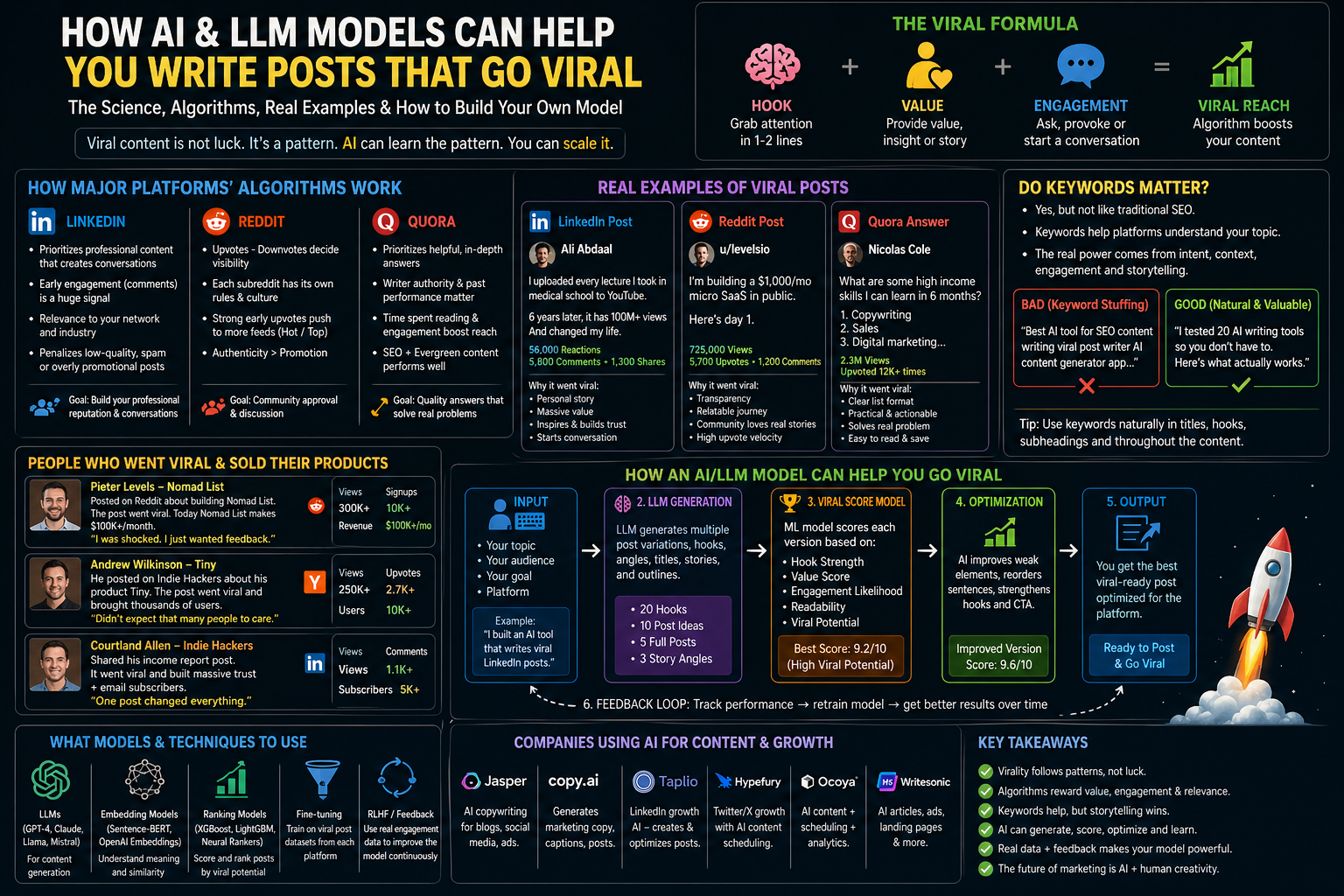
Every founder who has shipped a good product and then watched it disappear into silence eventually asks the same question: is viral writing random, or is there a system underneath it?
The most honest answer is this: there is no legal or reliable “hack” that forces a post to go viral on LinkedIn[1], Reddit[2], or Quora[3]. But there are repeatable patterns in how social platforms classify content, decide who to test it with, and expand distribution when early signals are strong. LinkedIn says its feed uses hundreds of signals from the post context, your profile, your network, and your activity; Reddit says recommendations depend on content information such as vote count, comment history, post age, flair, and user behavior; Quora’s own guidance says high-quality answers get more distribution and that titles, first lines, images, and credentials influence whether people interact. [4]
That distinction matters if you want to build a startup in this space. A good product here should not promise “guaranteed virality.” It should promise something more believable and more useful: better audience matching, better hooks, lower ad-smell, better platform fit, and better odds of meaningful reach.
Why founders believe there is a hidden virality system
Founders are not imagining things when they feel that some posts spread far beyond what their follower count should allow. Social platforms really do run staged distribution systems. LinkedIn’s public help pages describe a feed that personalizes content using many signals, including what type of content a post is and how relevant it is to a member’s professional world. Reddit describes a multi-step recommendation system that generates candidates, filters spam or repeated content, predicts what a user may like, and then sorts for relevance and diversity. Quora says it aims to reward high-quality answers with better distribution and explicitly ties wider distribution to quality and reader interest. [5]
In other words, the feeling that “something else” is happening beyond likes and views is correct. The “something else” is usually a combination of: the platform recognizing what the post is about, the platform having confidence about who should see it, and the first readers reacting in ways that tell the system it should expand testing. That is why two posts with similar ideas can perform completely differently: one is easy for the platform to classify and easy for the right audience to care about, while the other is vague, overly promotional, or mismatched to the audience. [6]
This is also why founders increasingly treat public posting as part of the go-to-market system, not as cosmetic brand work. A recent Business Insider report describes a new wave of founders who make content creation part of the company growth engine, with investor pressure and market pressure both pushing founders toward narrative-building online. One founder, Myles Slayton[7], said a single content stream on TikTok and Instagram helped draw users to his startup even when the startup itself was not being explicitly pitched in every video. [8]
How LinkedIn, Reddit, and Quora actually distribute written content
What the platform cares about on LinkedIn
LinkedIn’s official help documentation is unusually clear on one crucial point: the feed is not a simple chronological list, and it is not just a scoreboard of likes. LinkedIn says its AI systems consider the context of a post, the relevance of that post to a member, and many signals from a member’s profile, network, and activity. A separate LinkedIn “top content” explainer for 2025 emphasizes direct engagement and real conversations, not shallow vanity signals, as central ranking inputs. That makes LinkedIn a relevance-and-trust platform more than a pure entertainment platform. [9]
For builders, that has a direct implication: on LinkedIn, the best-performing product posts are usually not product announcements. They are posts that teach something useful, reveal a founder-level insight, or tell a specific professional story. A product is then introduced as the proof or the tool behind the lesson. This is why “I launched my app” often dies, while “I kept seeing this problem in customer interviews, so I built a tool around it” has a chance to spread.
What the platform cares about on Reddit
Reddit is more transparent than many social platforms because its official help center now explains the recommendation inputs directly. Personalized recommendations and ranking can depend on votes, comment history, post type, post age, flair, a user’s subscriptions, their recent visits, and their past interactions. Reddit also exposes explicit sorting models such as Hot, Top, New, and Rising. For logged-out users, Reddit says the Popular feed showcases the most popular recent posts as determined by net upvotes. [10]
The implication is different from LinkedIn. On Reddit, a post does not need to sound “professional.” It needs to feel like it belongs in that community. The highest leverage move is often not writing “better marketing copy,” but adapting the product presentation so it matches the subreddit’s local norms, rules, and humor. This is why founders who succeed on Reddit often talk about studying top posts in a subreddit before posting their own. The platform is less about brand polish and more about community fit. [11]
What the platform cares about on Quora
Quora’s public guidance points in a third direction. In its own help center, Quora says good answers are clear, credible, factually correct, and reusable by future readers, and that the most complete and thoughtful answers are more likely to rank near the top and reach lots of readers. In its guidance for Spaces, Quora also says distribution improves when content attracts the right followers, and it specifically notes that readers often see only the title, the first few lines, and an image before deciding whether to interact. Credentials matter too, because they help readers decide whether to trust the author. [12]
So Quora is closer to a hybrid of social discovery and search. It is weaker for sudden “viral spikes” than Reddit, but stronger for long-tail visibility when the writing is structured like a durable answer instead of a social update. That makes Quora especially useful for products that solve recurring questions, such as “How do I prepare for X exam?”, “What is the best way to learn Y?”, or “How do I choose between product A and B?”.
Why keywords matter, but not as magic triggers
Keywords matter mostly because platforms need language signals to classify content and retrieve it for search or recommendations. But words are not magic charms. On LinkedIn, relevance and network fit are doing much of the work; on Reddit, titles and community language matter because they help the platform and the subreddit understand what kind of post this is; on Quora, the title and first lines matter because they affect both ranking and click-through. Official platform guidance across these networks consistently points to a mix of content relevance, early interaction, author credibility, and user interest rather than any hidden list of “viral words.” [4]
Academic research backs that up. A widely cited study on online news sharing found that message features affect both selection and forwarding behavior, meaning that some stories are more likely to be clicked and more likely to be shared because of how they are written and framed. A Quora-focused study found that linguistic patterns in question text can meaningfully predict whether a question will eventually be answered. And a more recent headline-generation paper argues that attractive social-media headlines can immediately grab readers, even though the paper also warns that eye-catching surface features alone are not enough. [13]
The practical takeaway is simple: words matter as routing signals and packaging signals, not as “go viral” cheat codes. Strong wording helps the platform decide who should see the post and helps the user decide whether to stop and read. But the post still needs a real audience fit and a real reason to spread.
What real viral posts look like in practice
The easiest way to understand the system is to look at ordinary builders and operators who posted something, got unusual reach, and then measured what happened to the business. The examples below are not all perfect, and that is the point. Viral outcomes are usually messy. But they reveal patterns that a model can learn :
Example of When a LinkedIn post produced real product trials
In one of the clearest public examples, Yurii Rebryk[14] wrote that a viral LinkedIn post helped his startup Fluently[15] generate measurable product traffic. In his own post, he reported 2,132,000 impressions, 1,320,000 unique views, 7,193 new followers, 14,305 website visits, and 3,760 people who decided to try the product. The point of the follow-up post was not “look how famous I am”; it was explicitly to show that LinkedIn can function as a startup growth channel when a founder post gets broad reach. [16]
in this situation, it links writing performance to downstream behavior, not just likes. If a model only predicts impressions, it will miss what actually matters. A better system learns from views, clicks, trials, and eventually retained users.
Example of When a human story opened doors beyond direct revenue
Viral reach is not always a direct-sale event. Sometimes it is a trust and attention event that creates second-order opportunities. In a public LinkedIn post, Janet Lee[17] said that after she posted on LinkedIn, the post went viral, she was featured on CNBC, and LinkedIn itself later reached out with a paid partnership. Her lesson was that being more human and less over-managed online created opportunities that the usual “approved brand content” would not have created. [18]
For an AI writing startup, that example matters because it shows why a product cannot optimize only for lead-generation metrics. Some posts perform because they make the author more memorable, more trusted, or more culturally visible. A strong model should therefore score for authority-building potential as well.
Example of When consistency turned an early viral moment into a process
A useful counterexample to the “one-post miracle” fantasy comes from a LinkedIn breakdown by Andre Khurlapov[19] about Amanda Zhu[20] of Recall.ai[21]. According to the post, she went from roughly 1,000 to 43,000 followers in eight months, with one early post reaching about 100,000 impressions within the first two weeks of posting consistently. More importantly, the write-up explains the process behind that growth: customer interviews to learn where the audience actually spends time, a running idea database, content pillars, weekly planning meetings, batch writing, scheduling, and a daily block of time reserved for comments, DMs, and prospect engagement after posting. [22]
That is a better model for builders than the myth of inspiration. The winning behavior was not “write a genius post.” It was: find the right audience, write in a repeatable format, and treat distribution and conversation as part of the post.
Example of When Reddit turned a launch into downloads and registrations
On Reddit, Derek Pankaew[23] published a detailed account of launching his app in r/InternetIsBeautiful. He reported 725,000 views, 5,700 upvotes, about 3,000 mobile downloads, and more than 1,500 account registrations. The interesting part is how intentional the process was: he changed the product presentation to fit the subreddit’s rules, wrote multiple headline variants, and treated the post as a launch event rather than a casual mention. [24]
This is one of the clearest public examples that an “ordinary” founder can get extraordinary reach when the post is adapted to the culture of the distribution channel. For model design, that means your system should not just generate “good copy.” It should generate subreddit-fit copy, with separate constraints for communities that hate direct promotion.
Example of When Reddit produced both traffic and cash on day one
Another founder, Vivek Varma[25], wrote on Indie Hackers that Futurepedia[26] went viral on Reddit and got more than 40,000 views, more than 300 signups, and more than $250 in revenue in a single day. That matters because it shows a full funnel from post to traffic to users to at least some immediate revenue. [27]
A similar but smaller public case from Robin Saulet[28] reported more than 100,000 views for a Reddit launch post and about 90 signups in one day for Kaptr.me. The post framed the launch as a structured exercise, not luck. [29]
Example of When virality sold the product itself
One of the most relevant examples is the story told by Tom Orbach[30], creator of the “Viral Post Generator for LinkedIn.” On Indie Hackers, he wrote that the project attracted more than 2 million users in one week and was acquired shortly after launch. His process is especially revealing: he said he scraped and filtered high-engagement LinkedIn posts to reverse-engineer what tended to work, turned that insight into a humorous product, launched it across Product Hunt, Twitter, LinkedIn, and Reddit, and then got a massive second wave after posting in r/InternetIsBeautiful and being shared by a random Twitter user whose post reached about 15 million people. [31]
This story proves two things at once. First, virality can absolutely sell a product, even a tiny side project. Second, the underlying method was not “I hacked the algorithm.” It was: study what already spreads, extract the pattern, package it into a tool or story that people want to share, and place it in the right communities. It is also an example of what not to copy operationally on LinkedIn, because LinkedIn explicitly forbids third-party crawlers, bots, browser extensions, and automated scraping without permission. [32]
Example of When a trend-driven launch converted immediately
Marc Lou[33] published a public account of building an app in 24 hours after seeing a live discussion about fake MRR screenshots. He wrote that the app made $20,378 the next day. What matters here is not just the revenue number. The important pattern is that he did not create content in a vacuum. He built and posted into a conversation that already existed and already carried emotional charge. [34]
That pattern is extremely relevant for any AI virality system. A good model should not only know how to rewrite posts. It should know how to answer a deeper question: what conversation is already happening that this product naturally belongs inside?
Example of When launch communities amplified product demand
The founders of Openvid[35] wrote that a Product Hunt launch with almost 1,700 upvotes helped them go from zero to more than 10,000 users over three months. A separate LaunchPedia case study reported that Aaply[36] got 1,300 beta users from a Product Hunt launch. In both cases, the launch was prepared and structured rather than accidental. [37]
The lesson is that “viral writing” is often best understood as a system of packaging, placement, and iteration, not a one-off copywriting trick.
Why vanity metrics can still lie
A final example is important because it prevents the wrong startup from being built. In a public postmortem, Matthew Diakonov of Fazm wrote that one Reddit post got 114,000 views and only 19 signups, with zero returning users. The article’s entire point was that virality without retention means very little. [38]
This is the strongest argument against building a “viral post generator” that only optimizes for impressions. The real product opportunity is a system that helps people write posts that get relevant reach and meaningful outcomes, not empty reach.
The AI system that is actually buildable
For example, if anyone wants to build a LLM model for marketing, the best is to do not start by trying to train a giant language model from scratch. The smarter path is a hybrid system: a general LLM for generation, a smaller specialized model for ranking and critique, and a feedback loop that learns from real outcomes on the user’s account.
The core product idea
The best version of this startup is not “AI that guarantees virality.” It is something like: AI that turns your product, idea, or experience into platform-native posts that teach first and sell second, then scores which draft is most likely to work.
That is much closer to reality, and it matches what the public case studies above actually reveal. Nearly all of the examples that worked did one or more of the following:
- They started from a painful, specific problem instead of a product announcement. [39]
- They posted in a place where the intended audience already spent time. [40]
- They matched the local culture of the platform or community. [41]
- They created a follow-up loop through comments, DMs, trials, or signups. [42]
The data layer
The safest and most defensible training data is: the users’ own posts and outcomes, user-pasted examples of posts they admire, legally accessible platform data, and manually curated pattern libraries. This matters especially on LinkedIn, where the company forbids third-party crawlers, bots, scraping extensions, and other forms of automated data collection, and where many API permissions require explicit approval. On Quora, the official material surfaced readily for this research was content-quality guidance and advertising/conversion APIs, not a broad public content-search API for building a content-mining engine. [43]
That suggests a clear design principle: for example for building an ai agency is good to a build LinkedIn as a writing and analytics product, not as a scraping product. Let users import their own analytics, paste competitor examples manually, or connect whatever official APIs the platform allows. Use more open environments such as Reddit or launch communities to learn broad narrative patterns.
The generation layer
The marketing LLM’s job is not to invent “viral genius.” Its job is to generate many plausible versions of a message. For each product or idea, it should produce multiple hooks, multiple body structures, and multiple endings for different platforms: a founder-story version, a problem-solution version, a contrarian version, a lesson-learned version, and a community-discussion version.
On LinkedIn, the model should prefer professional insights, operator stories, and specific lessons. On Reddit, it should prefer community-native framing and transparent, non-corporate language. On Quora, it should generate answer-shaped content with strong first lines, rationale, evidence, and credentials. Those platform differences are not guesswork; they are consistent with what the platforms themselves say they reward. [44]
The ranking layer
This is where the actual moat can live. The specialized model should score each draft on features such as: hook clarity, audience specificity, perceived usefulness, credibility, emotional charge, comment potential, product relevance, and what is usually called ad-smell: the degree to which a post feels like a sales pitch too early.
A practical first version could predict several targets instead of one: distribution potential, conversation potential, and business potential. That is important because a post that gets comments may still be bad at driving trials, and a post that drives trials may not maximize impressions. The Fazm example is the cautionary proof that these are different optimization problems. [38]
The retrieval layer
One of the highest-leverage additions is a pattern library. Store high-performing real examples as embeddings, tagged by platform, format, audience, and business outcome. Then retrieve examples that are structurally similar to the user’s problem before the LLM writes. That gives the benefits of “learning from what already worked” without copying the text itself.
This is also the right place to encode platform-native templates discovered in the public examples above:
- Founder confession: “I thought X, then I learned Y.”
- Problem first: “Most people do X wrong.”
- Case study: “Here is what happened when we tried Z.”
- Community fit: “I made a useful free thing that belongs here.”
- Trend response: “This conversation is happening right now, so I built a response.”
The learning loop
The system only becomes truly valuable when it learns from outcomes. Every published draft should come back with platform-specific metrics: impressions or views, comments, saves or reposts where available, profile visits, website clicks, signups, and retained users. The more of that ladder you capture, the better the model gets at separating viral noise from commercial value.
Over time, the best systems in this category will look less like one-shot copy generators and more like creative decision engines. They will say not only “here are ten post drafts,” but also: “this version is high-reach but low-conversion,” “this version is lower reach but better for founder trust,” or “this version is most likely to attract the wrong audience.”
What existing companies do, and where the product gap still exists
There are already companies close to this space, but most of them stop before the hardest and most valuable part.
Example of Tools that generate and schedule content
Taplio[45] is one of the clearest examples in the LinkedIn ecosystem. On its own site, it describes itself as a growth tool for LinkedIn and highlights AI-powered content creation, post scheduling, engagement insights, and advanced analytics. Taplio also says its AI generates relevant posts by analyzing who you are and what you talk about. [46]
AuthoredUp[47] positions itself as an all-in-one LinkedIn content creation and analytics tool. Its public materials emphasize draft creation, formatting, previewing, and analytics for understanding what content works over time. [48]
Jasper[49] is broader, but its public product pages now describe a Social Media Campaign Agent that takes a campaign brief, audience information, and brand context, then generates channel-specific posts, hooks, headlines, and CTAs aligned with a shared message. [50]
Copy.ai[51] has moved even further up-market into a go-to-market AI platform that aims to codify best practices, unify data, and connect teams across GTM workflows rather than acting only as a social post generator. [52]
What these tools still do not fully solve
Most products in this market help with one or more of these tasks: drafting, formatting, scheduling, and analytics dashboards. Far fewer solve the harder problem: predicting which draft is most likely to work for a specific account, on a specific platform, for a specific business outcome, and explaining why.
That is the startup gap. The strongest defensible product here is not “another AI writer.” It is a ViralFit ranker or content operating system that combines: platform-specific generation, pattern retrieval from proven examples, outcome-aware scoring, and learning from the user’s own results over time.
Put differently: today’s tools mostly help users write more. The next category will help them decide better.
How to position the startup without overpromising
The worst possible positioning for this business is: “AI that guarantees any post goes viral.” That promise is not defensible, and the evidence above does not support it.
A much stronger positioning is: AI that studies what already works, rewrites your message to fit the platform, scores your drafts before you post, and learns from the results.
For a first wedge, the highest-value buyer segment is probably founders, indie hackers, and B2B operators using LinkedIn. The reasons are practical. LinkedIn has clear business intent, founders already want visibility there, and the platform’s restrictions make “safe writing assistance” more realistic than “aggressive data extraction.” For example also Reddit should still matter , but more as a research and pattern-mining surface than as a mass-automation surface because Reddit’s APIs and data usage are governed by approval flows and builder policies. [53]
Quora belongs in the product too, but probably later. The official material reviewed here gives strong guidance on how quality answers earn distribution, yet publicly documented creator case studies showing Quora answers directly driving startup signups were far harder to verify than comparable LinkedIn and Reddit cases. That likely makes Quora a good format adapter inside the product before it becomes the main product surface. [54]
All in all, What this means for anyone building such model
- What audience this message is really for.
- What platform-native format carries the message best.
- What wording makes the idea easier to classify, easier to trust, and easier to share.
- What angle reduces the feeling that the post is just an ad.
- What measurable business outcome the post should optimize for.
That is how a deep learning or LLM-powered system becomes useful here. Not by discovering a secret keyword incantation, but by doing at scale what the best founders in the public case studies already did manually: studying what worked, finding the narrative pattern, adapting it to the right audience, and learning from every result.
The surprising part is that the market still underserves this need. The examples above show that ordinary people really can post once and trigger signups, trials, coverage, partnerships, or even an acquisition. But those same examples also show that when founders win, they usually win because there was a system underneath: customer insight, pattern recognition, message packaging, community fit, and persistence. [55]
Open questions and limitations
Two limitations are worth being explicit about. First, the exact ranking formulas of LinkedIn, Reddit, and Quora are private and change over time; public help pages reveal important signals, but not the full model weights. Second, public case studies are much easier to find for LinkedIn and Reddit than for Quora, especially when the question is “did this viral post directly sell a product or SaaS?”. That means any production system should be built to adapt continuously from fresh user data rather than pretending it has discovered a permanent universal recipe. [5]
The best final summary is therefore also the safest one: you cannot guarantee virality, but you can absolutely build a model that makes writing more likely to earn the right kind of reach.
[1] [16] [17] [39] [42] [55] https://www.linkedin.com/posts/yrebryk_week-ago-my-post-went-viral-and-got-over-activity-7226199516595535873-yw37
https://www.linkedin.com/posts/yrebryk_week-ago-my-post-went-viral-and-got-over-activity-7226199516595535873-yw37
[2] [3] [38] https://fazm.ai/blog/114k-views-19-signups-reddit-post-retention
https://fazm.ai/blog/114k-views-19-signups-reddit-post-retention
[4] [5] [6] [7] [9] [19] [44] How the Feed ranks content | LinkedIn Help
https://www.linkedin.com/help/linkedin/answer/a9554004?utm_source=chatgpt.com
[8] [25] [28] https://www.businessinsider.com/young-startup-founders-selfie-sticks-venture-funding-influencers-2026-4
https://www.businessinsider.com/young-startup-founders-selfie-sticks-venture-funding-influencers-2026-4
[10] [35] [41] [45] [47] Reddit’s Approach to Content Recommendations
https://support.reddithelp.com/hc/en-us/articles/23511859482388-Reddit-s-Approach-to-Content-Recommendations?utm_source=chatgpt.com
[11] [15] [24] https://www.indiehackers.com/post/how-to-go-viral-on-reddit-725-000-views-5-7k-upvotes-1-000-signups-d029809634
https://www.indiehackers.com/post/how-to-go-viral-on-reddit-725-000-views-5-7k-upvotes-1-000-signups-d029809634
[12] [23] [36] [51] [54] What does a good answer on Quora look like? …
https://help.quora.com/hc/en-us/articles/360000470546-What-does-a-good-answer-on-Quora-look-like-What-does-it-mean-to-be-helpful?utm_source=chatgpt.com
[13] [49] Attracting Views and Going Viral: How Message Features and …
https://pmc.ncbi.nlm.nih.gov/articles/PMC4591750/?utm_source=chatgpt.com
[14] [30] [46] https://taplio.com/
https://taplio.com/
[18] https://www.linkedin.com/posts/jayleejanet_posted-on-linkedin-went-viral-got-featured-activity-7378413345336598528-yuUI
https://www.linkedin.com/posts/jayleejanet_posted-on-linkedin-went-viral-got-featured-activity-7378413345336598528-yuUI
[20] [31] [32] https://www.indiehackers.com/post/my-side-project-got-acquired-within-1-week-3-lessons-ive-learned-about-marketing-virality-e8943022be
https://www.indiehackers.com/post/my-side-project-got-acquired-within-1-week-3-lessons-ive-learned-about-marketing-virality-e8943022be
[21] [29] What’s New: Nailing your Reddit launch
https://www.indiehackers.com/post/whats-new-nailing-your-reddit-launch-fbf356ae9f?utm_source=chatgpt.com
[22] [40] https://www.linkedin.com/posts/khurlapov_a-few-months-ago-a-saas-founder-i-was-working-activity-7342679219723808768-x3Kc
https://www.linkedin.com/posts/khurlapov_a-few-months-ago-a-saas-founder-i-was-working-activity-7342679219723808768-x3Kc
[26] [43] https://www.linkedin.com/help/linkedin/answer/a1341387/prohibited-software-and-extensions?lang=en
https://www.linkedin.com/help/linkedin/answer/a1341387/prohibited-software-and-extensions?lang=en
[27] My website went viral on Reddit and got 40k+ views in one …
https://www.indiehackers.com/post/my-website-went-viral-on-reddit-and-got-40k-views-in-one-day-ae1c9bffee?utm_source=chatgpt.com
[33] [52] https://www.copy.ai/
https://www.copy.ai/
[34] I made an app in 24 hours and $20,378 the next day
https://newsletter.marclou.com/p/i-made-an-app-in-24-hours-and-20-378-the-next-day?utm_source=chatgpt.com
[37] https://medium.com/%40vinayh/0-10-000-users-how-openvid-launched-on-product-hunt-575ff9ecf7a1
https://medium.com/%40vinayh/0-10-000-users-how-openvid-launched-on-product-hunt-575ff9ecf7a1
[48] https://authoredup.com/
https://authoredup.com/
[50] https://www.jasper.ai/apps/social-media-campaign-advanced-task
https://www.jasper.ai/apps/social-media-campaign-advanced-task
[53] https://learn.microsoft.com/en-us/linkedin/shared/authentication/getting-access
https://learn.microsoft.com/en-us/linkedin/shared/authentication/getting-access