Transformer Models Comparison
| Feature | BERT | GPT | BART | DeepSeek | Full Transformer |
|---|---|---|---|---|---|
| Uses Encoder? | ✅ Yes | ❌ No | ✅ Yes | ❌ No | ✅ Yes |
| Uses Decoder? | ❌ No | ✅ Yes | ✅ Yes | ✅ Yes | ✅ Yes |
| Training Objective | Masked Language Modeling (MLM) | Autoregressive (Predict Next Word) | Denoising Autoencoding | Mixture-of-Experts (MoE) with Multi-head Latent Attention (MLA) | Sequence-to-Sequence (Seq2Seq) |
| Bidirectional? | ✅ Yes | ❌ No | ✅ Yes (Encoder) | ❌ No | Can be both |
| Application | NLP tasks (classification, Q&A, search) | Text generation (chatbots, summarization) | Text generation and comprehension (summarization, translation) | Advanced reasoning tasks (mathematics, coding) | Machine translation, speech-to-text |
Table 1: Comparison of Transformers, RNNs, and CNNs
| Feature | Transformers | RNNs | CNNs |
|---|---|---|---|
| Processing Mode | Parallel | Sequential | Localized (convolution) |
| Handles Long Dependencies | Efficient | Struggles with long sequences | Limited in handling long dependencies |
| Training Speed | Fast (parallel) | Slow (sequential) | Medium speed due to parallel convolution |
| Key Component | Attention Mechanism | Recurrence (LSTM/GRU) | Convolutions |
| Number of Layers | 6–24 layers per encoder/decoder | 1-2 (or more for LSTMs/GRUs) | Typically 5-10 layers |
| Backpropagation | Through attention and feed-forward layers | Backpropagation Through Time (BPTT) | Standard backpropagation |
Self-Attention Mechanism
The self-attention mechanism allows each word in a sequence to attend to every other word, capturing relationships between distant parts of the input. This mechanism is fundamental for understanding long-range dependencies, which RNNs often struggle with due to vanishing gradients. Here’s how self-attention works:
- Query (Q), Key (K), and Value (V) Vectors: Each word in the input sequence is transformed into Q, K, and V vectors through learned linear transformations. These vectors allow the model to determine how important each word is relative to others.
- Scaled Dot-Product Attention: Attention scores are calculated as the dot product of Q and K vectors, then scaled by the square root of the dimensionality of the key vectors, and passed through a Softmax to obtain attention weights.
- Weighted Sum: The attention weights are applied to the Value vectors to form the output.
Multi-Head Attention
Transformers use multi-head attention, which is an enhancement of self-attention that allows the model to learn multiple representations of the input simultaneously. Each attention “head” uses a different set of learned parameters, providing a variety of perspectives on the input, such as syntactic and semantic relationships.
- Parallel Attention Heads: Multiple attention heads (typically eight in the original Transformer) process the input in parallel, allowing the model to capture various types of relationships.
- Aggregation: The results from each head are concatenated and linearly transformed to generate a comprehensive representation of the input.
Positional Encoding
Since Transformers process inputs in parallel, they need to be informed of the order of words in the sequence. Positional encodings are added to the input embeddings to provide information about each word’s position in the sequence. The original Transformer used a sinusoidal function to encode positions, but recent improvements have introduced learned positional embeddings for even better performance.
Table 2: Example of Positional Encoding Values
| Word | Positional Encoding | Word Embedding | Final Input to Transformer |
|---|---|---|---|
| “The” | 0.001 | [1.1, 0.9, …] | [1.101, 0.901, …] |
| “cat” | 0.002 | [1.4, 0.6, …] | [1.402, 0.602, …] |
| “sat” | 0.003 | [1.2, 0.7, …] | [1.203, 0.703, …] |
Transformer Architecture: Encoder and Decoder
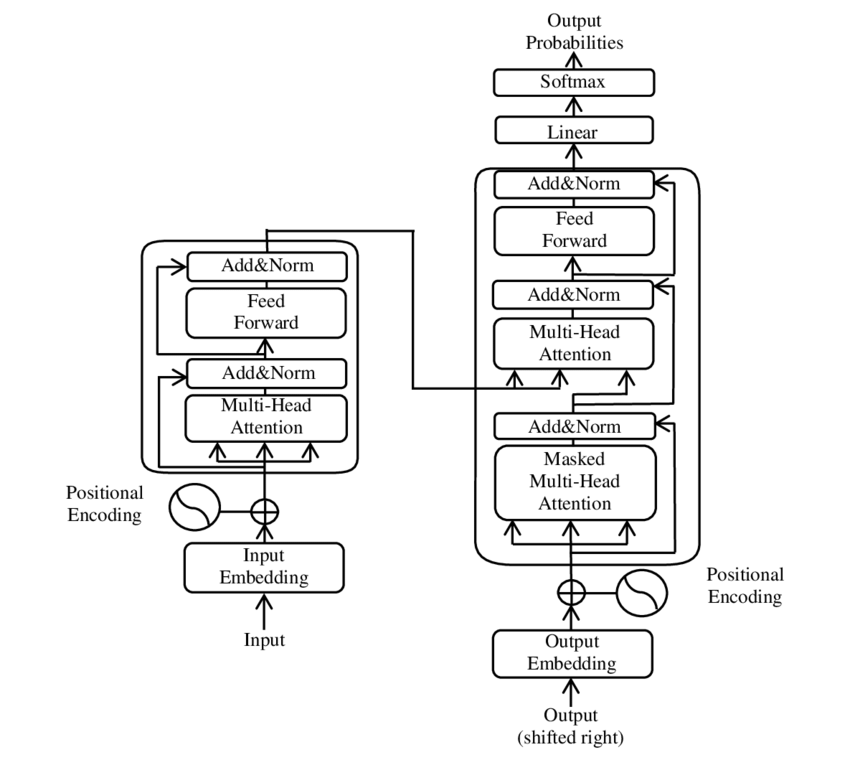
The Transformer follows an encoder-decoder structure, consisting of a stack of identical layers with multi-head attention and feed-forward components. The encoder converts the input into an attention-based representation, while the decoder generates the output using this representation.
- Encoder: Processes the input through multiple layers of self-attention and feed-forward networks. Each layer includes layer normalization and residual connections to stabilize training and allow the gradient to flow efficiently through deep networks.
- Decoder: Similar to the encoder but includes an additional attention mechanism that allows it to attend to the encoded representations while generating the output sequence. It uses masked attention to ensure that the prediction of each token in the sequence only considers the previous tokens, maintaining the autoregressive nature of the generation process.
Applications of Transformers
Transformers have found applications across a wide range of NLP tasks, demonstrating their versatility and efficiency.
Table 3: Applications of Transformer Models
| Application | Transformer Model | Description |
|---|---|---|
| Machine Translation | Transformer | Translates between languages |
| Text Summarization | BART | Summarizes long documents into shorter text |
| Question Answering | BERT | Retrieves answers based on context |
| Text Generation | GPT-3 | Generates human-like text based on input prompts |
Recent advancements also include Vision Transformers (ViTs), which apply the Transformer architecture to image recognition by treating image patches as tokens.
Understanding Transformers: The Backbone of Modern NLP
Introduction
Transformers have significantly transformed the field of Natural Language Processing (NLP). Originally introduced in the 2017 paper “Attention is All You Need” by Vaswani et al., Transformers replaced recurrent (RNN) and convolutional (CNN) architectures with an entirely attention-based system. This new architecture provided faster and more accurate results in tasks like machine translation, text summarization, and beyond.
Detailed Comparison of Modern Language Models
| Feature/Model | Transformers | BERT | ChatGPT | LLMs | Gemini | Claude 2 | DeepSeek |
|---|---|---|---|---|---|---|---|
| Architecture | Encoder-Decoder (Self-Attention) | Encoder (Bidirectional) | Decoder (Autoregressive) | Based on Transformer architecture | Transformer-based, multimodal | Transformer-based, multimodal | Mixture-of-Experts (MoE) with Multi-head Latent Attention (MLA) |
| Developed by | Vaswani et al. (2017) | Google (2018) | OpenAI | Various (OpenAI, Google, Meta, etc.) | Google DeepMind | Anthropic | DeepSeek, founded by Liang Wenfeng in 2023 |
| Core Functionality | General sequence modeling | Text understanding | Conversational AI, text generation | Wide-ranging language understanding | Multimodal (text, images, audio, video) | Text processing, reasoning, conversational AI | Advanced reasoning, coding, and mathematical problem-solving |
| Training Approach | Self-attention across sequences | Pretrained using Masked Language Model | Autoregressive: next token prediction | Pretrained on vast datasets | Multitask & multimodal learning | Emphasizes safety, alignment, and large context window | Pretrained on diverse datasets; employs reinforcement learning for reasoning capabilities |
| Contextual Handling | Full sequence attention | Bidirectional context | Autoregressive, token length limited | Few-shot/zero-shot capabilities | Up to 1M tokens context window | Up to 200K tokens context window | Supports context lengths up to 128K tokens |
| Strength | Versatile for diverse NLP tasks | Accurate context understanding | Conversational generation | General-purpose adaptability | Superior for real-time info and multimodal tasks | Strong text handling, safety-first | High efficiency and performance in reasoning and coding tasks; open-source accessibility |
| Weakness | Requires substantial data/compute power | Limited in text generation | Token length limits context memory | High computational costs | Occasional factual inaccuracies | Limited image processing, training biases | Potential censorship concerns; avoids topics sensitive to the Chinese government |
| Applications | Translation, summarization | Text classification, sentiment analysis | Chatbots, content generation | Translation, summarization, code | Cross-modal tasks (video, images, audio) | Customer service, legal documents | Mathematical reasoning, coding assistance, advanced problem-solving |
| Model Size | Varies (small to very large) | Medium to large | Large (e.g., GPT-4 Turbo) | Extremely large (GPT-4, LLaMA) | Nano, Pro, Ultra | Haiku, Sonnet, Opus (up to 1M tokens) | Models like DeepSeek-V3 with 671B total parameters, 37B activated per token |
| Pricing | Varies by implementation | Free (e.g., Hugging Face) | $20/month for GPT-4 | Varies (OpenAI, Google) | $19.99/month (Pro), more for Advanced | $20/month for Claude Pro | Open-source; free access to models like DeepSeek-V3 |
| Notable Feature | Foundation of modern NLP models | Strong contextual embeddings | Autoregressive text generation | Few-shot/zero-shot adaptability | Up-to-date web info, multimodal capabilities | Constitution-based ethics, long-form text coherence | Efficient training with lower computational costs; open-source under MIT license |
| Benchmark Performance | Suitable across NLP benchmarks | Excels in MMLU & classification | Effective in conversational tasks | Leads in multitask benchmarks (MMLU) | Strong in multimodal (DocVQA, TextVQA) | Excellent in coding benchmarks (HumanEval) | Outperforms models like Llama 3.1 and Qwen 2.5; matches GPT-4o and Claude 3.5 Sonnet in benchmarks |
| Explainability | Moderate | Clear, especially in embeddings | Limited for complex results | Varies by use case | Well-integrated with Google Docs | Constitution-driven ethics & transparency | Open-source code promotes transparency; potential concerns over content moderation |
Key Insights
– Gemini offers exceptional multimodal capabilities, including handling text, images, audio, and video, making it ideal for interdisciplinary and technical tasks like research and content creation. Integrated with Google’s ecosystem, Gemini provides seamless access to real-time information and excels in tasks requiring visual content analysis and up-to-date data.
– Claude 2 by Anthropic offers stronger language fluency, especially in long-form documents and complex analysis, supported by a 200,000 token context window. Prioritizing safety and alignment, Claude 2 is well-suited for tasks requiring extensive context understanding, focusing on ethical guidelines like adherence to Apple’s content standards.
– GPT-4 Turbo and ChatGPT excel in creative content generation, conversational AI, and ideation. While they are efficient for text generation, they sometimes struggle with memory retention in long conversations. They are excellent for dynamic applications like customer support and content creation.
– BERT is highly effective for understanding context, particularly in question-answering and text classification tasks. It excels in sentence-level understanding, making it perfect for tasks requiring accurate contextual embeddings.
Each model has its strengths for specific use cases. Whether you need multimodal processing (Gemini), safe long-context analysis (Claude 2), or high-quality conversational AI (ChatGPT/GT-4)**, each model shines in different areas. Depending on your requirements—be it **multimodal capabilities** like those found in **Gemini**, **long-context analysis** provided by **Claude 2**, or **conversational generation** that **ChatGPT** and **GPT-4** excel at—there is a model suited for your specific needs.
Conclusion
Transformer-based models have revolutionized Natural Language Processing (NLP), becoming the foundation for a wide array of applications. Models such as BERT, ChatGPT, Gemini, Claude 2, and the recent DeepSeek have been tailored to address specific needs, including text comprehension, conversational AI, and multimodal data processing.
The versatility and scalability of Transformer architectures have enabled them to excel in various tasks, from machine translation and sentiment analysis to code generation and cross-modal tasks. As the field advances, these models continue to evolve, incorporating larger datasets and more sophisticated training techniques, thereby enhancing their capabilities and performance.
Understanding the unique architectures, strengths, and limitations of each model is crucial for selecting the most appropriate one for specific tasks. For instance, while BERT offers strong contextual embeddings ideal for text classification, ChatGPT excels in generating human-like conversational responses. The emergence of models like DeepSeek highlights the rapid progress in the field, offering efficient training methods and open-source accessibility.
As Transformer-based models continue to mature, their impact on AI-driven applications is profound, paving the way for more advanced, efficient, and versatile solutions across various industries.