By Pegah Tafvizi · INGOAMPT
On November 24, 2026, Reuters published an original comparison of AI-managed Fantasy Premier League teams and human managers. Across the first eight gameweeks of the 2026–27 season, seven chatbot-directed teams averaged 499 points, three below the human average of 502. The leading 1,000 human managers averaged approximately 75 points more than the chatbot group.
For a builder, the finding highlights the difference between approaching typical human performance and replacing an expert. Changing a lineup at the right time and judging whether a player will actually play are different decision problems.
What was measured?
Fantasy Premier League is a competition in which participants select squads within a budget and score points based on real players’ performances. Managers choose their starting players, a captain whose points normally count double, and substitutes. Transfers let managers alter squads over the season.
Reuters analyzed nine teams, seven following chatbot recommendations. Scout Digital operated those teams using common weekly prompts, with staff implementing most selections. Its public experiment describes common league rules and allows model updates during the season. That makes the comparison relevant to real decision workflows, but it is not a fixed-version laboratory benchmark.
Close to average, still behind experts
| Group | Mean points over eight gameweeks | Interpretation |
|---|---|---|
| Seven chatbot-directed teams | 499 | Reported mean |
| Average human benchmark | 502 | Three points above chatbot mean |
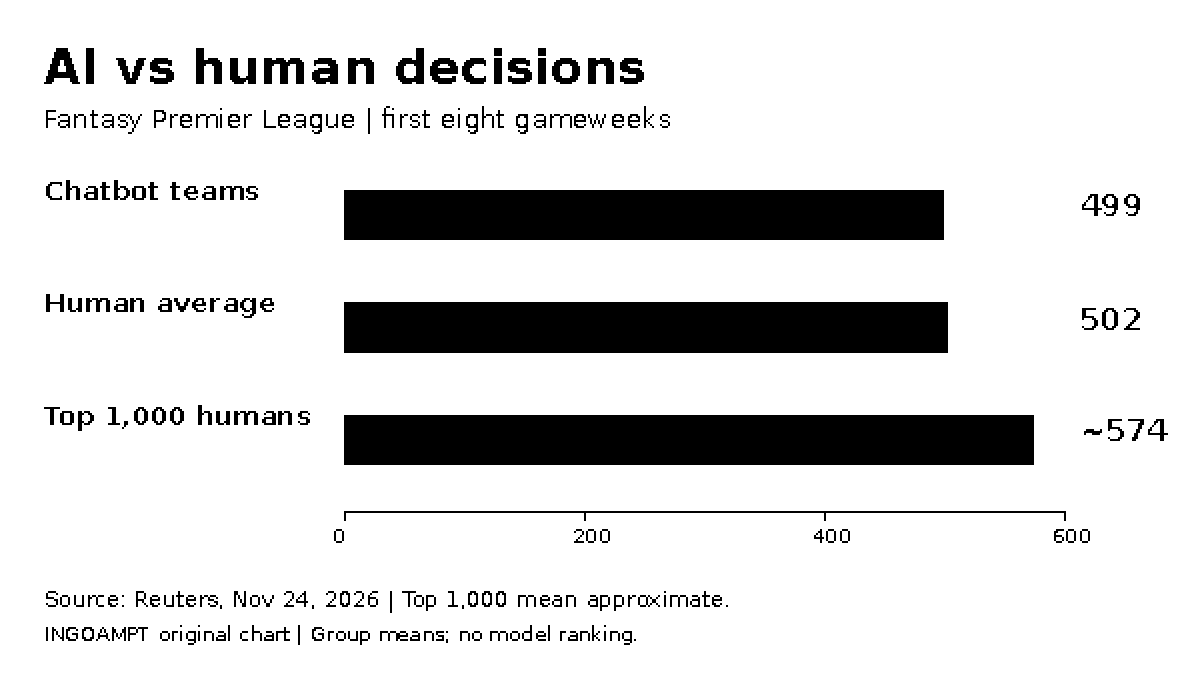
| Top 1,000 human managers | About 574 | Approximately 75 points above chatbot mean |
Original INGOAMPT comparison from Reuters’ reported figures. The approximate elite mean is calculated as 499 plus the reported approximate 75-point gap. No independent test or individual model ranking is implied.
The chatbot average was roughly 0.6% below the human benchmark (3 divided by 502), but approximately 13% below the estimated elite average (75 divided by 574). Group means hide variation among individual teams. These results do not establish statistical equivalence or the probability of outperforming a particular person.
Where the decision process matters
The report found that chatbot teams were relatively disciplined about transfers, yet their captain and bench choices were weaker than those of the strongest humans. Player availability is a difficult forecasting input because injuries, rest and coaching decisions may change shortly before a deadline.
For a developer building a recommendation system, that separates the optimization objective from the reliability of the facts used to optimize it. A lineup can satisfy every formal constraint and still be a poor choice. Fresh inputs, uncertainty estimates and a record of when a recommendation was generated matter independently of the model’s reasoning.
Real-world use and evaluation limits
A separate practitioner example illustrates that this is an active area of application. An FPL Analytics scorecard published November 5 reported that its hypothetical model-selected squad would have scored 50 points against a 45-point average in gameweek eight. Its authors explicitly said the picks were not published before the deadline. This demonstrates an evaluation workflow, not a prospective prediction result or a replication of the Reuters study.
Evaluation before results are known is stronger than reconstructing choices afterward. In any decision application, keep the original inputs and timestamped predictions so that later knowledge cannot leak into the test.
What can developers take away?
Compare a decision assistant with a simple baseline and an experienced operator using the same evaluation window. Distinguish the quality of recommendations from successful execution. Log the model version and available inputs, and evaluate high-consequence choices separately from routine ones. A small aggregate gap can conceal a consequential weakness.
INGOAMPT reviewed the new original reporting and documented practitioner examples. We did not operate the teams or independently reproduce their results. The news is the eight-gameweek analysis, not the launch of a new model. For more applied AI coverage, see INGOAMPT AI News.
Original INGOAMPT illustration: comparison of the three reported group means on a zero-based scale; the elite value is approximate.
Original reporting: Reuters, November 24, 2026, 09:01 UTC (04:01 Eastern). Background: Scout Digital’s public AI FPL experiment and FPL Analytics, November 5, 2026.