
By Pegah Tafvizi · INGOAMPT
On November 24, 2026, llama.cpp published prerelease b12669, adding two ways to specify the size of a compressed local AI model instead of selecting a fixed quantization preset. Developers can now ask the quantizer to aim for a particular GGUF file size or an average number of bits per weight. The practical distinction is important: a target file size can help plan distribution and storage, but it does not guarantee that a model will fit in a device’s available runtime memory.
What the quantizer changes
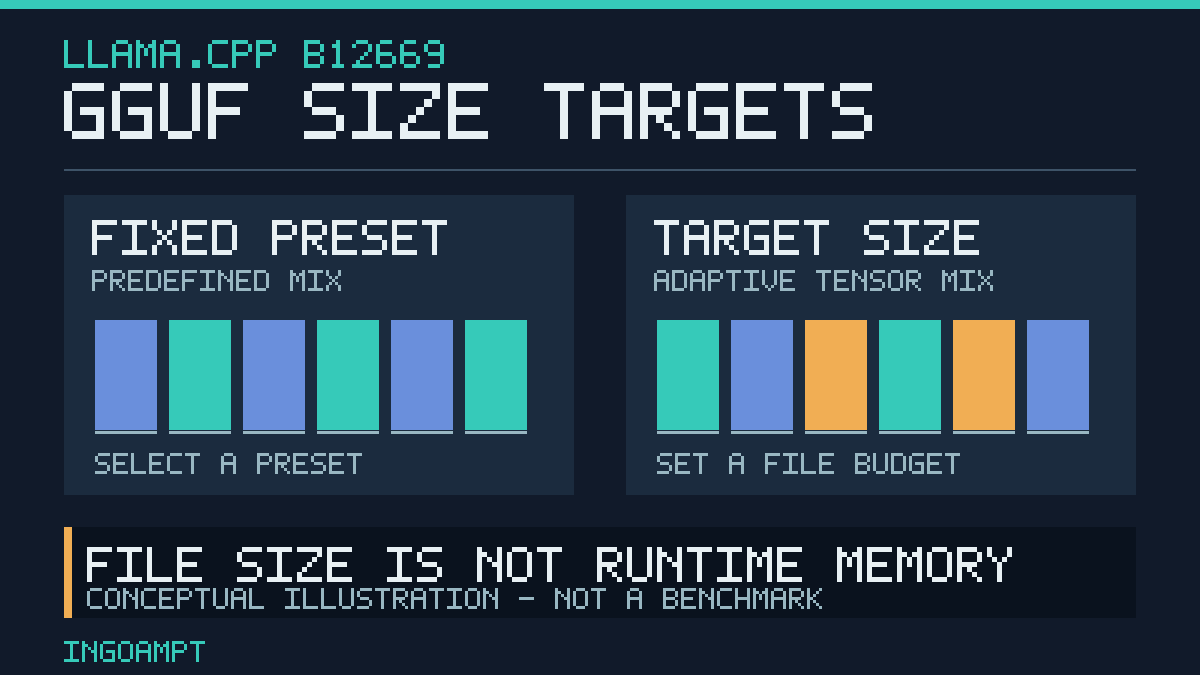
Quantization represents model weights at reduced precision to lower storage and memory requirements. Traditional presets apply a predefined mixture of formats. The new optimizer, described in pull request #15550, estimates how sensitive individual tensors are to compression and spends more of the available bit budget where the estimated error reduction is greatest.
The optimizer samples tensor rows, evaluates possible formats and removes less efficient choices. It then searches for a combination that stays near the overall budget. This is an estimate of weight error, not a direct optimization of your app’s answers. The source explicitly notes that errors can interact across layers.
Choose the budget that matches your constraint
| Option | What it controls | What it does not establish |
|---|---|---|
--target-size |
Approximate total output file size | Peak RAM or VRAM during inference |
--target-bpw |
Average bits per model weight | Identical answer quality across models |
| Fixed preset, such as Q4_K_M | Predefined quantization mix | Identical effective bit rate across architectures |
The new release-specific quantization guide includes this example, which aims for a 1.5 GiB output and saves the optimizer’s state:
./llama-quantize --target-size 1.5g --state-file my-state-file.dat --imatrix imatrix.gguf input-model-f32.gguf output-model.ggufThe input model, a compatible importance matrix containing activation statistics, and a build containing the new quantizer are prerequisites. The documentation also allows a fixed precision for selected tensors; those allocations count toward the budget and can leave too little room for the remaining weights. Resumable state helps avoid repeating the expensive scoring stage. The documented --target-exclude option prevents selected quantization formats from being chosen but disables saving a state checkpoint while it is active.
What the contributor actually measured
The pull request reports 238 model-and-quantization comparisons across 34 models, using KL divergence (KLD) as its comparison metric. KLD measures the difference between probability distributions; lower divergence here indicates closer agreement with the reference distribution under the reported evaluation. It does not establish that a particular user’s task accuracy improved.
| Contributor result | Comparisons |
|---|---|
| Win | 195 |
| Tie | 26 |
| Loss | 16 |
| Not applicable | 1 |
Wins and ties total 221 of the 238 listed comparisons (about 93%). The contributor also estimates that the first optimization can take five to ten times as long as standard quantization. These are project-reported comparisons, not independent INGOAMPT benchmarks. We checked the release, original code review and documented flags, and calculated the combined percentage; we did not run the quantizer or reproduce the tests.
Why file size and memory are different
A downloaded GGUF file is only one part of a running system. Context length, the key-value cache, compute buffers, multimodal components and the chosen backend can add memory requirements. A model sized to fill nearly all available RAM may still fail to load or run a long prompt. A target of 1.5 GiB is therefore a packaging choice, not a promise about peak memory.
For a developer distributing a local document assistant, the useful test is to compare the fixed preset and the target-size version on the same model, prompt set and device. Measure the resulting file size, peak memory, response quality and latency separately. Keep enough storage for the source weights and temporary files during conversion. The release’s separate Apple Silicon, Intel, Linux and Windows builds do not imply that every model can run on every device.
For additional context, see our local AI prompt-processing report, which separates an individual optimization from total runtime performance, and the AI News newsroom.
Availability and limits
b12669 is a public prerelease, not a new model or cloud service. No new API price or distribution entitlement was announced. Model licenses still govern redistribution, and the quantizer itself does not establish a privacy guarantee for every application built around it.
Original INGOAMPT illustration: conceptual comparison of fixed precision allocation and an adaptive tensor allocation under a file-size budget; not a benchmark or product screenshot.
Original sources: llama.cpp b12669, first published November 24, 2026 at 02:38:41 UTC; the original implementation and contributor evaluation; release-specific quantizer documentation.