By Pegah Tafvizi · INGOAMPT November 23, 2026
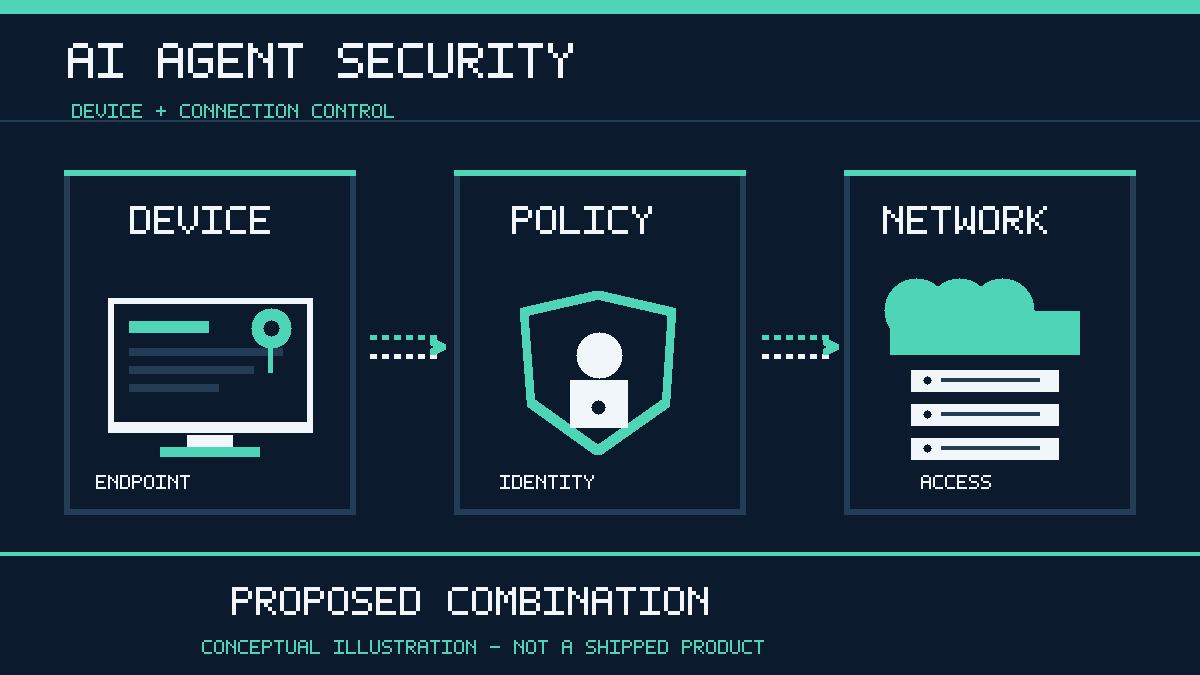
On November 23, CrowdStrike and Zscaler announced an agreement for CrowdStrike to acquire Zscaler in an all-stock transaction valued at approximately $43.9 billion. Their ambition is to bring endpoint security—the controls on a device or workload—closer to zero-trust access, which evaluates connections to applications and data. That distinction matters to anyone deploying AI agents: an agent can run inside an approved environment and still attempt a connection that the organization should not permit. But the companies have announced a future combination, not launched a finished unified AI-agent security product today.
The original company announcement describes CrowdStrike’s Falcon sensors as the endpoint control and Zscaler’s Zero Trust Exchange as the connection control. It says the companies expect to combine those capabilities after the transaction closes, subject to necessary approvals. The reported target is the second half of CrowdStrike’s fiscal 2028. A developer choosing security controls this week still has to evaluate the products and contracts actually available now.
Why an AI agent needs more than one kind of permission
Traditional business applications generally perform predefined actions. An AI agent may choose tools, read context, call a service and make another decision based on what came back. That flexibility makes authorization at each action and network boundary important even when the agent itself runs on an approved machine.
For example, a support agent might need to read a customer’s ticket but not download an entire customer database. Device security asks whether the machine or workload running the agent is trusted. Network and application access controls ask whether this particular agent, using this identity, may make this request to this destination. Neither check automatically answers every question the other addresses.
SecurityWeek’s independent November 23 report describes the existing relationship: more than 2,000 shared customers and 16 integrations already connect the companies’ offerings. Those current integrations should not be confused with the post-acquisition platform described in the announcement.
What the announcement changes—and what it does not
| Question | Verified position on November 23 | What remains to verify |
|---|---|---|
| Has the deal closed? | No. The companies announced a definitive agreement for approximately $43.9 billion in stock. | Shareholder and regulatory approvals and actual closing. |
| Do the companies already work together? | Yes. The companies report more than 2,000 shared customers and 16 existing integrations. | Which integration works under a customer’s actual subscription and deployment. |
| Is unified endpoint and zero-trust policy live? | The companies describe a plan to converge these data and policy layers after closing. | A released product, supported policy behavior, availability and independent testing. |
| Does the transaction make AI agents safe by itself? | No such technical guarantee follows from an acquisition announcement. | Specific tool permissions, identity checks, session revocation, logging and independent security evaluation. |
| Are developer API prices or free quotas changing today? | The press release does not establish a new public AI-agent API price or free tier. | A dated product announcement and actual terms, if one arrives. |
The proposed exchange ratio is 1.135 CrowdStrike shares for each Zscaler share. That number describes the purchase terms for shareholders; it is not the cost of an AI-agent security service. Likewise, the combined annual-recurring-revenue forecast is a financial projection rather than evidence that a security control has been validated in production.
A useful test: what happens to an already-open agent session?
A concrete technical question emerged in a same-day LinkedIn discussion by Cyber Security News. One reader asked what happens to an already-open application session when the endpoint falls out of compliance. That is more precise than asking whether a platform supports “zero trust.”
A practitioner can turn that question into an acceptance test for existing systems—not a claim about this proposed merger. Start an authorized session on a test device, then deliberately change a policy condition such as device compliance. Observe whether the session remains active, whether a new request is blocked, how long revocation takes, and which event the audit trail records. Separately test whether the agent’s tool credentials can access a destination that the human operator could not. Run only in an environment where those controls and changes are authorized.
The company announcement does not provide results for these tests, and INGOAMPT did not perform an independent Falcon or Zscaler benchmark. The comparison clarifies what buyers and builders should ask of any security platform before granting an agent production access.
What individual developers should do today
For a solo developer, the immediate takeaway is not to buy two enterprise platforms because a merger was announced. It is to identify the boundaries of the agent being shipped: what data it may read, what external systems it may call, what requires approval, and how an administrator can revoke access during an active run.
When evaluating a vendor, ask for documentation of endpoint posture, identity-aware network access, session termination, audit events, availability, and prices for the exact workload. Product names and platform diagrams are not a substitute for a demonstrated control. Smaller projects can start with scoped tool permissions, separate identities, constrained outbound access and human approval for consequential actions before evaluating larger commercial integrations.
Original announcement: November 23, 2026 · CrowdStrike and Zscaler. The original press release describes the transaction and planned platform. SecurityWeek’s original reporting provides separate business and technical context. The same-day public LinkedIn discussion provides a specific professional question, not proof of technical performance or widespread reach.