By Pegah Tafvizi · INGOAMPT
Orders associated with artificial-intelligence data centers helped British factories increase output in November, even as growth across the wider UK private sector slowed. Reuters reported the newly released figures on November 23, 2026. The useful takeaway for software builders is a distinction: rising orders for physical AI infrastructure do not, by themselves, establish cheaper or more available computing capacity.
The original Reuters report appeared at 09:34 UTC on November 23. A separate Guardian report on the survey was published at 09:43 GMT that morning. S&P Global scheduled the November UK flash purchasing managers’ survey for 09:30 GMT. The survey describes companies’ November conditions; it does not imply all data-center projects began on November 23.
What the November PMI figures show
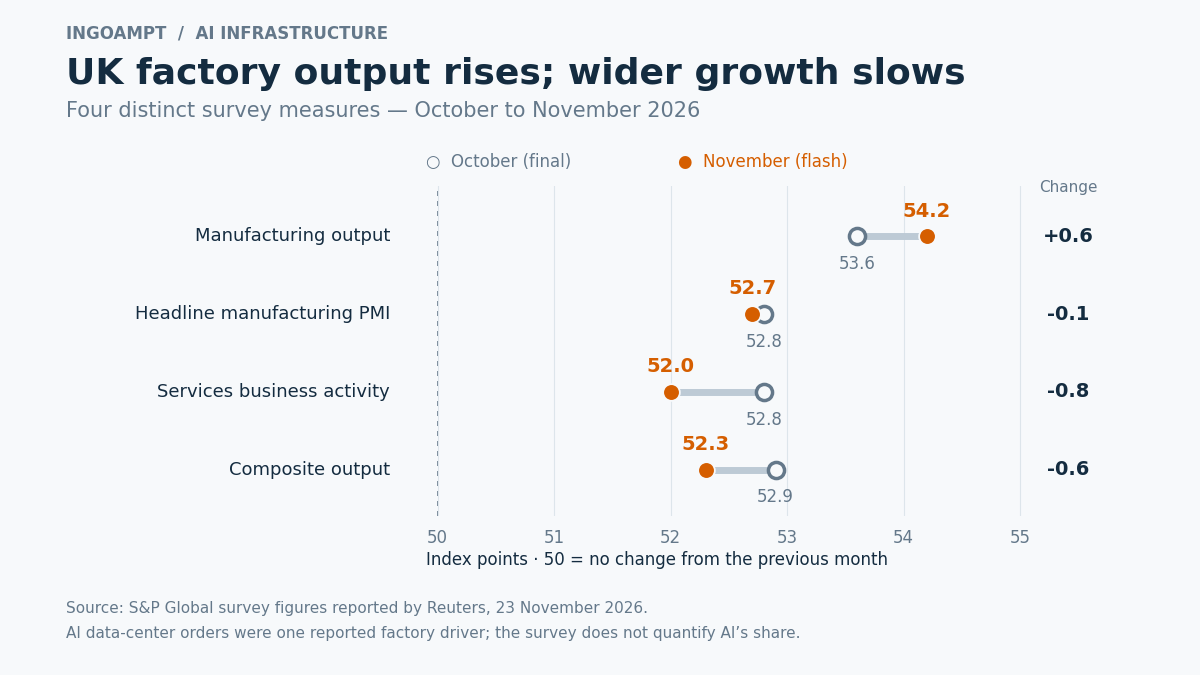
Manufacturing output rose from 53.6 in October to 54.2 in November, its strongest reading in more than two years. But the wider headline manufacturing index edged down from 52.8 to 52.7. Services activity fell from 52.8 to 52.0, and the combined private-sector output measure declined from 52.9 to 52.3.
These four figures are not interchangeable. A purchasing managers’ index measures reported change from the previous month. Readings above 50 generally signify expansion; a decrease from 52.9 to 52.3 means growth has slowed, not that output is necessarily shrinking. The factory-output reading concentrates on production while the composite covers manufacturing and services together.
Why AI data centers matter to factories
Some manufacturers told S&P Global they had received more orders associated with data-center construction. That is a concrete signal of demand for supplied equipment and materials. The reporting also cited defense and food-and-drink orders as contributors to the factory rebound. It would therefore be wrong to credit the entire manufacturing gain to AI.
The survey does not quantify the share of output attributable to AI data centers, the components purchased, how much of the investment will become working model-serving capacity, or which customers originated the orders. An infrastructure order is not a new GPU rental price, an available cloud region, or a product launch.
Implications for solo developers
Someone choosing between running a local model and paying for a hosted inference service should treat the findings as evidence of longer-term investment rather than a change to today’s deployment economics. A verified decision still requires checking a provider’s actual machine availability, geographic location, measured workload performance and price per token or hour.
For example, a founder who requires UK data residency might monitor future data-center commissioning and cloud availability updates. The November survey alone gives no opening date, capacity entitlement, API tariff or data-processing commitment, so it is not a basis for changing a production architecture now.
The wider economic picture is mixed
Reuters also found softer services export demand, hiring pressure and elevated business costs. The Guardian independently highlighted the contrast between the AI-linked manufacturing uplift and weaker overall private-sector growth. Technology investment can boost certain suppliers even when customers elsewhere in the economy remain cautious.
Our original comparison separates the four PMI measures so readers do not confuse stronger factory production with a broad-based AI economic boom. For another source-linked example of why investment value and physical shipment volumes tell different stories, see our analysis of Japan’s chipmaking equipment exports.
Original reporting: Reuters, November 23, 2026. Independent reporting: The Guardian, November 23, 2026, 09:43 GMT update. Original survey release timing: S&P Global calendar. INGOAMPT compared the reported figures and limitations; it did not run the survey or test cloud prices.