INGOAMPT AI News · Original developer analysis published Saturday, 7 November 2026 · Vienna (CET/UTC+1). The source’s publication and event dates are distinguished below. Illustrations are original editorial artwork rather than documentary photographs.
In brief: Across 15 environmental groups interviewed by Reuters, AI is helping with wildfire warnings, wildlife counts and historical research—while organizations weigh the electricity and water impact of the computing they use.
What was reported on 7 November
Reuters interviewed 15 environmental and conservation organizations, all of which said they use some form of AI and worry about the environmental cost of the infrastructure behind it. Conservation International uses satellite hotspot data to alert patrol teams in Cambodia to forest-fire risks. The Jane Goodall Institute is using AI to digitize and translate decades of complex field notes; its estimated processing time has fallen from 13–15 years to roughly two. Those estimates are from the organizations and reflect their own workloads.
The wildlife data insight
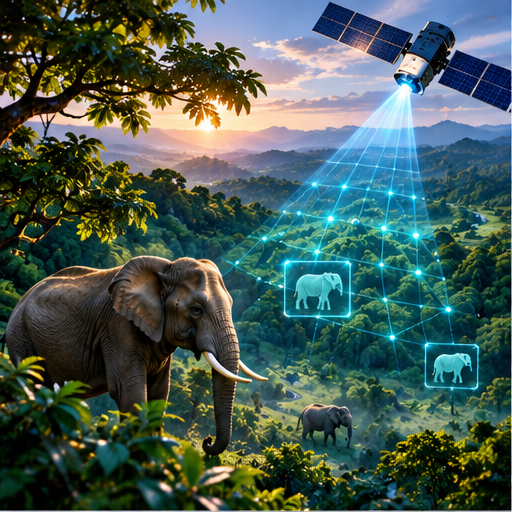
Save the Elephants described how AI-assisted aerial image analysis can process surveys that previously took months of manual work. According to the group, automated analysis found animals human observers had missed. That illustrates the value of specialized vision models with a human validation loop: more accurate data can improve decisions, but evaluation against trustworthy ground truth is essential.
The environmental trade-off
The International Energy Agency projects significant growth in electricity and water consumption associated with data centers by 2030. These are forecasts, not bills for one particular inference request. The World Resources Institute said it limits resource-intensive video/image generation and caches repeated queries; the Nature Conservancy uses edge cameras on fishing boats to avoid transferring unnecessary video to centralized servers.
A usable developer exercise
Try a cost-aware workflow for your AI app. Collect 30 representative requests. Compare a lightweight model and larger model on task completion rate, repeated-query cache hit rate, network payload and latency. Add a human review requirement for high-stakes classifications, and avoid claiming an exact carbon footprint unless you have measured the relevant electricity and infrastructure.
How this affects a solo SaaS
A useful product may come from reducing a well-defined labor bottleneck rather than deploying the biggest general-purpose model. Think wildlife image triage, document structuring or privacy-preserving local processing. Ask customers for a pilot outcome first, then decide whether model/API costs can support profitable recurring pricing.
Sources, limitations and further reading
- Original reporting
- The International Energy Agency — Energy and AI
- INGOAMPT — AI platform comparison
INGOAMPT’s recommendations and test exercises are independent editorial analysis, not claims by the cited publishers. Product demonstrations, company statements and reported financing are attributed rather than treated as independently proven. This article is educational, not investment or legal advice.