
AI Agents and MCP in 2026: What They Are, How to Build Them, and Where the Real Opportunity Is
An AI agent is not just a chatbot. It is software that can understand a goal, plan steps, call tools, use memory, check results, and continue working until a task is finished. In 2026, AI agents are becoming the new layer between people and software: they can write code, search the web, manage CRM tasks, analyze documents, support marketing, and connect to business systems through protocols such as MCP — Model Context Protocol.
1. What Is an AI Agent?
An AI agent is an application that can do multi-step work with some degree of autonomy. OpenAI’s agent documentation describes agents as applications that plan, call tools, collaborate across specialists, and keep enough state to complete multi-step work.[2] In simple language, an AI agent is an AI system that does not only answer one question; it can keep working toward a goal.
Usually answers one message at a time. It may not remember long tasks, use tools, or check whether a goal is complete.
Runs fixed rules: “if this happens, do that.” It is useful, but it usually cannot reason about new situations.
Receives a goal, creates a plan, calls tools, observes results, repairs mistakes, and continues until done.
2. What Is MCP and How Is It Connected to AI Agents?
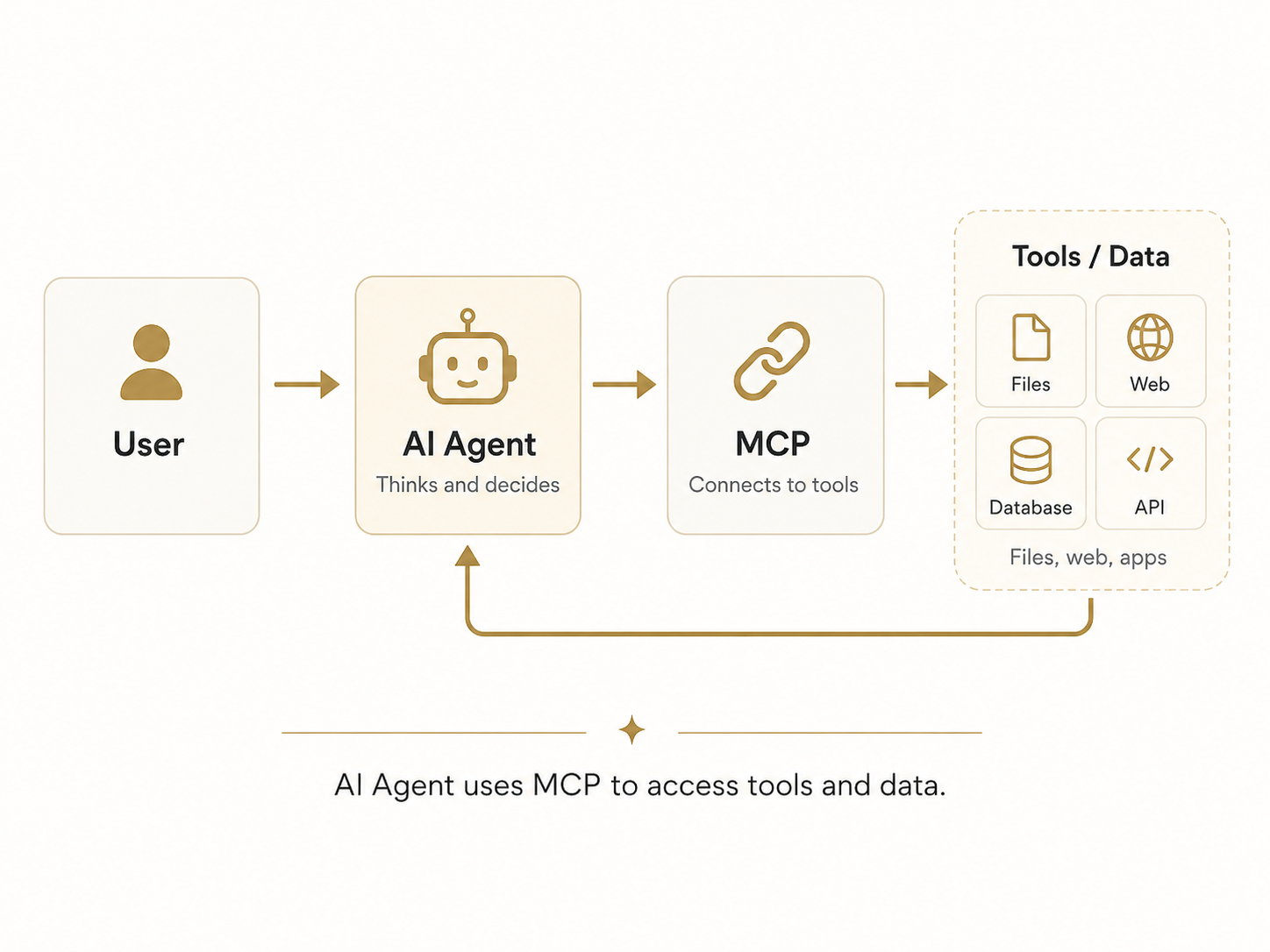
MCP means Model Context Protocol. The official MCP documentation defines it as an open-source standard for connecting AI applications to external systems. It lets AI applications connect to data sources such as local files and databases, tools such as search engines and calculators, and workflows such as specialized prompts.[1]
The best beginner explanation is this: MCP is like a USB-C port for AI applications. Instead of creating a different custom connection for every AI model and every tool, developers can expose tools through an MCP server, and many AI clients can connect to it.
| Question | Simple Answer | Developer Meaning |
|---|---|---|
| Is MCP an AI model? | No. | MCP is a protocol/interface, not a neural network. |
| Is MCP an AI agent? | No, but it helps agents. | An agent uses MCP to discover and call tools. |
| Does MCP need GPU? | Usually no. | The MCP server itself is mostly I/O, schemas, permissions and tool routing. The tools behind it may need GPU. |
| Why is MCP important? | It reduces custom integrations. | You can build one MCP server and connect it to multiple AI clients that support MCP. |
3. The Important Parts Needed to Build an AI Agent
A useful agent is not only “an LLM with a prompt.” A production AI agent needs architecture. It needs a model, tools, memory, planning, permissions, logging and evaluation. Recent agent research surveys describe AI agent systems as combining foundation models with reasoning, planning, memory and tool use.[5]
| Component | What It Does | Example | Why It Matters |
|---|---|---|---|
| Model / Reasoning Core | Understands goals, writes plans and chooses next actions. | GPT, Claude, Gemini, Llama, Mistral, Qwen. | This is the “brain” of the agent. |
| Tools | Let the agent act outside the chat window. | Search, calendar, email, database, file system, code runner, CRM. | Without tools, the agent can talk but cannot do much. |
| MCP / Tool Protocol | Standardizes how tools are exposed to the agent. | MCP server for Google Drive, Slack, GitHub, Postgres, Stripe. | Reduces integration cost and makes tools reusable. |
| Memory | Stores user preferences, task state, past actions and retrieved knowledge. | Vector database, SQL database, Redis, files, long context. | Allows continuity and personalization. |
| Planner | Breaks a large goal into smaller steps. | “Find leads → qualify leads → write email → update CRM.” | Turns vague goals into executable work. |
| Guardrails | Limits unsafe, expensive or wrong actions. | Human approval before sending emails or deleting files. | Prevents damage and builds trust. |
| Evaluation | Measures if the agent succeeds. | Task success rate, tool error rate, hallucination rate, cost per task. | Without evaluation, you cannot improve the agent scientifically. |
| Observability | Records traces, logs and tool calls. | Trace view: prompt → plan → tool call → result → final answer. | Needed for debugging and production safety. |
A tiny developer-style AI agent loop
This is not production code, but it shows the basic idea:
goal = "Find 20 potential customers for my German flashcard iOS app"

memory = load_memory(user_id)
tools = [web_search, keyword_planner, email_draft, crm_update]

while not task_is_complete(goal, memory):
    context = collect_relevant_context(goal, memory)
    plan = llm.create_plan(goal, context, available_tools=tools)
    action = choose_next_safe_action(plan)

    if action.is_risky:
        ask_human_approval(action)

    result = run_tool(action.tool, action.arguments)
    memory.save(action, result)

final_report = llm.summarize_results(goal, memory)
return final_report4. Famous AI Agents and Platforms in 2026
There is no single official ranking of “most famous AI agents,” because the market changes quickly. A practical 2026 view is to group agents by use case: general assistants, coding agents, enterprise agents, workflow agents and research agents.
| Category | Examples in 2026 | Main Use | Why Developers Care |
|---|---|---|---|
| General AI assistants | ChatGPT, Claude, Gemini, Perplexity | Research, writing, reasoning, documents, web answers. | They are the front door to agentic workflows for many users. |
| Coding agents | GitHub Copilot, Codex, Claude Code, Cursor, Devin, OpenHands | Code generation, debugging, refactoring, tests, pull requests. | They show where agentic AI is already commercially valuable. |
| Enterprise agents | Microsoft Copilot, Salesforce Agentforce, ServiceNow agents | CRM, IT service, office automation, internal data tasks. | They connect agents to enterprise data and workflows. |
| Automation platforms | Zapier AI, Make, n8n, LangGraph-style custom agents | Automating repetitive software workflows. | Good for startup prototypes and MVPs. |
| Research / deep research agents | Deep research tools, browser agents, scientific literature agents | Long research tasks, document synthesis, report generation. | Important for knowledge work and PhD/research tools. |
| Voice and customer agents | Voice agents, support bots, sales qualification agents | Calls, customer support, lead qualification, follow-up. | Direct commercial path for B2B and B2C products. |
The most important lesson: “AI agent” is not one product. It is a design pattern. A developer can build an agent for job applications, marketing, scientific papers, therapy support, customer support, data analysis, code repair, or almost any multi-step digital workflow.
5. Is an AI Agent More Useful Than Robotics?
AI agents and robotics solve different problems. A good rule is: AI agents automate digital work; robots automate physical work. McKinsey describes a similar distinction between nonphysical work handled by agents and physical work handled by robots.[8]
| Comparison | AI Agent | Robot |
|---|---|---|
| World | Software, data, websites, apps, documents, APIs. | Physical world: factories, hospitals, homes, streets. |
| Main action | Click, write, search, call API, analyze, decide. | Move, grasp, carry, inspect, clean, assemble. |
| Cost to start | Low to medium. A developer can build with APIs and cloud tools. | High. Requires hardware, sensors, motors, safety testing. |
| Best startup path | Faster MVP: marketing agent, job agent, support agent, research agent. | Longer path: logistics robot, medical robot, manufacturing robot. |
| Risk | Data privacy, wrong actions, hallucination, security. | Physical injury, hardware failure, regulation, liability. |
| Which is “more useful”? | More useful for most software startups because it is cheaper and faster to deploy. | More useful when the problem needs physical action. |
6. Can AI Agents Help Marketing and Grow a Startup With Zero Customers?
Yes — but not magically. An AI agent cannot create product-market fit from nothing. It can, however, make a small startup behave like a larger team by doing repetitive research, SEO, content planning, lead discovery, follow-up, support and analytics.
| Marketing Agent Type | What It Can Do | Good Startup Use | Human Approval Needed? |
|---|---|---|---|
| SEO research agent | Find keywords, competitors, search intent, article outlines. | Build organic traffic for a new website. | Before publishing final pages. |
| Content repurposing agent | Turn one article into LinkedIn posts, newsletters, FAQs and short landing-page copy. | Save time without making videos. | Before posting under a brand name. |
| Lead discovery agent | Find people or companies likely to need the product. | Useful when the startup has no customers yet. | Yes, especially before outreach. |
| Email/outreach agent | Draft personalized emails or LinkedIn messages. | Test demand without expensive ads. | Always before sending at first. |
| Analytics agent | Read Search Console, App Store analytics, ad data and website traffic. | Find why views do not become sales. | No for analysis; yes for budget changes. |
| Customer support agent | Answer common questions and collect feature requests. | Support first users without hiring staff. | For refunds, legal, medical or sensitive topics. |
7. Does GPU Help AI Agents or MCP?
The answer depends on which part of the system you mean:
| Part | Does GPU Help? | Why | Beginner Recommendation |
|---|---|---|---|
| MCP protocol server | Usually no. | MCP mostly handles tool schemas, requests, permissions and routing. | CPU + RAM + secure networking are enough for many MCP servers. |
| LLM inference | Yes, strongly. | Running local models is matrix computation; GPUs are designed for this. | Use cloud API first; buy GPU when you need local/private/high-volume inference. |
| Embeddings / vector search | Sometimes. | GPU helps when embedding many documents or serving high traffic. | CPU is fine for small projects; GPU helps at scale. |
| Image/video generation tools | Yes. | Diffusion and generative video models are GPU-heavy. | NVIDIA GPU or cloud GPU is useful. |
| Agent planning loop | Indirectly. | The loop needs model calls, memory, tool latency and orchestration. | Fast CPU, enough RAM, good SSD and reliable APIs matter a lot. |
Practical hardware importance for AI agent developers
The chart below is a practical developer heuristic, not a universal benchmark. The best hardware depends on whether you use cloud models, local LLMs, video generation, robotics, or production serving.
8. New NVIDIA AI Laptops vs New MacBooks for Building AI Agents
For AI agent development, the best laptop depends on your workflow. If you mostly use cloud APIs and build web apps, you do not need the most expensive GPU laptop. If you run local LLMs, embeddings, computer vision or image generation, GPU and memory become more important.
| Developer Profile | Best Direction | Why | Suggested Specs |
|---|---|---|---|
| Beginner building API-based agents | MacBook Air/Pro or Windows laptop with strong RAM | Most model work happens through APIs; local GPU is not required. | 32GB RAM preferred, 1TB SSD, good battery. |
| iOS + web + AI agent developer | MacBook Pro M4 Pro / M4 Max | Best for Xcode, iOS apps, web development and local model experiments. | 64GB+ unified memory if budget allows. |
| Local LLM / CUDA / vision developer | NVIDIA RTX laptop or workstation | CUDA ecosystem is strong for PyTorch, inference servers and ML tooling. | RTX 4080/4090/5080/5090-class or RTX Pro; 64GB RAM; 2TB SSD. |
| Researcher running larger local models | MacBook Pro M4 Max 128GB or desktop/cloud GPU | Apple’s unified memory can be useful for large models; NVIDIA is better for CUDA speed. | 128GB unified memory on Mac or 24GB+ VRAM NVIDIA GPU. |
| Production startup | Laptop + cloud GPU/server | Laptop is for development; production needs scalable, monitored infrastructure. | Use managed APIs first, then add GPU servers when cost/latency requires it. |
Apple says the M4 Max supports up to 128GB unified memory and up to 546GB/s memory bandwidth, and says this allows developers to interact with large language models with nearly 200 billion parameters.[3] That makes a high-memory MacBook Pro attractive for developers who want a quiet, portable local AI workstation.
On the NVIDIA side, 2026 reporting around RTX Spark described a new AI-focused laptop/PC platform with a Blackwell GPU, 128GB LPDDR5X memory and a focus on agentic AI computing.[4] NVIDIA laptops are especially attractive when you need CUDA, PyTorch acceleration, local inference servers, image generation, robotics simulation or GPU-heavy research.
9. If You Want a PhD in AI Agents, What Should You Study?
The closest academic areas are multi-agent systems, LLM agents, automated planning, reinforcement learning, tool use, human-AI interaction, AI safety, and evaluation of agentic systems. A good PhD topic should not be “build an agent” only. It should ask a research question that can produce papers.
| PhD Focus | Research Question | Possible Paper Direction | Commercial Potential |
|---|---|---|---|
| Reliable tool-using agents | How can agents call tools correctly under uncertainty? | Benchmarks for tool choice, error recovery and safe API use. | Enterprise automation, CRM, finance, legal, healthcare. |
| MCP security and permissions | How can MCP agents avoid prompt injection, data leakage and unsafe tools? | Formal threat models, policy engines, sandboxing, auditing tools. | Security product for companies using MCP. |
| Agent memory | What should an agent remember, forget and verify? | Personalized memory with privacy, retrieval and evaluation. | Personal assistants, education agents, healthcare support. |
| Multi-agent coordination | When should many agents collaborate, debate or specialize? | Coordinator architectures, role assignment, communication protocols. | Software teams, research teams, customer support teams. |
| Agent evaluation | How do we measure long-horizon task success? | New benchmarks for real tasks, cost, failure modes, reproducibility. | Agent testing platforms and observability tools. |
| Human-in-the-loop agents | When should the agent stop and ask a human? | Approval policies, risk scoring, user trust, interface design. | Medical, legal, sales, finance, regulated industries. |
| AI agents for job search | Can an agent match CVs to jobs, personalize applications and respect user consent? | Job matching, explainable ranking, fairness, autonomous application workflows. | Job-hunter SaaS platform with user-approved applications. |
| AI agents for scientific research | Can agents extract evidence from papers without hallucination? | Citation-grounded literature synthesis and structured evidence extraction. | Research assistant tools for PhD students and labs. |
Best “expert path” for a serious AI agent PhD
- Foundation: machine learning, deep learning, probability, algorithms, databases and distributed systems.
- Agent theory: planning, multi-agent systems, reinforcement learning, decision-making under uncertainty.
- LLM engineering: prompting, function calling, tool use, RAG, memory, long context, evaluation.
- Infrastructure: APIs, MCP, containers, sandboxing, authentication, observability, cloud deployment.
- Safety: prompt injection, permission models, human approval, red teaming, privacy.
- Domain focus: choose one application area such as job search, marketing, healthcare, education, coding or science.
12. FAQ
Is an AI agent the same as ChatGPT?
No. ChatGPT can be used inside agentic workflows, but an AI agent usually includes planning, tools, memory, state and evaluation around the model.
Is MCP required to build an AI agent?
No. You can build agents with direct APIs. MCP becomes useful when you want reusable, standardized tool connections across many clients and systems.
Does MCP need a GPU?
Usually no. MCP itself is a protocol layer. GPU is useful for the model or heavy tools behind the MCP server, such as local LLM inference, embeddings or image generation.
Can AI agents help marketing?
Yes. AI agents can support keyword research, competitor analysis, content planning, lead discovery, CRM updates, outreach drafts and analytics. Human review is still important before public posting or sending messages.
Can an AI agent cure autism?
No current AI agent can cure autism. AI can support screening, communication practice, caregiver education and research, but clinical decisions must remain with qualified professionals.
What should I study for a PhD in AI agents?
Study machine learning, multi-agent systems, automated planning, reinforcement learning, LLM tool use, memory, safety, evaluation and human-AI interaction. Then choose one real domain such as healthcare, job search, marketing, software engineering or scientific research.
Conclusion: Where the Real Opportunity Is
AI agents are useful because they connect language to action. MCP is important because it gives agents a standard way to connect to tools and data. GPU matters when you run local models or heavy AI tools, but many useful agents can be built first with APIs, good product thinking, strong data, secure tool design and careful evaluation.
For developers and founders, the best opportunity in 2026 is not simply “make a chatbot.” The stronger opportunity is to build narrow, useful, measurable AI agents for expensive repeated work: job applications, scientific research, customer support, SEO diagnosis, sales qualification, healthcare administration, app marketing, code repair and business operations.
References
- Model Context Protocol Documentation. “What is the Model Context Protocol (MCP)?” Explains MCP as an open-source standard for connecting AI applications to external systems and describes MCP as a USB-C-like standard for AI applications. Source
- OpenAI Developers. “Agents SDK.” Defines agents as applications that plan, call tools, collaborate across specialists and keep enough state to complete multi-step work. Source
- Apple Newsroom. “Apple introduces M4 Pro and M4 Max.” Includes official details on M4 Pro/Max unified memory, bandwidth and AI workloads. Source
- Tom’s Hardware. “Nvidia unveils RTX Spark Superchip for laptops and desktop PCs at Computex 2026.” Reports the 2026 RTX Spark platform focus on agentic AI PCs. Source
- Xu, Bin. “AI Agent Systems: Architectures, Applications, and Evaluation.” arXiv, 2026. Survey of agent architecture, planning, tool use, memory and evaluation challenges. Source
- Radosevich, Brandon and Halloran, John. “MCP Safety Audit: LLMs with the Model Context Protocol Allow Major Security Exploits.” arXiv, 2025. Discusses security risks in MCP-enabled agent workflows. Source
- Sohn, J. et al. “Implementation of generative AI for the assessment and treatment of autism spectrum disorders: a scoping review.” Frontiers in Psychiatry, 2025. Reviews GenAI opportunities and limitations for ASD care. Source
- McKinsey Global Institute. “AI: Work partnerships between people, agents, and robots.” Discusses the distinction between software agents and robots for nonphysical and physical work. Source
- Guo, Taicheng et al. “Large Language Model based Multi-Agents: A Survey of Progress and Challenges.” arXiv, 2024. Survey of LLM-based multi-agent systems, coordination and open challenges. Source
- OpenHands Software Agent SDK paper. “A Composable and Extensible Foundation for Production Agents.” arXiv, 2025. Discusses production software agents, sandboxed execution, lifecycle control and security. Source




Excellent overview. MCP is becoming an important bridge between AI agents and real-world tools, making agent development more practical and scalable.https://cal.com/farrukhhafeez?redirect=false
True I like mcp personally as we