INGOAMPT · Research Engineering
Broken Citations: How Wrong References Spread Through arXiv, and How Machines Catch Them
A technical field guide to bibliographic errors, LLM citation hallucination, and the matching algorithms that repair them — written for researchers and developers who have to build the checker, not just complain about the problem.
The short version
- Broken references are not new. Studies across medicine, science, and history put bibliographic error rates at roughly 11–41% of references, and content (“quotation”) error rates around 15–25%.
- Most citations are copied, not read. By modelling repeated identical typos, Simkin & Roychowdhury estimated only about 20% of citing authors read the original. Errors therefore propagate like a virus.
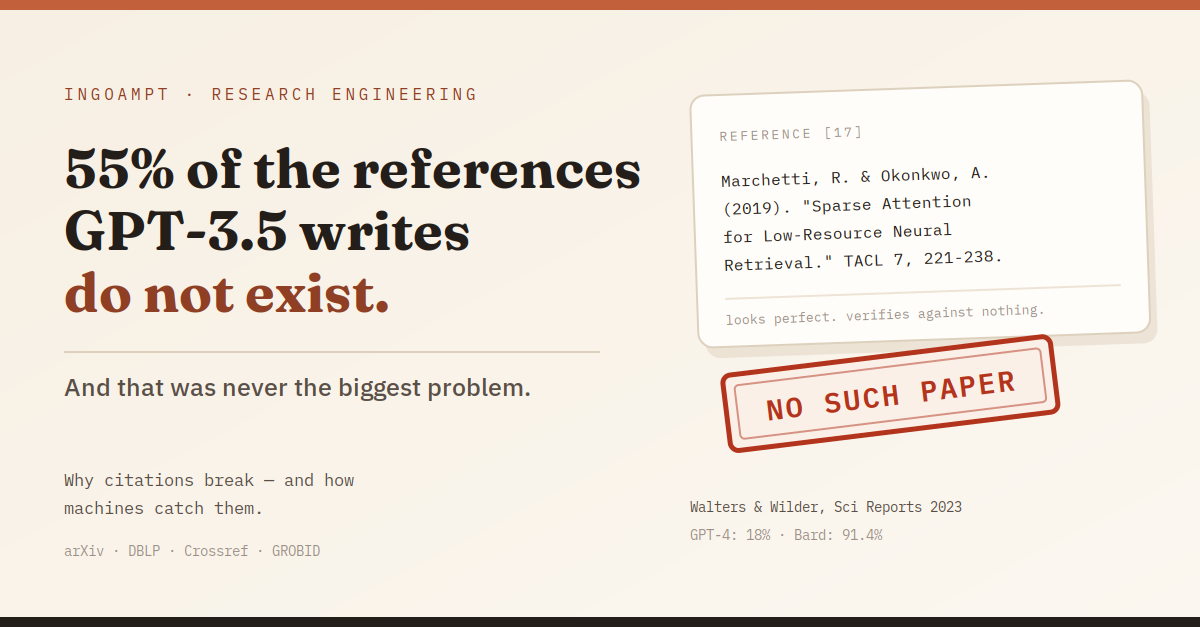
- LLMs made it dramatically worse. Measured fabrication rates run from 18% (GPT-4) to 55% (GPT-3.5) to 91.4% (Bard) depending on study and model.
- arXiv does not check your references. It distributes and moderates; reference extraction and linking happen downstream at INSPIRE-HEP, NASA ADS, and Semantic Scholar.
- The fix is architectural, not prompt engineering. Retrieve, don’t generate: let the model search, but fetch the final BibTeX record straight from the database. One such system reports 82.7% perfect matches vs 28.2% for web search, with zero metadata corruption.
Every researcher has had the moment. You click a citation in a paper you trust, and the DOI lands on something else entirely. Or the page range is impossible. Or the paper simply does not exist. For decades this was a slow leak in the scholarly record. Since 2023, with language models writing bibliographies, it has become a flood.
This article does three things. First, it shows what the empirical literature actually measures — with real numbers and real sources, not vibes. Second, it opens up the machinery: how researchers check millions of references at once, and how a matcher decides whether a reference is wrong or just formatted differently. Third, it lays out the architecture that works, so you can build one.
01A reference is a lookup key wearing a costume
Before the error rates make sense, it helps to see what a reference really is. To a human, it is a sentence. To a matcher, it is a bundle of fields — some of which survive reformatting, and some of which do not.
Fig. 1 — The central discrimination problem. A citation matcher must separate cosmetic variation from factual corruption. Identifiers (DOI, arXiv ID, DBLP key) are the only fields that settle identity outright; everything else is probabilistic.
Hold on to that split. Almost every design decision downstream — thresholds, scoring functions, ground truth — exists to answer one question: same work, or different work? And once you know it is the same work, a second question: are the printed details right?
02The pre-AI baseline: errors were already everywhere
It is tempting to blame language models for everything. The literature does not support that. Long before ChatGPT, systematic reviews were measuring substantial error rates in printed reference lists.
Two error families run through all of this work, and conflating them is the most common mistake in popular coverage:
- Bibliographic / citation errors — the metadata is wrong. Wrong year, wrong volume, misspelled author, dead DOI. The paper exists; the pointer is broken.
- Quotation / content errors — the metadata is perfect, but the cited paper does not support the claim being made. Mogull’s meta-analysis of 15 studies found 64.8% of quotation errors were “major”, meaning the source contradicted or was unrelated to the claim.
Watch your denominators. Older studies count errors per reference; Mogull recalculated per quotation examined. That single methodological choice moves the headline number from “20–25%” down to “14.5%”. If you plot these on one chart without saying which denominator each uses, the chart is wrong. This is exactly the sort of detail that gets copied uncritically from paper to paper — which is, ironically, the subject of the next section.
Citation contagion: how one typo infects a literature
The most elegant piece of evidence in this whole field comes from Mikhail Simkin and Vwani Roychowdhury’s Read Before You Cite! (Complex Systems, 2003; arXiv:cond-mat/0212043). Their reasoning is almost forensic.
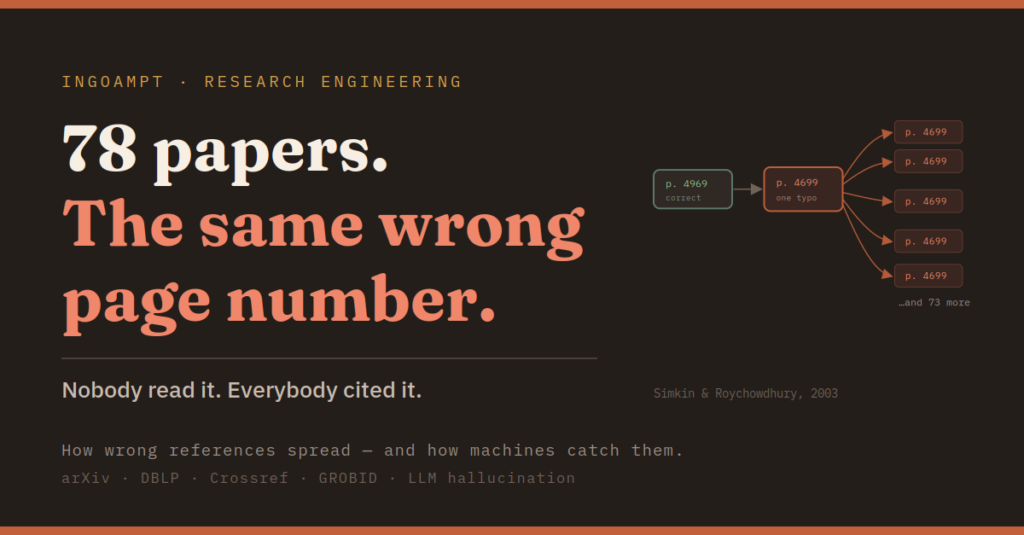
They took a famous, heavily cited paper and collected every misprinted citation to it. They found 196 misprints, but only 45 distinct ones. One single wrong page number appeared 78 separate times. Independent typing errors would be scattered and mostly unique. Identical errors repeating dozens of times mean one thing: people are copying reference lists from each other. From the ratio of repeats to distinct errors, they estimated that 70–90% of citations are copied rather than read.
Fig. 2 — Simkin & Roychowdhury’s argument, sketched. The distribution of repeated misprints followed a Zipf law across roughly 4,300 citations. Practical consequence for engineers: a frequency-based prior (“many papers say 4699, so 4699 must be right”) is actively dangerous.
The retraction problem
A related failure: papers keep citing work that has been formally retracted. Hsiao & Schneider found that only 5.4% of post-retraction citation contexts acknowledged the retraction at all (722 of 13,252 contexts). A separate study in dentistry landed on the same 5.4% figure independently. If you are building a reference checker, a retraction flag is one of the cheapest high-value features you can ship — Crossref, OpenAlex (is_retracted), and the Retraction Watch database all expose it.
03What arXiv actually does — and does not — check
A persistent misconception among developers is that arXiv validates references. It does not. arXiv is a distribution and moderation service. Its own help pages on references describe how to format citations so that downstream services can extract them cleanly — notably encouraging high-energy-physics authors to use INSPIRE-generated LaTeX/BibTeX so references extract properly. There is no submission-time correctness check on your bibliography.
Fig. 3 — The arXiv reference ecosystem. Note that the extraction engines (refextract, GROBID) live outside arXiv. If you want reference-level ground truth for arXiv papers, you go to these partners or extract it yourself from the source archive.
The 2025 policy change is worth reading carefully, because it is the clearest institutional admission that the problem has changed character. arXiv restricted CS review and position papers after a surge of LLM-generated submissions — essentially annotated bibliographies with no new contribution. Coverage in Science quoted a moderator saying rejection rates moved from roughly 4% to 10–12%. That is a moderation response to volume, not a reference-correctness mechanism. Nobody is checking whether the citations in an accepted preprint resolve.
Practical note for anyone harvesting arXiv references. Parsing the PDF is the hard road. The source archive often contains a .bbl or .bib file — the bibliography before it was typeset. Extracting from there gives you clean fields with no OCR or column-detection failures. Not every submission includes one, so you need a PDF fallback, but always try the source route first.
04The LLM era: measured fabrication rates
Here the numbers get dramatic. Several groups ran the same basic experiment: ask a model for references on a topic, then try to verify each one. The results vary by model, prompt, and domain, but the direction is consistent.
Fig. 4 — Fabrication rates are not a single number. Walters & Wilder reported 55% (GPT-3.5) vs 18% (GPT-4); Chelli et al. reported 39.6% / 28.6% / 91.4% for GPT-3.5 / GPT-4 / Bard. These are different studies with different verification protocols and must not be merged into one series.
And fabrication is only half of it. Walters & Wilder also found that among the references that were real, 43% (GPT-3.5) and 24% (GPT-4) still contained substantive errors. Bhattacharyya’s medical sample was starker: 47% fabricated, 46% real but erroneous, and only 7% both authentic and accurate, with a mean of 4.3 wrong fields out of 7.
The five failure modes, with examples
If you are writing a detector, these are the shapes you are looking for. Note how each one defeats a different naive check.
Why mode ④ is the dangerous one. Many “reference checkers” stop at does the DOI resolve? A resolving DOI proves a record exists — not that it is this record. Any serious checker must fetch the resolved metadata and compare it field by field against the written reference. Resolution is the beginning of verification, not the end.
05How researchers check millions of references
Now the engineering. Every large-scale citation-error study, and every production matcher, follows roughly the same four stages. The interesting variation is which algorithm goes in stage C.
Fig. 5 — The canonical four-stage pipeline. Parsing benchmarks from Tkaczyk, Collins, Sheridan & Beel (JCDL 2018, arXiv:1802.01168); matching figures from Crossref’s own evaluation of search-based matching.
The single most important architectural finding
Crossref’s work on reference matching contains a result every builder should internalise. The old approach was parse-then-match: chop the string into fields, then look each field up. The new approach is search-based matching: throw the entire raw reference string at a search index, retrieve top candidates by relevance, then validate the best candidate against the string using the fields that survive reformatting.
| Approach | Precision | Recall | F1 |
|---|---|---|---|
| Legacy parse-then-match | 99.3% | 42.0% | 52.9% |
| Search-based matching | 99.2% | 79.0% | 84.5% |
Read those columns again. Precision is essentially identical — it drops by 0.1 points. Recall nearly doubles. Parsing was never the precision bottleneck; it was the recall bottleneck, because a single mis-segmented field caused the whole lookup to fail. Search-based matching is tolerant of exactly the noise that real references contain.
Blocking: why you cannot compare everything to everything
A practical constraint. DBLP holds over six million publication records; OpenAlex holds hundreds of millions. Comparing one reference against every record is impossible, and comparing a million references against all of them is absurd. Record linkage solves this with blocking: cheaply narrow to a few hundred plausible candidates, then spend real compute only on those.
Fig. 6 — Recall lives at the top of the funnel, precision at the bottom. This asymmetry is why candidate generation is tuned aggressively for recall even at the cost of noisy candidates.
The algorithms, explained without the jargon
| Technique | Plain-language idea | Catches | Misses |
|---|---|---|---|
| Normalized key | Lowercase, strip punctuation and accents, squash spaces, then compare exactly. | Casing and punctuation noise | Any typo at all |
| Levenshtein / Jaro-Winkler | Count how many single-character edits turn one string into the other. | Typos, transposed digits | Reordered author lists |
| Character n-grams | Chop into 3-letter chunks and compare the bags of chunks. Order matters less. | Word reordering, abbreviations | Synonymous venue names |
| BM25 / TF-IDF | Rank by shared rare words. “Transformer” counts more than “the”. | Partial, truncated references | Pure paraphrase |
| Dense embeddings (SPECTER2, SciNCL, BGE) | Map text to a vector so semantically similar titles land near each other. | Paraphrased or translated titles | Distinguishing near-identical papers |
| Cross-encoder rerank | Feed the query and one candidate together into a model that judges the pair. | Fine-grained disambiguation | Too slow to run on millions |
| Field validation | Compare year, first author surname, volume, pages one by one; require agreement. | Wrong-record-right-title errors | References missing those fields |
No single row wins. The modern consensus — visible in Crossref’s validator, in EnsembleLink (arXiv:2601.21138), and in most production systems — is a hybrid: sparse and dense retrieval unioned for recall, then a reranker and a deterministic field check for precision. EnsembleLink is notable because it achieves this with no training labels, using local models at roughly half a second per query with 50 candidates. For anyone building against a local database without an annotated corpus, that is the reference design.
06Wrong, or just written differently? The decision that defines your system
This is where most homegrown checkers fall apart. They flag “Proc. ACL” against “Proceedings of the 58th Annual Meeting of the Association for Computational Linguistics” as an error, drown the user in false positives, and get switched off.
Fig. 7 — A workable taxonomy. Identifier-anchored ground truth is the top branch because it is the only path that settles identity deterministically. Everything else is scored.
The threshold is a policy decision, not a technical one
Every fuzzy matcher outputs a score. Somewhere you draw a line. Move the line up and you get fewer false alarms but miss real errors; move it down and you flood the user. The Wikipedia Citations dataset project, using Crossref’s confidence score at a threshold of about 35, reported 70% precision and 67.6% recall — a useful, honest illustration that the threshold is where the trade-off lives.
Fig. 8 — Two thresholds beat one. Below the lower bound, reject silently; above the upper, accept automatically; in between, ask a human. Those human decisions become the labelled data that improves the next version.
Constructing ground truth honestly
You cannot measure a matcher without a gold set. The standard method, and the one to copy:
- Anchor on identifiers. Take references that carry a DOI or arXiv ID. Resolve them to get the true record. That record is your ground truth.
- Strip the identifier to build the test query. Now feed the matcher only the messy human-written string, with the anchor removed. You know the right answer; the matcher does not.
- Degrade deliberately. Introduce controlled noise — drop the venue, abbreviate authors, shift a year — to measure how gracefully performance decays.
- Annotate the residue by hand, with more than one annotator, and report inter-annotator agreement. For references with no identifier, this is the only honest route.
This DOI-anchoring protocol is elegant because it produces ground truth at scale without manual labelling, while still testing the matcher on genuinely noisy input. A related large-scale study (Zhang & Abernethy, arXiv:2411.06101) went further into content errors, building an expert-annotated set of 250 statement–reference pairs — of which 44.8% were unsubstantiated and 49.6% fully substantiated — then feeding GROBID-extracted chunks through embedding retrieval into GPT-4 to classify substantiation without fine-tuning.
07The fix that actually works: retrieve, don’t generate
Here is the key insight of the last two years. If a language model writes the bibliographic record, the record can be corrupted — no matter how good your retrieval was. The model is a lossy channel. The solution is to route around it.
Fig. 9 — The unmediated export pattern, as described in Szeider’s Unmediated AI-Assisted Scholarly Citations (arXiv:2602.01686). The model does the fuzzy searching, which it is good at; the database does the record writing, which it alone can do correctly.
Think of it as an online shopping cart. The model browses, compares, and adds items to a cart. But when you check out, the warehouse ships the actual product — it does not ask the salesperson to rebuild it from memory. In this system the LLM sees a DBLP key like conf/acl/LoWNKW20, and the BibTeX is fetched from the database and written straight to disk. Only the citation key is substituted in your LaTeX, deterministically, by regex.
The design rule, stated once: a generative model may select a record, but must never author one. Any architecture that lets model output reach the final bibliography has an unbounded corruption surface, however good the retrieval was.
The reported numbers — 82.7% perfect match versus 28.2% for a web-search baseline, with zero metadata corruption — come from a small evaluation of 104 obfuscated citations, so treat them as promising rather than definitive. But the architectural claim does not depend on sample size. Zero corruption is not a statistical result; it is a structural guarantee. If the bytes never pass through the model, they cannot be altered by it.
08The tool landscape, and how each one finds a match
A working map of what exists, with the mechanism made explicit — because “AI-powered citation checker” tells you nothing about whether it will hallucinate at you.
| System | Retrieval strategy | Scoring | LLM in the loop? | Reported result |
|---|---|---|---|---|
| Crossref search-based matching | Full string into a metadata search index | Relevance + field validation (year, volume, pages, first author) | No | F1 84.5% (P 99.2 / R 79.0) |
| MCP-DBLP arXiv:2602.01686 | DBLP API + fuzzy sequence matching | Similarity threshold; export bypasses the model | Search only | 82.7% perfect match, 0% corruption |
| EnsembleLink arXiv:2601.21138 | Dense embeddings ∪ character n-grams | Cross-encoder rerank, top-1 | No (local models) | Matches label-hungry methods, zero training labels |
| citecheck arXiv:2603.17339 | Multi-pass across PubMed, Crossref, arXiv, Semantic Scholar | Manifestation-aware matching; policy-gated rewrites | Optional | Research prototype (47 tests) |
| CiteAudit arXiv:2602.23452 | Embedding memory + web retrieval | Multi-agent claim extraction and calibrated judgment | Yes | Outperforms SOTA LLM and commercial baselines |
| scite | GROBID extraction → DOI linkage | Deep-learning citation-intent classification | No | ~70% end-to-end context→DOI linkage |
| ALCE benchmark EMNLP 2023 | n/a — evaluation harness | Fluency (MAUVE) + correctness + NLI-verified citation recall/precision | Under test | Best models lack full citation support ~50% of the time on ELI5 |
| LongCite arXiv:2409.02897 | Coarse-to-fine passage selection | Sentence-level citation F1 | Yes (trained) | LongCite-8B/9B beat GPT-4o by 6.4 / 3.6 F1 |
Naming collision worth knowing. There are two distinct systems in the recent literature using the name CiteCheck/citecheck: Lee’s MCP-server tool (arXiv:2603.17339) and a separate retrieval-grounded hallucination detector (arXiv:2605.27700). If you cite one, check which one you mean.
On the traditional side, the infrastructure has existed for years and is underused: Crossref’s Simple Text Query and Metadata Search, publisher-side tools like eXtyles and Edifix, Frontiers’ AIRA, and reference managers with strict BibTeX handling. Most reference errors in human-written papers would be caught by running the bibliography through Crossref before submission. The gap has never been capability. It is that nobody does it.
09If you are building one: a staged plan
Concrete guidance, ordered by effort. Each stage has an exit criterion, so you know when to stop and when to escalate.
Fig. 10 — Resist starting at Stage 3. A well-tuned Stage 2 reaches Crossref-grade F1 and is far easier to debug, deploy, and explain to a reviewer.
Non-negotiables
- Prefer
.bib/.bblover PDF parsing. If you must parse PDFs, use GROBID and consider retraining on your domain — worth roughly +3 F1 points. - Use search-based matching, not parse-then-match. The recall difference is close to double.
- Anchor identity on identifiers, score everything else, and expose your threshold as a tunable with published precision/recall.
- Never let a generative model write the final record. Fetch canonical BibTeX from the database and write it to disk directly.
- Handle preprint ↔ published manifestations explicitly. Decide your canonicalization policy before you index, not after.
- Add a retraction flag. Cheap to implement, high value, and addresses a failure where only ~5% of citing contexts currently acknowledge the problem.
- Emit “unknown” as a real answer. Absence from your database is not proof of fabrication — especially for books, theses, standards, and non-English work.
10Caveats — read these before you quote any number
- Do not merge studies into one series. Walters & Wilder’s 55%/18% and Chelli et al.’s 39.6%/28.6%/91.4% used different protocols and domains. Plot them as separate studies with labels.
- Denominators differ. Errors-per-reference and errors-per-quotation-examined are not comparable. Mogull’s recalculation exists precisely because they were being conflated.
- The 82.7% MCP-DBLP figure comes from a small evaluation (104 obfuscated citations, workshop track). Preliminary. The zero-corruption claim is structural and more robust than the match rate.
- Model figures age within months. Any hallucination rate for a named model is a snapshot of one version at one date. Re-measure rather than cite.
- Database sizes move daily. arXiv passed three million articles in 2026; DBLP holds over six million publication records; OpenAlex counts run to hundreds of millions. Cite a snapshot date whenever you print one.
- Two different tools share the CiteCheck name. See the note in section 08.
11Questions people actually ask
Does arXiv check whether my references are real?
No. arXiv checks formatting, licensing, compilation, and applies moderation and endorsement policies, but it does not validate the correctness of your bibliography. Reference extraction and linking happen downstream at INSPIRE-HEP, NASA ADS, and Semantic Scholar, and those services extract what you wrote — including your errors.
How often does ChatGPT make up references?
It depends heavily on model and study. Walters & Wilder (Scientific Reports, 2023) measured 55% fabricated for GPT-3.5 and 18% for GPT-4. Chelli et al. (JMIR, 2024) measured 39.6%, 28.6%, and 91.4% for GPT-3.5, GPT-4, and Bard respectively. Rates have fallen with newer models but are not zero, and among the real references, a substantial fraction still carry wrong metadata.
If a DOI resolves, is the reference correct?
No. A resolving DOI proves that some record exists at that identifier — not that it matches the reference as written. A common LLM failure is attaching a real, resolvable DOI to the wrong title. You have to fetch the resolved metadata and compare it field by field.
What is the difference between a citation error and a quotation error?
A citation (bibliographic) error means the metadata is wrong — wrong year, wrong venue, misspelled author. A quotation (content) error means the metadata is perfect but the cited paper does not support the claim. Detecting the first needs a database lookup; detecting the second needs reading the source, which is where retrieval-grounded LLM checkers are now being applied.
Why do the same citation errors appear in many different papers?
Because reference lists get copied. Simkin and Roychowdhury demonstrated this by counting repeated identical misprints — one wrong page number appeared 78 times — and estimated that 70–90% of citations are copied rather than read. This means an error’s popularity is not evidence of its correctness.
What is the single most effective fix for AI-generated bibliographies?
Architectural, not prompt-based: never let the model write the record. Have it search and select a candidate, then fetch the canonical BibTeX directly from the authority database and write it to the file. This eliminates metadata corruption structurally rather than probabilistically.
12Sources
Citation error rates and propagation
- Simkin, M. V. & Roychowdhury, V. P. (2003). Read Before You Cite! Complex Systems 14, 269–274. arXiv:cond-mat/0212043. Also: Stochastic modeling of citation slips, Scientometrics 62 (2005) 367–384, arXiv:cond-mat/0401529; A mathematical theory of citing, JASIST 58 (2007) 1661–1673, arXiv:physics/0504094.
- Mogull, S. A. (2017). Accuracy of cited “facts” in medical research articles. PLOS ONE 12(9): e0184727. doi:10.1371/journal.pone.0184727
- Unverified history: an analysis of quotation accuracy in leading history journals. Scientometrics (2023). doi:10.1007/s11192-023-04755-w
- Quotation accuracy in educational research articles. Studies in Educational Evaluation (2021).
- Hsiao & Schneider — post-retraction citation acknowledgement (5.4% of contexts).
LLM hallucination measurement
- Walters, W. H. & Wilder, E. I. (2023). Fabrication and errors in the bibliographic citations generated by ChatGPT. Scientific Reports 13:14045. doi:10.1038/s41598-023-41032-5
- Bhattacharyya, M. et al. (2023). High Rates of Fabricated and Inaccurate References in ChatGPT-Generated Medical Content. Cureus 15(5):e39238. doi:10.7759/cureus.39238
- Chelli, M. et al. (2024). Hallucination Rates and Reference Accuracy of ChatGPT and Bard for Systematic Reviews. JMIR 26:e53164. doi:10.2196/53164
- Athaluri, S. A. et al. (2023). Cureus 15(4):e37432. doi:10.7759/cureus.37432
- Agrawal, A., Suzgun, M., Mackey, L., Kalai, A. (2024). Do Language Models Know When They’re Hallucinating References? Findings of EACL 2024. arXiv:2305.18248
- Rao, Wong & Callison-Burch (2026). Detecting and Correcting Reference Hallucinations in Commercial LLMs and Deep Research Agents. arXiv:2604.03173
Extraction, parsing, and matching
- Tkaczyk, D., Collins, A., Sheridan, P., Beel, J. (2018). Machine Learning vs. Rules and Out-of-the-Box vs. Retrained. JCDL 2018. arXiv:1802.01168
- Tkaczyk, D., Sheridan, P., Beel, J. (2018). ParsRec: A Novel Meta-Learning Approach to Recommending Bibliographic Reference Parsers. arXiv:1808.09036
- Crossref engineering blog — Matchmaker, matchmaker, make me a match and Reference matching: for real this time.
- Tkaczyk, D. et al. (2015). CERMINE: automatic extraction of structured metadata from scientific literature. IJDAR 18(4):317–335.
- Lo, K., Wang, L. L., Neumann, M., Kinney, R., Weld, D. (2020). S2ORC: The Semantic Scholar Open Research Corpus. ACL 2020. arXiv:1911.02782
- Saier, T. & Färber, M. (2020). unarXive. Scientometrics 125(3):3085–3108. doi:10.1007/s11192-020-03382-z — and unarXive 2022, JCDL 2023.
- Subramanian, S., King, D., Downey, D., Feldman, S. (2021). S2AND: A Benchmark and Evaluation System for Author Name Disambiguation. JCDL 2021. arXiv:2103.07534
- Dasanaike, N. EnsembleLink. arXiv:2601.21138
- GROBID — github.com/kermitt2/grobid · refextract — github.com/inspirehep/refextract
Detection and verification systems
- Szeider, S. (2026). Unmediated AI-Assisted Scholarly Citations. arXiv:2602.01686; doi:10.52825/ocp.v8i.3161 (AAAI-26 Bridge on AI for Scholarly Communication).
- Lee, J. (2026). citecheck. arXiv:2603.17339
- Yuan, Z., Shi, K., Zhang, Z., Sun, L., Chawla, N. V., Ye, Y. (2026). CiteAudit. arXiv:2602.23452
- CiteCheck: Retrieval-Grounded Detection of LLM Citation Hallucinations in Scientific Text. arXiv:2605.27700 (distinct from the above)
- Ovcharov, V. Citation Grounding. arXiv:2606.00898 (legal domain)
- Zhang & Abernethy. Detecting Reference Errors in Scientific Literature with Large Language Models. arXiv:2411.06101
- Gao, T., Yen, H., Yu, J., Chen, D. (2023). Enabling Large Language Models to Generate Text with Citations. EMNLP 2023, 6465–6488. arXiv:2305.14627
- Zhang, J. et al. (2025). LongCite. Findings of ACL 2025. arXiv:2409.02897
- Nicholson, J. M. et al. (2021). scite: A smart citation index. Quantitative Science Studies 2(3):882–898.
arXiv policy and infrastructure
- arXiv — References to and in arXiv Documents, info.arxiv.org/help/faq/references.html
- arXiv blog (Oct 2025) — CS review/position paper submission policy change, effective 31 October 2025.
- Science — coverage of arXiv moderation changes and rejection-rate figures.
- Accomazzi, A. et al. — Creation and use of Citations in the ADS, arXiv:cs/0610011; Automated Resolution of Noisy Bibliographic References, arXiv:cs/0401028.
About INGOAMPT
INGOAMPT is an independent iOS and applied-AI studio based in Vienna, working on machine learning systems, developer tooling, and research infrastructure. This article accompanies ongoing work on fuzzy citation matching against a federated bibliography service.
Every figure in this article is an original diagram. Statistics are attributed to their primary sources above; where a number comes from a small or preliminary evaluation, that is stated in the text. If you spot an error, that is rather the point of the topic — please write in.