arXiv, DOIs & BibTeX, Explained With Pictures
What arXiv actually is, why some papers have a DOI and others don’t, and what on earth .bib and .bbl files are — for total beginners.
1What is arXiv, really?
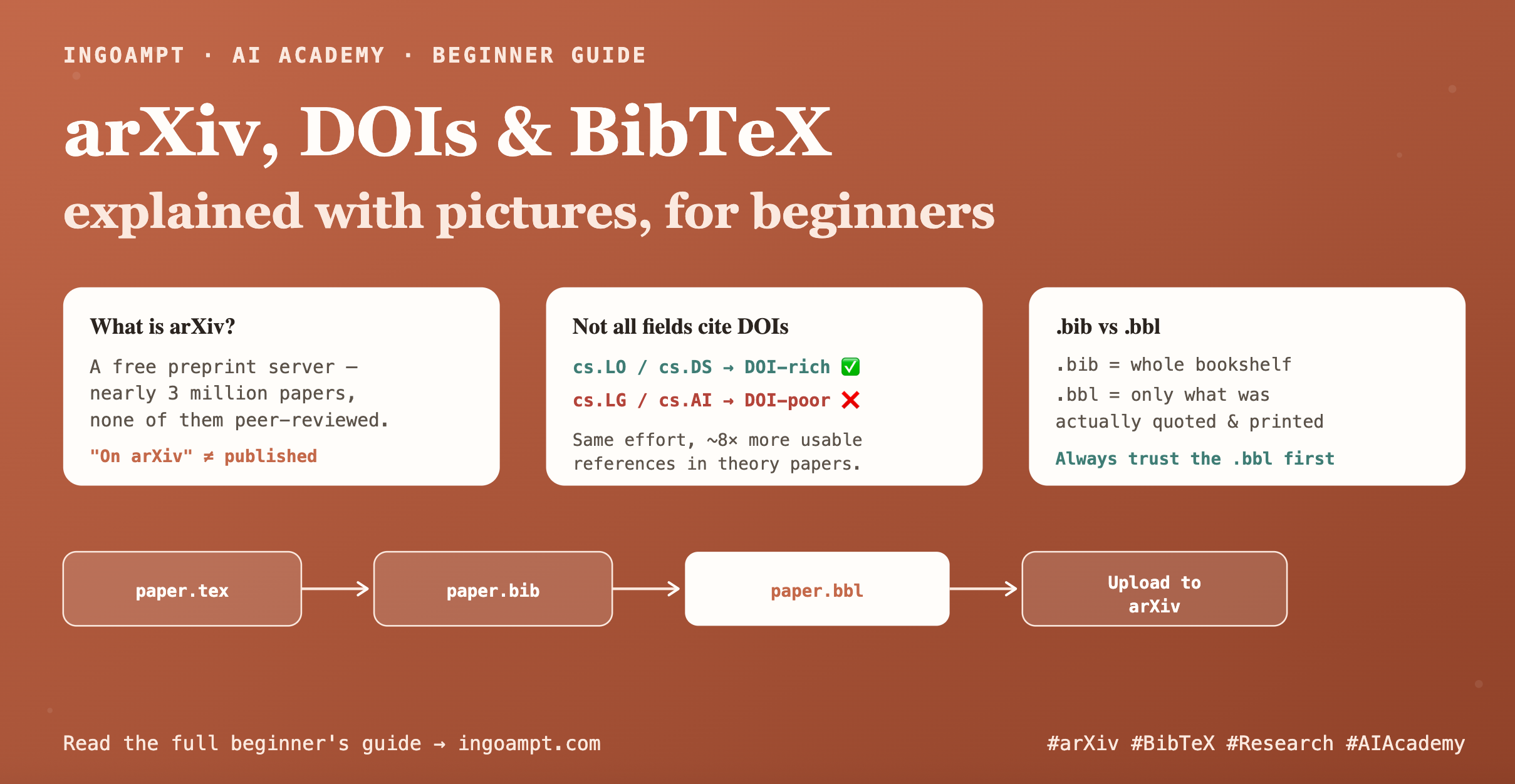
arXiv (pronounced “archive,” the X stands for the Greek letter chi) is a free website where researchers post their papers before, during, or sometimes instead of formal publication. It was started in 1991 by physicist Paul Ginsparg, and is now run out of Cornell University — soon to become its own independent nonprofit.
Think of arXiv as a public bulletin board for science. A physicist finishes a paper on Monday, uploads it Tuesday, and by Wednesday a colleague in another country is reading it — months or years before it might appear in a journal. That speed is exactly why arXiv became so central to fields like computer science, physics, and math.
A paper being “on arXiv” says nothing about whether it’s correct, finished, or accepted anywhere. arXiv is moderated (someone checks it’s not spam or plagiarism), but it is not peer-reviewed. Many arXiv papers later get properly published — some never do.
2How arXiv versions work
Papers on arXiv aren’t frozen forever. Authors can upload a revised version any time — to fix a typo, add a missing reference, or respond to feedback. Each revision gets a new version number, but the old ones are never deleted.
This matters more than it sounds. If an author cites the wrong year for a paper in v1, and fixes it in v2, you have direct, author-confirmed proof that v1 contained a mistake — no guessing required.
3What is a DOI, and why don’t all papers have one?
A DOI (Digital Object Identifier) is a permanent web address for a specific piece of research — a paper, dataset, or book chapter. It always starts with 10., and it never breaks, even if the paper moves to a new website.
Here’s the catch: a DOI is issued by a publisher — a journal, a conference proceedings organizer, a data archive. arXiv itself is not a publisher in that sense; it’s a preprint server. So historically, a raw arXiv preprint had no DOI at all, unless the paper was later formally published somewhere.
Since 2022, arXiv does automatically give every new paper its own DOI (starting with 10.48550) just for being on arXiv. But this is different from a publisher DOI — it just proves the preprint exists, not that it passed review anywhere.
Why this matters for you: a DOI is a reliable “answer key.” If a reference has a DOI, you can look up exactly what paper it points to and check whether the citation details (year, authors, venue) are correct. A reference with no DOI is much harder to verify with certainty.
4Which research fields cite DOIs — and which don’t
Not all corners of computer science cite the same way. Theory and systems papers usually cite formally published journals and proceedings — which almost always have DOIs. Machine-learning papers often cite each other’s arXiv preprints directly — which usually don’t.
| Category | Cites mostly | Has DOIs? | Good source of DOIs? |
|---|---|---|---|
| cs.LO, cs.DS, cs.CC | Journals, LIPIcs, Springer | Yes, a lot | ✅ Best |
| cs.DB, cs.SE, cs.PL | ACM / IEEE venues | Yes | ✅ Good |
| cs.AI, cs.LG, cs.CL, cs.CV | arXiv preprints, NeurIPS / ICML | Often none | ❌ Weak |
ML research moves fast — a paper is cited within weeks of appearing on arXiv, long before (or instead of) ever being formally published. Even top ML conferences like NeurIPS and ICML don’t issue DOIs at all. Theory and systems fields move slower and mostly publish in DOI-bearing journals and proceedings (LIPIcs, ACM, IEEE, Springer).
5The BibTeX pipeline: how a paper builds its reference list
Papers written in LaTeX (the standard typesetting system for science and math) don’t type out their reference list by hand. They use a system called BibTeX that assembles it automatically from a database of citations.
The four-file relay works like this, step by step:
- LaTeX runs first — it notices every
\cite{key}in the text and writes down which keys were used. - BibTeX runs next — it looks up each of those keys in the
.biblibrary, formats them properly, and writes a new file: the.bbl. - LaTeX runs again — it inserts the
.bblcontent into the paper wherever the reference list belongs. - LaTeX runs one more time — to fix up the in-text citation numbers, like turning
[?]into[12].
For a long time, arXiv didn’t run BibTeX itself — authors had to upload the already-finished .bbl file. That’s why so many older arXiv papers include a .bbl but no .bib. Since November 2025, arXiv can process .bib files directly too.
6.bib vs .bbl — the difference that actually matters
This is the single most useful distinction in this whole guide, so let’s make it concrete.
Say a .bib entry has a misspelled title. Before calling that a “wrong reference,” check whether it was ever cited in the paper’s text. If it wasn’t, it’s just clutter sitting unused in someone’s personal library file — not an error in the published paper.
In short: reading order matters. Look for the .bbl first (it’s the ground truth of what was printed). If there’s no .bbl, check the .tex file for a hand-written bibliography. Only use the raw .bib as a fallback, and always confirm each entry is actually cited before trusting it.
7How researchers and developers use this, in practice
For researchers
Reference managers like Zotero, JabRef, and BibDesk all read and write .bib files. They let you collect papers, auto-generate citation keys, and export a ready-to-use .bib for your own LaTeX document — no manual typing required.
For developers and tool-builders
If you’re building anything that checks citations, matches references to a database, or studies citation accuracy, the .bib/.bbl distinction decides how clean your data is:
arXiv’s source packages are available at arxiv.org/e-print/<paper-id> — a small compressed file containing the .tex, .bib, and/or .bbl files, plus figures. For large-scale work, arXiv also publishes bulk archives.
8Quick glossary
- arXiv
- A free preprint server where researchers post papers before or instead of formal publication. Not peer-reviewed.
- Preprint
- A paper version posted before, or without, formal peer review.
- DOI
- Digital Object Identifier — a permanent web address for one specific paper, dataset, or chapter, issued by a publisher or repository.
- .bib file
- A plain-text bibliography database — an author’s full reference library, which may include entries never actually cited.
- .bbl file
- The compiled, final bibliography — only the references actually cited and printed in the paper.
- BibTeX
- The tool that reads a .bib file and a paper’s citation list, and produces the .bbl file.
- \cite{key}
- The LaTeX command an author writes in their text to cite a specific reference by its key.
- Version (v1, v2…)
- arXiv keeps every revision of a paper permanently accessible — useful for spotting an author’s own corrections.