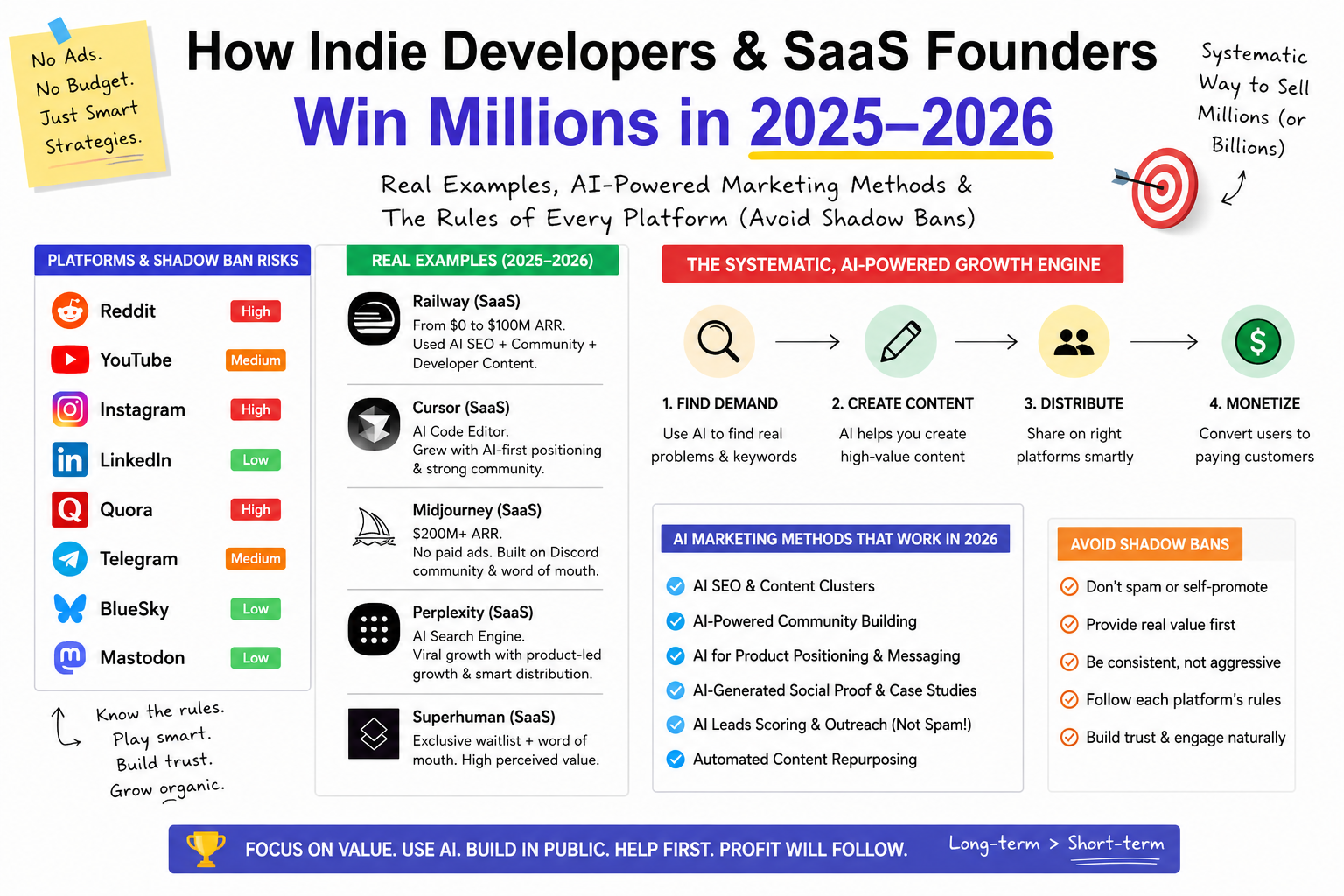
What actually created million-dollar outcomes in 2025 and 2026 for app developers
The clearest pattern across recent breakout apps is that growth came from distribution systems that matched the product to the platform. Below are the highest-confidence examples with specific methods described publicly. [3]
| Company | Public result | Exact growth method | AI layer inside the marketing system | What an indie founder should copy |
|---|---|---|---|---|
| Cal AI | Business Insider reported that the app was acquired by MyFitnessPal less than two years after launch, and another 2025 Business Insider profile said the company was generating around $30 million annually. [4] | Cofounder Jake Castillo said influencer marketing was the main strategy. The team plugged the product into fitness creators’ “what I eat in a day,” weight-loss, and snack-related videos because distribution already existed there. [5] | The product itself was AI-native, which made demos instantly legible in creator content; the founders also emphasized speed of execution as the moat. [5] | Do not begin with ads or comments. Begin with creators whose existing content already makes your app look useful in one clip. [5] |
| Gamma | By November 2025, Gamma had reached 70 million users and $100 million in ARR, according to public comments cited by Business Insider. [6] | Grant Lee said he personally onboarded every early influencer, focused on micro-influencers rather than giant accounts, walked them through the product, brainstormed angles, and let them tell the story in their own voice. He said word-of-mouth accounted for more than 50% of subscriber growth. [6] | The AI product made it easy for influencers to create visible transformations, but the real growth engine was a human-managed micro-influencer system, not mass automation. [6] | Personally onboard the first wave of niche creators and treat them like an extension of the team. That is slower at the start and dramatically stronger later. [6] |
| Turbo AI | Business Insider reported that the company grew from 1 million to 5.7 million users in six months, was adding about 20,000 new users per day, and was tracking toward eight-figure ARR. TechCrunch separately reported 5 million users and eight-figure ARR. [7] | The founders described a scrappy campus launch: cookies, posters in bathroom stalls, campus presence, then repeated TikTok posting until one of forty to fifty TikToks broke out and hit about 20 million views. [8] | The app itself used AI for lecture capture and note generation, while the growth strategy paired offline seeding with short-form content and constant product iteration. [7] | If your audience is concentrated somewhere physical or institutional, seed there first, then convert that proof into short-form social content until one format breaks. [8] |
| Alinea | TikTok’s official case study said Alinea increased subscriptions by 73%, reduced CPA by 42%, and generated more than 13.2 million impressions. [9] | The company combined Smart+ iOS App Promotion, Spark Ads, and an App Profile Page to scale subscriptions while reducing manual optimization and lowering friction between interest and install. [9] | This is one of the clearest examples of AI-native media buying: algorithmic delivery plus native creator-style amplification, rather than static ad campaigns. [9] | If you do spend later, buy automation that amplifies already-working native content. Do not pay to push weak creative. [9] |
| Higgsfield | Reuters reported that Higgsfield said it had reached a $200 million annualized run rate by January 2026, with social media marketers making up about 85% of usage, and a valuation above $1.3 billion after new funding. [10] | Its public materials describe Higgsfield Earn as an automated creator monetization program in which creators verify social accounts, join campaigns, and get paid based on views and performance. The company also says it has commissioned 10,000+ creators and distributed $1 million+ through the program. [11] | This is a strong example of automation around creators rather than fake audience automation: software handled creator matching, tracking, and payouts while creators still produced the public-facing content. [12] | If you want scale without getting flagged as spam, automate your creator ops, not your public commenting behavior. [13] |
| Duolingo | Business Insider reported that the company reached 50 million daily active users in 2025 and was reworking its social acquisition playbook in 2026. [14] | Its CMO said organic reach from the main TikTok account had become harder, so the company was experimenting with a “creator army,” staffing Reddit, doubling down on PR, growing a blog, and using WhatsApp channels as broadcast distribution. [14] | The important AI-era move here was not “more posting.” It was shifting toward creator-distributed content and channels that matter for generative-answer visibility, especially Reddit and blog content. [14] | When a brand account’s organic reach decays, move outward into creators, searchable content, and owned broadcast channels. [14] |
A cautionary counterexample is Cluely. TechCrunch reported that the company used provocative, rage-bait marketing to drive early customer acquisition and keep itself in headlines, and later reported that the CEO admitted to publicly lying about revenue numbers from the prior year. That makes Cluely useful as a visibility case study, but not as a durable trust model for indie developers who need repeatable sales without enforcement risk. [15]
What AI changed about startup marketing
The real AI advantage in 2026 is not “let the model post everywhere.” It is that AI reduces the cost of four hard things: finding demand, generating variations, personalizing the pitch, and measuring what converts. A recent academic review in the Journal of Macromarketing frames GenAI’s value across marketing research, strategy formation, and marketing actions, while McKinsey’s 2025 work argues that AI and generative AI let marketers scale personalization and tailored online interactions more effectively. [16]
In practice, the strongest AI-native methods visible in the 2025–2026 examples were these. First, algorithmic media buying: Alinea used TikTok Smart+ to automate targeting and delivery while Spark Ads amplified content that already felt native. Second, creator operating systems: Gamma built a hands-on micro-influencer engine, while Higgsfield automated creator recruitment, tracking, and payouts rather than automating fake user behavior. Third, routing and relevance: Apple’s App Store tools now let developers create custom product pages with unique URLs, measure campaign links down to downloads and subscriptions, and compare which pages bring in higher-value users. Fourth, generative engine optimization: Duolingo’s 2026 shift toward Reddit and blog publishing reflects the reality that answer engines increasingly cite discussion forums and owned content. [17]
There is also an emerging but more speculative category: AI characters and virtual influencers. Business Insider reported that AvatarOS raised new funding in 2025 around the thesis that AI can reduce the cost of animated, on-brand digital characters and extend the playbook pioneered by Lil Miquela. That is a real trend, but it should be treated as an advanced, brand-heavy tactic rather than the first move for a bootstrapped founder. [18]
| AI method | What it actually does | Best supporting example | Why it is safer than spam bots |
|---|---|---|---|
| Audience clustering | Turns reviews, support messages, community posts, and comments into a ranked map of pain points, objections, and jobs-to-be-done. [19] | Not tied to one startup in public, but this is consistent with how GenAI is described in research and consulting literature for research and strategy work. [19] | It improves relevance before publishing anything, which lowers moderation risk. [20] |
| Creative variation at scale | Generates many scripts, hooks, thumbnails, and opening claims so only the best-performing ideas get published or funded. [21] | Alinea’s Smart+ plus Spark Ads; Apple’s product page optimization and custom product pages. [22] | You are testing messages, not faking users. [23] |
| Creator ops automation | Automates tracking, briefs, approvals, payouts, and performance for real creators. [13] | Higgsfield Earn. [13] | Public-facing promotion still comes from identifiable people, which is much closer to platform norms. [24] |
| Segmented conversion surfaces | Sends different audiences to different landing or app-store pages and measures which segment actually activates or pays. [25] | Apple campaign links and custom product pages. [25] | Less pressure to oversell in comments because the real persuasion happens after the click. [26] |
Why shadowbans feel real even when platforms avoid the word
“Shadowban” is usually an unofficial user term. Most platforms rarely define it that way. Instead, their documents describe spam flags, held comments, reduced recommendation eligibility, tapered distribution, account limits, silencing, or labels. To a founder, the effect can feel the same: you keep posting, but other people do not see the result. [27]
| Platform | What the official docs say | Does the platform openly use “shadowban” language? | Can visibility be reduced without a big public signal? | Editorial verdict for founders |
|---|---|---|---|---|
| Reddit’s help center says posts, comments, chat messages, and profile pages may not show “as expected” if an account is flagged for spam or inauthentic activity. Its spam guidance also warns against bots that continuously promote specific products and says users whose contributions mostly link to their own business should watch frequency and community rules. Reddiquette still points to the long-standing 9:1 rule of thumb. [28] | No. [29] | Yes. The account-status article explicitly says content may not show as expected. [29] | One of the easiest places to feel “shadowbanned.” Great for authentic niche participation; terrible for repetitive self-promotion. [30] | |
| YouTube | YouTube bans fake engagement, repetitive comments, and comments whose sole purpose is to drive viewers off-platform. It also lets channel owners hold comments, block links, and hide users; held comments are not publicly visible unless approved. Formal strikes come with email notice, but comment moderation and recommendation effects are more indirect. [31] | No. [32] | Yes, especially at the comment layer. A comment can simply be held, filtered, or removed. [33] | Strong for demos and evergreen discovery, weak for link-dropping in comments. [34] |
| Bluesky | Bluesky’s official bot docs say bots should self-label and only interact with users in opt-in ways, or they may be treated as spam. Bluesky also documents rate limits, public labels, a strike system, human review for complex harms, and reply filtering that reduces visibility of antisocial replies rather than silently deleting them. [35] | No. [36] | Yes, but the system is more transparent than most large platforms because labels and strikes are increasingly explicit. [37] | One of the best places for compliant automation, provided it is labeled, rate-limited, and opt-in. [38] |
| Quora | Quora prohibits repeated content, irrelevant answers or comments used to drive traffic, business-promotion questions, and excessive promotion of the same product or service. Enforcement can include warnings, removal, warning tags, or limitation/termination of access. [39] | No. [39] | Sometimes. Quora openly allows “limitation” and content warnings, but its public docs do not spell out a separate shadowban taxonomy. [39] | Good for expert answers and credibility; bad for sneaking links into generic replies. [39] |
| Instagram says Recommendations Guidelines determine what public-account content is eligible to be recommended. Instagram also provides Account Status so users can see whether content may lead to account restrictions, and its Terms of Use prohibit creating accounts or accessing or collecting information in automated ways without permission. Meta’s transparency materials also describe account restrictions and some restriction history being visible in Account Status. [40] | No. [41] | Yes. Recommendation ineligibility and reduced discoverability can feel like shadowbanning even when there is an account-status trail. [42] | Useful for consumer or visual apps, but high-risk for unauthorized automation and repetitive comments. [43] | |
| Telegram | Telegram’s spam FAQ says accounts reported for spam can be temporarily limited from contacting strangers, and unsolicited advertisements, links, and channel invites are explicitly risky. Its EU guidance says Telegram uses AI-driven and manual moderation for public content, can suspend the ability to contact people who likely do not know you, and says it will usually notify users of restrictions unless law prevents that. Telegram also says it does not use recommendation algorithms to amplify trending content. [44] | No. [45] | Less “shadowban,” more direct reach restriction. You lose the right to contact strangers rather than getting silently downranked by a feed. [46] | Excellent as an owned audience and community channel; poor as a cold outreach surface. [46] |
| Mastodon | Mastodon’s docs say moderation is local to each server, default moderation decisions notify affected users by email, and “limited” accounts are hidden from all users on that instance except followers while still remaining searchable in some ways. The account model also explicitly has bot and limited fields. [47] | No. [48] | Yes, locally. But compared with centralized networks, the mechanism is more explicit and server-specific. [48] | Good for open-source, privacy, dev-tool, and federated communities if you fit the local culture. Not one-size-fits-all because rules differ by server. [49] |
| LinkedIn says its feed algorithms taper distribution of low-quality and unsafe content. It also prohibits third-party software that scrapes or automates activity, warns that excessive invitations and suspected automation can trigger restrictions, and in Groups explicitly says to avoid self-promotion, state relevance when sharing links, and notes that commercial URLs can be reported and removed. Collaborative articles allow useful links but discourage self-promotional ones. [50] | No. [51] | Yes. Reach can taper quietly, while account restrictions and invitation suspensions usually generate notices. [52] | Best organic platform in this list for B2B SaaS, provided the tone stays professional and the links are contextual rather than promotional. [53] |
The short version is that centralized platforms increasingly punish behavior that looks like industrialized self-promotion. If “bot” means “software acting like a stranger who repeatedly inserts a product into public conversations,” the trend line is bad almost everywhere. The exceptions are environments that either explicitly support labeled bots or structure the interaction around opt-in and transparency, such as Bluesky and some Mastodon servers. [54]
How to mention your product in comments and replies without getting burned
The safest rule across all eight platforms is this: the comment must still be useful if the product mention is removed. If the value disappears when the pitch disappears, moderators and spam systems are more likely to treat it as promotion-first content. The public policies across these platforms repeatedly reward authenticity, relevance, and context and punish repetitive, untargeted, or traffic-seeking behavior. [55]
| Platform | Lowest-risk way to mention a product | What most often gets people flagged |
|---|---|---|
| Answer the question fully, disclose your connection if relevant, and mention the product only when it directly solves the exact thread topic. Keep self-links to a small minority of your activity and obey each subreddit’s local rules. [56] | Cross-subreddit repetition, business-first posting, and bots that promote specific products. [57] | |
| YouTube | Reply with the insight first, then point to your product only if it answers the commenter’s stated problem. Assume channels may hold links for review, so the text itself must do the work. [34] | Repetitive comments, comments whose sole purpose is to drive viewers away from YouTube, and fake engagement schemes. [58] |
| Bluesky | If you automate anything, label the account as a bot and keep interactions opt-in. For human accounts, reply like a real participant and avoid high-volume reply behavior that resembles spam. [38] | Unlabeled automation, bulk interactions, or non-consensual bot replies. [38] |
| Quora | Write a full answer, use credentials or a company account honestly, and link out only when the external resource is the natural continuation of the answer. [39] | Irrelevant answers, repeated messages, solicitation-style questions, and excessive promotion of the same service. [39] |
| Use replies mainly to deepen conversations that are already happening under your own content or creator collaborations, not as a mass-comment acquisition channel. Review Account Status if reach falls. [59] | Unauthorized automation, recommendation-ineligible content patterns, and repetitive engagement behavior. [43] | |
| Telegram | Post in your own channel, discussion group, or communities where people have opted in. Use replies for support, not cold discovery. [60] | Unsolicited DMs, stranger outreach, channel links sent to people who did not ask, and commercial harassment. [61] |
| Mastodon | Keep product context in your profile, pinned post, or project tag, then join conversations as a person or clearly identified project account. Respect the local server’s norms because moderation is local. [47] | Landing on the wrong server culture, posting like a brand in a relationship-driven space, or getting treated as local spam by instance moderators. [49] |
| State relevance, keep it professional, invite discussion, and use the least self-promotional framing possible. In Groups and collaborative articles, provide value first and be very cautious with commercial links. [53] | Self-promotional links, automation, connection-spam, and repeated posting across groups. [62] |
If a founder wants one sentence to remember, it is this: never use comments as your primary landing page. Use comments to prove expertise and route the highest-intent people into a profile, a creator video, a tailored landing page, a demo, or an owned channel. That is how you get distribution without looking like distribution. [63]
A no-budget growth system that scales without shadowbans
No honest system can guarantee 70,000 sales in 30 to 60 days with zero spend. What the public evidence does support is a repeatable no-budget path that compounds better than mass replying: a founder-led proof engine, a micro-creator loop, platform-native publishing, and increasingly strong owned distribution. [64]
Start with demand mining, not promotion
Use AI to cluster pain points from the places your users already complain: app reviews, Reddit threads, YouTube comment sections, Quora questions, support tickets, and onboarding calls. The point is not to let AI write your marketing voice. The point is to identify the exact phrases people already use so your demos, articles, and replies sound native to the problem. This is the most defensible use of GenAI in marketing because it improves relevance before content ever reaches a platform. [19]
Build proof assets that can travel natively
Create a small proof library around your top use cases: one 30–60 second demo, one before/after workflow, one “how it works” article, one FAQ answer, one comparison page, and one founder or user story for each important segment. Turbo AI’s early campus proof and TikTok breakout show how a scrappy, specific proof asset can lift an entire company. Gamma and Cal AI show that creators amplify proof better than brand copy. [65]
Recruit a very small creator network and over-serve them
The best low-cash pattern is not “get hundreds of affiliates.” It is “manually recruit and onboard the first 10 to 20 micro-creators or power users.” Give them free access, walkthroughs, direct feedback, content ideas, and fast support. Gamma’s public playbook is the clearest evidence that deep onboarding of small creators can produce a word-of-mouth engine big enough to move a nine-figure ARR business. Higgsfield shows how this idea can later become software-assisted ops. [66]
Publish where the format already fits the product
Cal AI fit naturally inside health creator videos. Turbo AI fit naturally on student TikTok. Alinea fit inside vertical-video finance creative plus app-install flows. Duolingo is now treating Reddit and blogging as important channels for both product discovery and answer-engine presence. The lesson is to pick the surface where the product can be shown, not just mentioned. [67]
Route traffic into segment-specific destinations
If for example, you are selling an app, use tailored product pages and campaign links. Apple’s current tooling lets you create custom product pages with unique URLs, test product-page treatments, and measure which external efforts produce higher-value users, not just more clicks. This is critical because it removes pressure from comments and lets you learn which audience-message pair actually converts. [68]
Move people into owned channels as fast as possible
Owned channels are where you escape moderation volatility. Duolingo’s 2026 pivot is instructive here: more creators, more blog content, more Reddit presence, more WhatsApp. Telegram can also work well here—not as a stranger-acquisition hack, but as a broadcast and community layer once people have opted in. If a platform changes its feed tomorrow, your email list, blog archive, support community, and opt-in channels still exist. [69]
Use AI for speed, but keep human review on anything public
Bluesky, LinkedIn, Reddit, YouTube, Instagram, and Telegram all have explicit anti-spam or anti-automation rules in ways that make public-facing mass automation increasingly fragile. The safest split is this: let AI research, summarize, cluster, draft, and propose variations; let humans decide what gets posted, where it gets posted, and whether a product mention is appropriate in that context. [70]
Where founders with no ad budget should invest their time first
The table below is a synthesis of current policy friction, organic discovery potential, and the strongest public case studies above. It is not a universal truth. A B2B SaaS aimed at recruiters should rank LinkedIn first; a visual consumer app may rank Instagram or YouTube higher. But for a typical indie developer or lean SaaS team in 2026, this is the most defensible zero-budget order of operations. [71]
| Channel | Best use | No-budget attractiveness | Moderation risk if you pitch badly | Recommended role |
|---|---|---|---|---|
| YouTube | Evergreen demos, comparisons, tutorials, credibility. [34] | High. One good demo can keep compounding through search and recommendations. [72] | Medium. Risk is highest in repetitive comments and off-platform baiting, not in good videos. [73] | Core discovery channel if your product is demo-able. [74] |
| B2B expertise, founder brand, network growth, partnership discovery. [75] | High for SaaS. Especially strong when the founder can teach publicly. [76] | Medium to high if you automate or self-promote in Groups. [62] | Core channel for B2B SaaS; secondary for consumer apps. [53] | |
| Problem discovery, founder support threads, niche community trust, feedback. [77] | High upside, but only if you are truly part of the niche. [56] | Very high for self-promo-first behavior. [77] | Use for listening and selective participation, not mass posting. [77] | |
| Bluesky | Tech audience participation, labeled automation, rapid conversation loops. [78] | Medium to high, especially for developer and startup audiences. [79] | Lower than most if you are transparent; higher if you try to fake human behavior. [38] | Strong experimental channel and good place for opt-in bots. [38] |
| Mastodon | Open-source and privacy communities, long-horizon credibility, project presence. [47] | Medium, but highly instance-dependent. [48] | Medium. Risk depends on local server culture more than platform-wide algorithmics. [48] | Use if your audience is already there; avoid if you are forcing fit. [48] |
| Visual consumer apps, creator collaborations, short visual proof. [80] | Medium. Great if your app looks good on screen; weak if it doesn’t. [81] | High for automation and recommendation-ineligible behavior. [43] | Use as a creator-supported channel, not as a comment-spam surface. [82] | |
| Quora | Evergreen expert answers and intent capture. [39] | Medium to low. High intent, but tighter self-promo expectations. [39] | High if you answer mainly to drive clicks. [39] | Use selectively for authority and problem-answering. [39] |
| Telegram | Retention, communities, product updates, opt-in broadcast. [60] | Low for top-of-funnel discovery; high for owned audience once acquired. [45] | High for unsolicited messages and channel-link spam. [83] | Treat as retention infrastructure, not cold acquisition. [45] |
If the target is a B2B SaaS, the best starting stack is usually LinkedIn + YouTube + selective Reddit + blog/email. If the target is a consumer or student app, the best starting stack is usually YouTube/short-form demo content + creators + Reddit for listening + an owned channel for retention. That judgment is exactly what the recent winners above reflect. [84]
Open questions and limitations
There are three important limits to keep in mind. First, “shadowban” is rarely an official product term, so some of the platform comparison above is a synthesis of visible effects described by official policies rather than a literal admission by the companies. Second, Instagram’s official Help Center pages were intermittently rate-limited during retrieval, so the Instagram section relies on official help snippets and Meta Transparency materials rather than a full page read. Third, Mastodon is federated, which means moderation norms vary materially by server even though Mastodon’s core documentation explains the technical moderation tools. [85]
The bottom line is still clear. If you want a system that can scale without getting trapped by hidden moderation, stop trying to distribute like a spammer and start operating like a publisher, a teacher, and a creator manager. The 2025–2026 winners grew by proving value in public, recruiting trusted distribution partners, and routing attention into owned assets—not by dropping the same pitch into endless reply boxes. [86]
[1] [3] [4] [5] [64] [67] [86] https://www.businessinsider.com/startup-ai-app-tiny-team-scaled-millions-sold-myfitnesspal-2026-4
https://www.businessinsider.com/startup-ai-app-tiny-team-scaled-millions-sold-myfitnesspal-2026-4
[2] [27] [28] [29] [30] https://support.reddithelp.com/hc/en-us/articles/360045309012-My-account-was-flagged-for-spam-or-inauthentic-activity
https://support.reddithelp.com/hc/en-us/articles/360045309012-My-account-was-flagged-for-spam-or-inauthentic-activity
[6] [63] [66] [84] https://www.businessinsider.com/gamma-cofounder-microinfluencers-raise-ai-startup-founder-billion-2025-11
https://www.businessinsider.com/gamma-cofounder-microinfluencers-raise-ai-startup-founder-billion-2025-11
[7] [8] [65] https://www.businessinsider.com/turbo-ai-notetaking-app-2025-11
https://www.businessinsider.com/turbo-ai-notetaking-app-2025-11
[9] [17] [21] [22] https://ads.tiktok.com/business/en-US/inspiration/alinea-smart-plus-app-campaigns
https://ads.tiktok.com/business/en-US/inspiration/alinea-smart-plus-app-campaigns
[10] [12] https://www.reuters.com/business/media-telecom/ai-video-startup-higgsfield-hits-13-billion-valuation-with-latest-funding-2026-01-15/
https://www.reuters.com/business/media-telecom/ai-video-startup-higgsfield-hits-13-billion-valuation-with-latest-funding-2026-01-15/
[11] [13] [24] https://higgsfield.ai/earn
https://higgsfield.ai/earn
[14] [69] https://www.businessinsider.com/duolingo-resets-unhinged-marketing-tiktok-strategy-2026-4
https://www.businessinsider.com/duolingo-resets-unhinged-marketing-tiktok-strategy-2026-4
[15] https://techcrunch.com/2026/03/05/cluely-ceo-roy-lee-admits-to-publicly-lying-about-revenue-numbers-last-year/
Cluely CEO Roy Lee admits to publicly lying about revenue numbers last year
[16] [19] [20] https://journals.sagepub.com/doi/10.1177/07439156241309874
https://journals.sagepub.com/doi/10.1177/07439156241309874
[18] https://www.businessinsider.com/ai-animation-virtual-influencer-startup-avataros-raises-seed-pitch-deck-2025-3
https://www.businessinsider.com/ai-animation-virtual-influencer-startup-avataros-raises-seed-pitch-deck-2025-3
[23] https://developer.apple.com/app-store/product-page-optimization/
https://developer.apple.com/app-store/product-page-optimization/
[25] [26] [68] https://developer.apple.com/help/app-store-connect-analytics/acquisition/campaign-links/
https://developer.apple.com/help/app-store-connect-analytics/acquisition/campaign-links/
[31] https://support.google.com/youtube/answer/3399767?hl=en
https://support.google.com/youtube/answer/3399767?hl=en
[32] https://support.google.com/youtube/answer/2802032?hl=en-GB
https://support.google.com/youtube/answer/2802032?hl=en-GB
[33] https://support.google.com/youtube/answer/9483359?hl=en
https://support.google.com/youtube/answer/9483359?hl=en
[34] [58] [73] [74] https://support.google.com/youtube/answer/2801973?hl=en
https://support.google.com/youtube/answer/2801973?hl=en
[35] [38] [70] [78] https://docs.bsky.app/docs/starter-templates/bots
https://docs.bsky.app/docs/starter-templates/bots
[36] https://bsky.social/about/support/community-guidelines
https://bsky.social/about/support/community-guidelines
[37] [79] https://bsky.social/about/blog/01-29-2026-transparency-report-overview
https://bsky.social/about/blog/01-29-2026-transparency-report-overview
[39] https://help.quora.com/hc/en-us/articles/360000470706-Platform-Policies
https://help.quora.com/hc/en-us/articles/360000470706-Platform-Policies
[40] [41] [42] [80] [81] [85] Recommendation eligibility on Instagram
https://help.instagram.com/653964212890722/?utm_source=chatgpt.com
[43] [82] Terms of Use | Instagram Help Center
https://help.instagram.com/termsofuse?utm_source=chatgpt.com
[44] [46] [61] [83] https://telegram.org/faq_spam
https://telegram.org/faq_spam
[45] https://telegram.org/tos/eu-dsa
https://telegram.org/tos/eu-dsa
[47] [48] [49] https://docs.joinmastodon.org/admin/moderation/
https://docs.joinmastodon.org/admin/moderation/
[50] [51] [52] [76] https://www.linkedin.com/help/linkedin/answer/a1339724
https://www.linkedin.com/help/linkedin/answer/a1339724
[53] [71] [75] https://www.linkedin.com/help/recruiter/answer/a565276
https://www.linkedin.com/help/recruiter/answer/a565276
[54] [55] [56] [57] [77] https://support.reddithelp.com/hc/en-us/articles/360043504051-Spam
https://support.reddithelp.com/hc/en-us/articles/360043504051-Spam
[59] Check your Account Status on Instagram
https://help.instagram.com/338481628002750/?utm_source=chatgpt.com
[60] https://telegram.org/faq_channels
https://telegram.org/faq_channels
[62] https://www.linkedin.com/help/linkedin/answer/a1340567
https://www.linkedin.com/help/linkedin/answer/a1340567
[72] On YouTube’s recommendation system
https://blog.youtube/inside-youtube/on-youtubes-recommendation-system/?utm_source=chatgpt.com