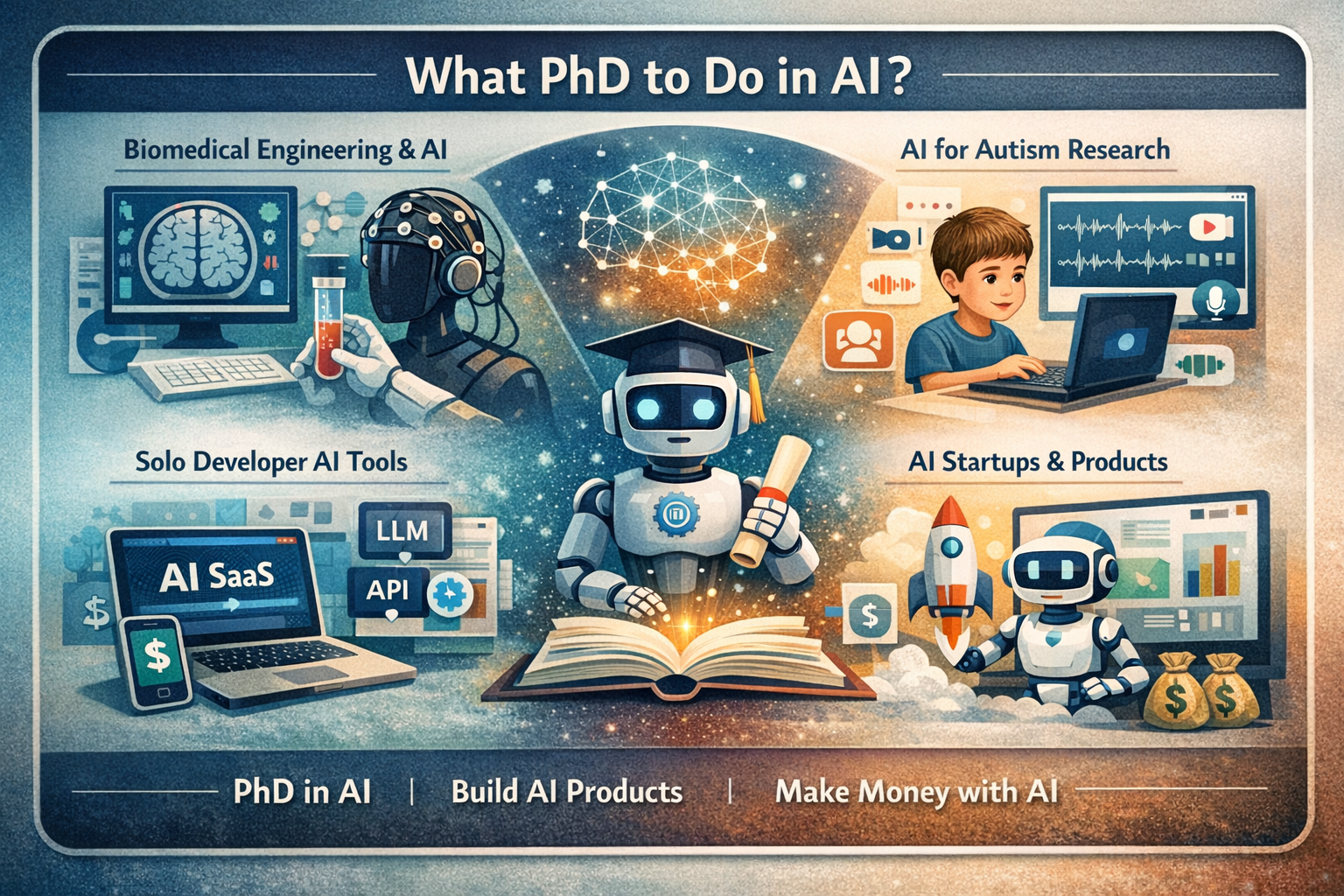
What PhD to do in AI — a long guide for students, biomedical engineers, and solo devs who want to build products
Why pick a PhD in AI in 2025?
AI is now both a deep science and an enormous product stack. A PhD gives you:
- Depth to push novel algorithms (theory, causality, robustness).
- Credibility in medicine, regulated industries, and research partnerships.
- Time & collaborators to build datasets, run longitudinal studies (important in biomedical fields), and ship robust, publishable work.
But not every PhD should be the same. Choose your endgame first: academic career vs. industry research vs. founding a company / solo product.
Which PhD topics are “best” — and what they lead to
I group themes by end-use: research-first, applied industry, and interdisciplinary biomedical. Pick a theme that maps to the career you actually want.
Research-first (aim: publish & push fundamentals)
- ML theory & optimization — provable training methods, generalization theory. (Leads to tenure-track / deep-research labs.)
- Causality & structure learning — necessary for models that can support decision-making in high-stakes settings (medicine, policy).
- Foundational multimodal learning / reasoning — building new architectures that generalize beyond pattern matching.
Applied / industry-facing (aim: deployable, strong product impact)
- Scaling and compressing LLMs — efficiency, quantization, adapters, parameter-efficient fine-tuning.
- RL & agent systems — autonomous agents, industrial automation, robotics.
- Privacy-preserving ML & MLOps — production pipelines, federated learning, model governance.
Interdisciplinary biomedical (aim: translational & commercial)
- Medical imaging + multimodal integration (images + EHR).
- Signal processing + DL for EEG/ECG (seizure detection, sleep staging).
- Digital biomarkers & mobile-health pipelines (behavioral analytics, developmental screening).
Choosing programs/advisors: prioritize advisors with strong publication records and industry/clinical partnerships if you want productization. Availability of datasets and compute matters more than school brand, especially for applied projects.
Biomedical Engineering + AI (what you can do with a PhD)
Biomedical engineers bring hardware, signal-processing, and physiology knowledge that multiplies the value of ML skills. Typical PhD outcomes:
Research paths
- Publications in MICCAI, NeurIPS (applied tracks), NeuroImage, NPJ Digital Medicine.
- Translational grants and collaborations with hospitals.
Commercial paths
- Found medical device startups (AI-powered ultrasound tools, EEG wearables).
- License algorithms to device makers or clinics.
High-impact project areas
- Automated medical imaging: segmentation, lesion detection, prognosis predictors.
- EEG/MEG analysis: spike detection, epileptiform event detection, sleep scoring, seizure prediction.
- Wearables + tinyML: on-device inference for privacy and low-latency alerts (seizure/fall detection).
- Multimodal digital biomarkers: combine audio, video, sensor data with clinical records to detect or monitor conditions.
Important: Clinical tools require validation and regulatory approval; plan early for ethical review and data governance.
Concrete PhD proposal example: autism screening with AI (one ready-to-adapt idea)
Title: Multimodal lightweight models for early screening of autism spectrum disorder (ASD) using home videos, audio, and EEG biomarkers
Rationale: Early detection of ASD improves access to interventions. Combining brief home videos, vocalization features, and EEG-derived biomarkers can increase screening sensitivity while preserving privacy via on-device or federated processing. Recent work in 2024–2025 shows promising automated, video-based screening approaches. (Nature)
Aims
- Build anonymized, consented dataset of short home videos + audio + (optional) short EEG recordings from clinical partners.
- Develop a lightweight multimodal model that fuses pose/gaze features (video), vocalization embeddings (audio), and EEG-derived features. Use adapters/LoRA-style parameter-efficient tuning to keep models small.
- Design explainability layers (feature importance, attention visualization) and uncertainty estimation to support clinician triage decisions.
- Run a prospective validation study at partner clinics to measure sensitivity/specificity vs. standard screening tools (M-CHAT, ADOS-2).
- Create a human-in-the-loop clinician interface and plan for regulatory pathway (class II device? depends on jurisdiction).
Method notes
- Privacy-first: use on-device inference or federated learning when possible.
- Evaluation: AUROC, PPV/NPV on age cohorts; cost-benefit analysis for triage workflows.
- Translation: design MVP that outputs clinician-oriented flags and short, interpretable summaries (not diagnostic labels).
Why this is fundable & publishable: combines multimodal inputs (video + EEG) and targets a clearly defined clinical use (triage & faster referral), aligning with current research trends. See 2025 reviews and studies showing feasibility of automated video-based ASD screening. (Nature)
Caution: any screening/diagnostic claim requires clinical trial-level evidence and regulatory clearance — do not deploy as a diagnostic tool without that.
Solo developers: product ideas, stacks, and how to make money (realistic playbook)
Many solo founders build profitable AI businesses by focusing on one strong niche, making a delightful UX, and keeping recurring costs under control. Below I give product categories, stack suggestions, and concrete monetization strategies.
Best product buckets for solo builders
- Vertical LLM assistants / niche RAG apps — legal brief summarizer, real-estate document assistant, clinical-note summarizer (non-diagnostic).
- Micro-SaaS dev tools — automated PR summarizers, test generation for specific frameworks.
- Creator tools — SEO blog generators, short-video scripts, multilingual localization pipelines.
- Niche fine-tuned APIs — sell an API for a specialized language model (finance, clinical summaries, legal lookup).
- On-device privacy-first apps — speech-to-text + sentiment for therapists, seizure-alert companion for caregivers (paired with hardware).
- Data/annotation pipelines — sell pre-cleaned domain datasets or labeling services.
Example solo dev success patterns (evidence)
- Indie Hacker community: many solo founders reach $1k–$10k MRR quickly with niche AI SaaS; a number scale higher with good product-market fit and enterprise customers. Real case studies and community writeups appear on Indie Hackers and founders’ blogs. (Indie Hackers)
Technical stack (minimum viable product)
- Model base: start with a small, capable open model (Mistral, Llama 3 variants, Falcon) and use LoRA/QLoRA for fine-tuning. (docs.mistral.ai)
- RAG & vector DB: Pinecone / Weaviate / Milvus (or open-source for cost control).
- Hosting/inference: Hugging Face Inference, Replicate, or self-host on cloud GPU (Lambda Labs / Vast.ai) if you need cheaper scaling.
- Frontend: Next.js (web), React Native or Flutter (mobile).
- Billing & ops: Stripe for payments; Sentry for errors; monitoring + budget alerts for inference costs.
Pricing & go-to-market
- Freemium + subscription often works: free tier for small usage, paid for heavy use / team seats.
- API-first: usage-based credits for developer customers.
- Enterprise/licensing: white-label or per-clinic licensing (good for medical tools but long sales cycles).
- Distribution: content marketing, SEO, community (Reddit/Indie Hackers), and integrations (Zapier, Slack, Notion plugins).
Quick MVP checklist for a solo dev (4 weeks)
- Pick a tight niche and talk to 5–10 potential users.
- Build a single-use-case prototype (RAG + prompt template + simple frontend).
- Deploy using hosted inference (Hugging Face/Replicate).
- Launch a landing page, simple pricing, and a sign-up flow.
- Iterate with real users, measure conversion.
Which LLMs should an indie / PhD use ?
Open & practical choices (2025):
- Llama (Meta) 3 / 3.1 — powerful, open-ish family, good for fine-tuning and on-prem inference. (Meta AI)
- Mistral — strong small/medium models and good engineering for code and multimodal tasks (multiple releases in 2024–2025). (docs.mistral.ai)
- Falcon — established open model (Falcon 40B) with permissive license for research & commercial work. (falconllm.tii.ae)
- Other choices (context-based): commercial APIs (OpenAI GPT-4o, Anthropic Claude) if you need top-of-the-line capability without infra ops. Tech press comparisons help evaluate tradeoffs. (TechRadar)
Practical tip: start with an open model to prototype (cost & control), then hybridize with commercial APIs for high-quality features if necessary.
Monetization comparison: apps vs. SaaS vs. APIs
Short comparative summary (revenue potential vs. difficulty examples ):
- Enterprise RAG SaaS — High ARR, long sales cycle, requires SLAs & compliance.
- Vertical consumer app — Medium revenue, high marketing need, faster user growth.
- Developer tool / API — Recurring revenue potential, attract developer communities; easier to sell via product-market fit.
- On-device/embedded product — Niche, hardware integration complexity, but defensible.
Pick the path aligned with your sales strengths: marketing/growth or direct enterprise sales.
Ethics, safety, and medical/regulatory guardrails
- Medical AI: do not market a tool as diagnostic without clinical trials and regulatory clearance. Use non-diagnostic language (triage, assistive, decision-support) until validated. Recent reviews emphasize careful validation and human-in-the-loop safeguards for autism screening tools. (PMC)
- Data privacy: follow GDPR, HIPAA (if US), and local laws. Consider federated learning for hospital data.
- Hallucinations: mitigate with RAG and source attribution; add uncertainty thresholds and require human sign-off for critical outputs.
One example of : Long-form roadmap: PhD → product → company (practical milestones)
Year 0–1 (PhD start / Skill-building)
- Take ML fundamentals, signal processing, and systems courses.
- Build 2–3 reproducible projects: image segmentation, EEG classifier, or small RAG app.
Year 2–3 (Thesis + prototype)
- Publish initial papers, gather clinical or industry partners.
- Build clinician-facing prototype or MVP; validate with retrospective datasets.
Year 4–5 (Translation & commercialization)
- Run prospective validation; prepare regulatory submission if medical.
- Consider spin-out, license tech, or continue research in industry labs.
For solo devs, compress this — focus on a 4–12 week MVP loop, rapid user feedback, then scale or pivot.
Appendix — Short list of recommended readings & resources (selected 2024–2025)
Below I include the full links you requested. These are the primary sources I used while writing this guide. I’ve numbered them so you can paste them to your site directly.
- Meta — Introducing Meta Llama 3 (April 2024).
https://ai.meta.com/blog/meta-llama-3/ (Meta AI) - Meta — Llama 3.1 announcement (July 2024).
https://ai.meta.com/blog/meta-llama-3-1/ (Meta AI) - Mistral — Models (official docs / model pages).
https://docs.mistral.ai/getting-started/models (docs.mistral.ai) - Google Cloud blog — Announcing Mistral Large availability (Vertex AI) (Jan 2025).
https://cloud.google.com/blog/products/ai-machine-learning/announcing-new-mistral-large-model-on-vertex-ai(Google Cloud) - Falcon 40B — model page (TII / Falcon overview).
https://falconllm.tii.ae/falcon-40b.html (falconllm.tii.ae) - Falcon 40B on Hugging Face.
https://huggingface.co/tiiuae/falcon-40b (Hugging Face) - TechRadar — Best Large Language Models of 2025 (overview & comparison).
https://www.techradar.com/computing/artificial-intelligence/best-llms (TechRadar) - Instaclustr — Top 10 open-source LLMs for 2025 (summary).
https://www.instaclustr.com/education/open-source-ai/top-10-open-source-llms-for-2025/ (Instaclustr) - Indie Hackers — Stories (solo/indie founder case studies & examples).
https://www.indiehackers.com/stories (Indie Hackers) - Indie Hackers — Bootstrapping insights (example solo founder post).
https://www.indiehackers.com/post/how-bootstrapping-as-a-solo-founder-made-me-skilled-in-every-area-of-my-business-6f04a939e3 (Indie Hackers) - Nature (NPJ Digital Medicine?) — Automated, video-based AI model for early ASD screening (2025 paper).
https://www.nature.com/articles/s41746-025-01993-5 (Nature) - PubMed Central — 2025 review: AI-assisted early screening, diagnosis, and intervention for autism.
https://www.ncbi.nlm.nih.gov/pmc/articles/PMC12036476/ (PMC) - Le Monde — Mistral & Helsing partnership / European AI (Feb 2025).
https://www.lemonde.fr/en/economy/article/2025/02/10/european-ai-start-ups-mistral-and-helsing-join-forces-in-ai-europeans-have-every-chance_6737987_19.html (Le Monde.fr) - N8N Blog — The 11 best open-source LLMs for 2025.
https://blog.n8n.io/open-source-llm/ (n8n Blog) - AppKodes / Indie SaaS one-person examples (trend writeup, 2025).
https://appkodes.com/blog/one-person-indie-saas-projects-built-using-ai/ (appkodes.com)